Despite the abundance of PDF parsers on the market, most are not fit for production, whether you are building agents or automations. They break in ways no demo shows: broken reading order, checkboxes tied to the wrong label, accuracy that looks fine on clean files and falls apart on real forms. Agents can't act on data they can't read. The hard part of picking a PDF parsing API for AI agents is not that it hands you a primitive, it is whether the parse is accurate on messy documents, whether the developer experience lets you ship fast, and whether you can tune cost, latency, and accuracy to your use case. We ranked the six best options on exactly those criteria.
TLDR:
- The choice comes down to three things: parsing accuracy on messy documents, developer experience, and control over cost, latency, and accuracy for your use case.
- Production parsers must handle four jobs correctly: layout detection, OCR, table reconstruction, and reading-order preservation.
- AWS Textract scores 70.5% field-level Q&A accuracy on RealDoc-Bench, with a 42.2-point gap on healthcare documents.
- LlamaParse and Reducto top out at 92.1% and 91.1% field-level Q&A accuracy in their agentic modes on RealDoc-Bench, which are slower and pricier than their standard modes.
- Extend Performance Parse (Parse 2.0) leads RealDoc-Bench at 95.7% field-level Q&A accuracy and sits on the Pareto frontier for both cost and latency at $0.020 and 19.67s per page.
- Extend Light Parse reaches 90.5% field-level Q&A accuracy at $0.00625 per page, making it the most accurate non-agentic parser on RealDoc-Bench.
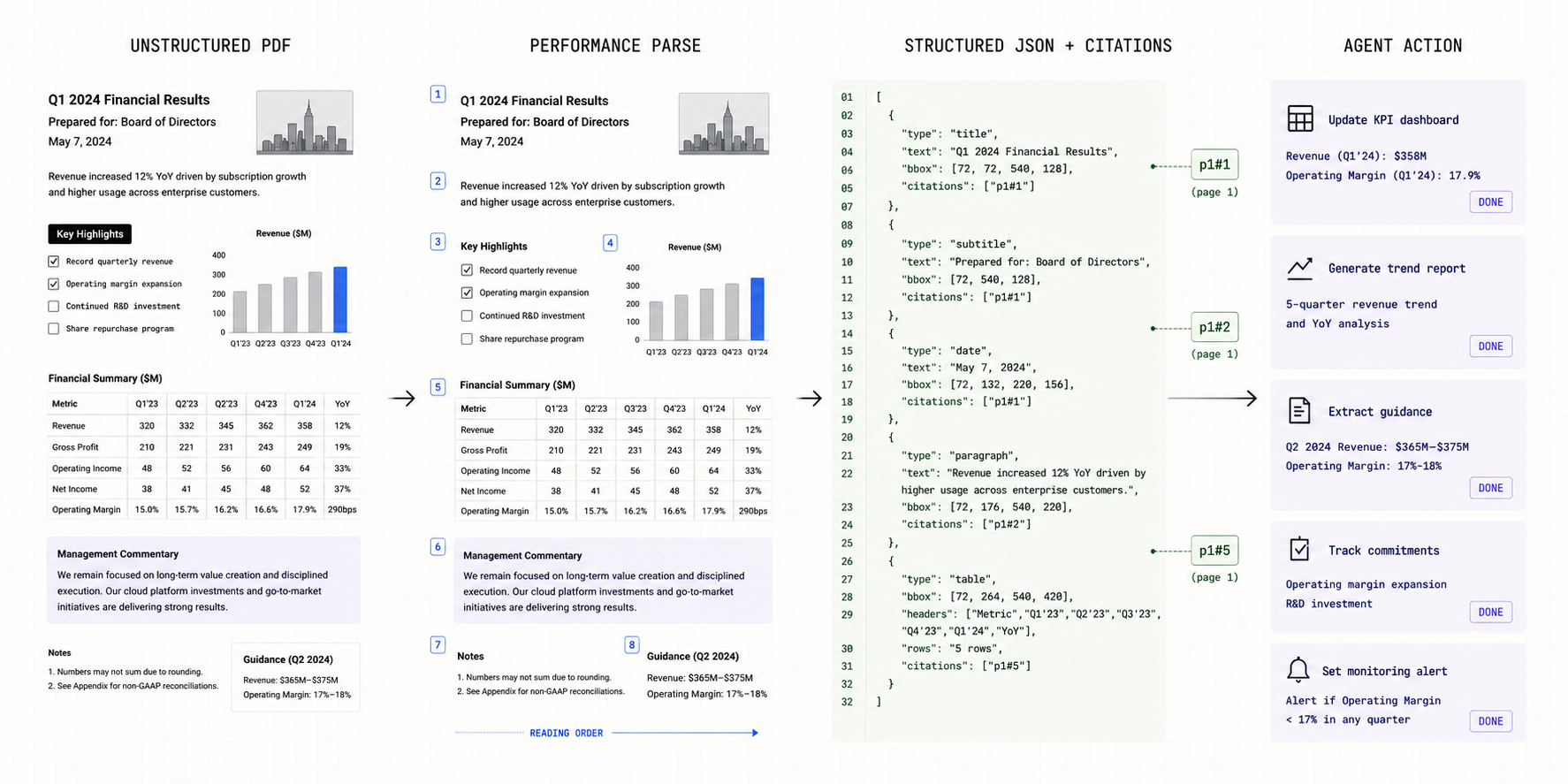
What Is a PDF Parsing API?
A PDF parsing API is a service that turns unstructured documents into structured, machine-readable output like markdown or JSON that an AI agent can act on. Instead of returning a raw wall of text, it preserves the structure that meaning depends on: which value pairs with which label, how a table's rows and columns line up, and the order a human would read the page.
Every production parser handles four jobs:
- Layout detection: find forms, tables, figures, and key-value regions
- OCR: read scanned pages and handwriting
- Table structure reconstruction: recover rows, columns, and headers so cells stay aligned
- Reading-order preservation: keep content in sequence
Get any of these wrong, and every downstream step inherits the error.
Research benchmarking 21 PDF parsers on table extraction found scores ranging from 2.10 to 9.55 out of 10. Even top-ranked parsers produced misaligned spanning cells and incorrect header associations.
How We Ranked These PDF Parsing APIs
We ranked each API on the criteria that decide whether an agent can trust the output in production, not marketing claims or clean-PDF demos.
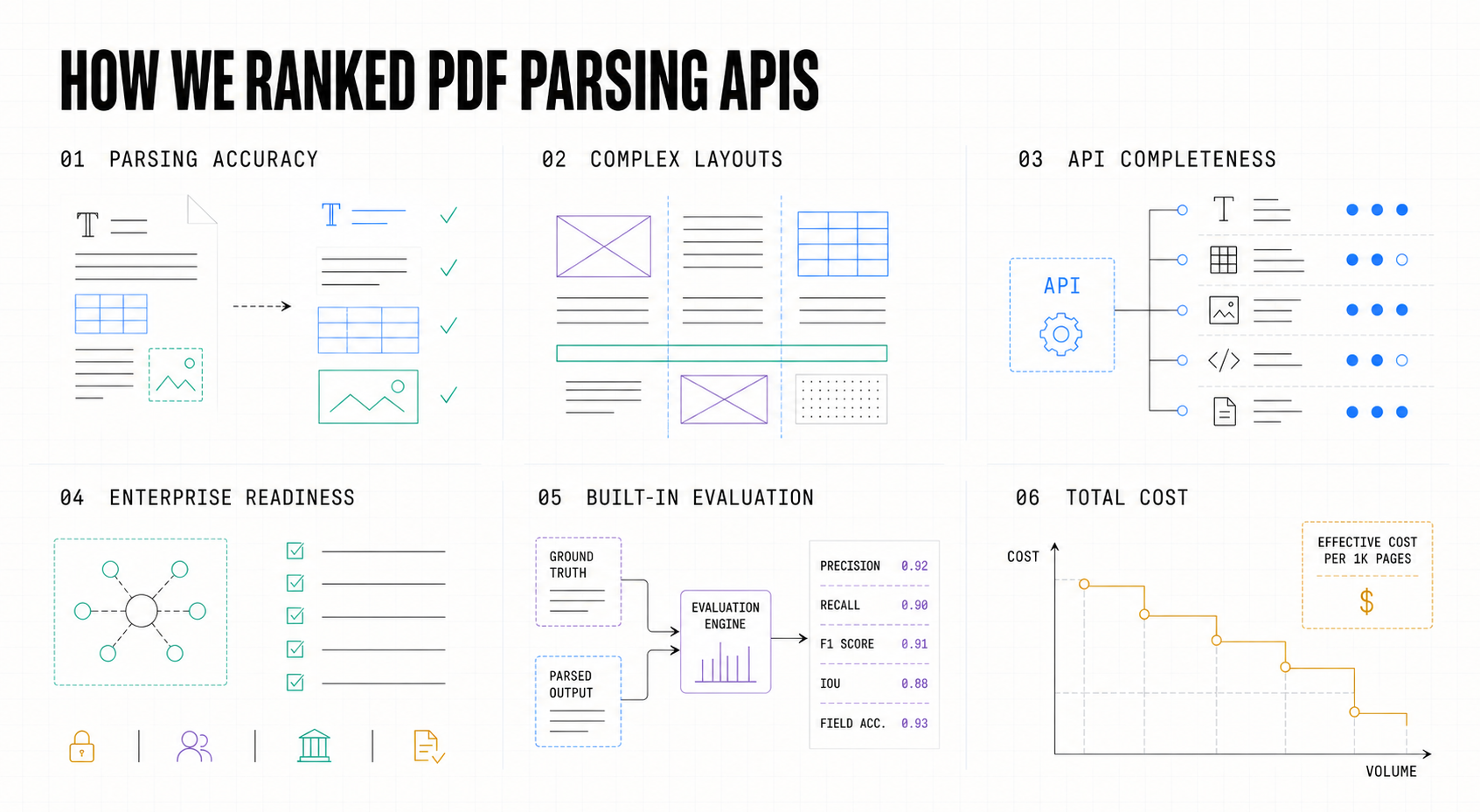
- Parsing accuracy: field-level Q&A accuracy on RealDoc-Bench, measured against messy production files like dense forms and scanned pages.
- Developer experience: how fast you can integrate, iterate, and debug, from SDKs and docs to a studio and review surfaces.
- Control over cost, latency, and accuracy: modes and tuning that let you match the parse to each use case instead of accepting one fixed trade-off.
- Complex layout support: nested tables, checkboxes, handwriting, and separated headers where most parsers break down.
- API completeness: parse, extract, classify, split, and form fill so you aren't stitching together vendors.
- Enterprise readiness: SOC 2, HIPAA, deployment flexibility, and schema versioning.
Best Overall PDF Parsing API: Extend
Engineers are building agents that can take on increasingly complex work, but those agents can't act on critical data trapped in messy, unstructured documents. Extend delivers a production-ready document ingestion layer that turns those documents into structured output that agents can reliably use, freeing up engineers to focus on building their core product. It provides APIs that cover parsing, extraction, splitting, and form filling, while giving you a complete toolkit to support deployment and controls over accuracy, latency, and cost.
Core strengths
- Highest parsing accuracy: Extend Performance Parse (Parse 2.0) leads RealDoc-Bench at 95.7% field-level Q&A accuracy and 0.847 Adjusted F1 layout accuracy, ahead of every other provider including their agentic modes.
- Light Parse for high-volume throughput: Light Parse reaches 90.5% field-level Q&A accuracy at $0.00625 per page, the best result among non-agentic parsers.
- Full pipeline in one API: parse, extract, classify, split, and form fill, plus workflow orchestration, schema versioning, and a review UI.
- Enterprise controls: SOC 2, HIPAA, GDPR, zero data retention, and flexible deployment.
- Pareto-optimal cost and latency: top RealDoc-Bench accuracy at $0.020 per page and 19.67s per page, while the next-most-accurate agentic options are slower, pricier, or both.
Reducto
Reducto began as a parsing product for RAG ingestion and has expanded into a general-purpose document processing platform with Parse, Extract, Split, Classify, Edit, and Pipelines. Its broader API surface does not close the accuracy gap. On RealDoc-Bench, Reducto Agentic—the configuration required for its best result—scores 91.1% field-level Q&A accuracy and 0.759 layout Adjusted F1, 4.6 points behind Extend Performance Parse. Reducto Standard scores 88.5%. See the full Extend vs. Reducto comparison for benchmarks, pricing, and platform differences.
What they offer
- Standard and Agentic Parse: separate processing modes with different accuracy, latency, and credit costs
- Deep Extract and Deep Split: agentic modes for complex extraction and splitting workloads
- Classify endpoint: routes documents before downstream processing
- Edit and Pipelines: form filling and reusable single-call Parse, Split, Extract, and Edit pipelines
- Batch Queue: high-volume asynchronous processing at discounted credit rates
Best For: Lower-stakes ingestion and RAG workloads where the measured accuracy gap and variable latency are acceptable, or enterprise teams that require an air-gapped deployment and can operate Kubernetes and PostgreSQL themselves.
Limitations: Reducto trails Extend on open-source parsing, extraction, and splitting benchmarks. Its Standard, Agentic, Deep Extract, and Deep Split modes use endpoint-specific controls and variable billing; the modes competitive on accuracy cost more. Evaluations are restricted to custom-priced Growth plans, there is no native schema versioning or packaged human-review UI, and ZDR and no-training commitments require Growth or Enterprise plus a platform fee.
AWS Textract
AWS Textract is a managed ML service in the AWS ecosystem that pulls text, key-value pairs, tables, layout elements, and signatures from documents. It returns Block objects your team maps to your own data models.
What they offer
- OCR and layout detection: forms, tables, and queries for JPEG, PNG, PDF, and TIFF files
- Specialized APIs: AnalyzeExpense, AnalyzeID, and Analyze Lending for specific document types
- Native AWS integration: S3, Lambda, and Step Functions; A2I remains available to existing customers but is closed to new customers and receives no new features
- Per-page pricing: forms at $0.05/page, tables at $0.015/page, additive when combined
Best For: AWS-native teams processing clean PDFs who want low-cost text detection and will own schema mapping, review, and orchestration on top of Block output.
Limitations: On RealDoc-Bench, Textract scores 70.5% field-level accuracy, with the gap widening to 42.2 points on healthcare documents. It ships no orchestration, form editing, or schema versioning. A2I no longer accepts new customers and AWS plans no new features for it, leaving Textract without a replacement packaged review UI. Learn more about AWS Textract pricing and alternatives.
Google Document AI
Google Document AI is a GCP-native managed document processing service built on Vertex AI. It offers general-purpose OCR, a Form Parser, a Layout Parser, and multiple additional pretrained processors for common document types.
What they offer
- Pretrained processors: invoices, receipts, W-2s, and driver's licenses
- Custom Extractor: few-shot learning via Gemini for limited labeled data
- Native GCP integration: Cloud Storage, BigQuery, and Vertex AI
- Pay-as-you-go pricing: basic OCR from $1.50 per 1,000 pages (dropping to $0.60 per 1,000 pages at high volume), Form Parser and Custom Extractor at $30 per 1,000 pages
Best For: GCP-native teams with Vertex AI or BigQuery investments processing standard document types who want a managed processor without building OCR from scratch. See our breakdown of document layout analysis for how parsers handle page structure.
Limitations: Document AI is an extraction layer with no packaged review UI, no schema versioning, no evaluation tooling, and no form filling. Production workflows need heavy custom engineering to add orchestration, human review, and accuracy QA. See the Extend vs. Google Cloud Document AI comparison for a full breakdown.
LlamaParse
LlamaParse is the document parsing product from LlamaIndex (LlamaCloud). It converts documents into markdown or structured output for AI agent consumption and retrieval indexing. Its suite spans Parse, Extract, Classify, Split, Sheets, and LlamaCloud Index. For a full comparison, see Extend vs. LlamaParse.
What they offer
- Layout-aware parsing: Fast, Cost Effective, Agentic, and Agentic Plus tiers, with bounding-box citations
- Schema-defined extraction: Pydantic or Zod schemas with confidence scores
- LlamaCloud Index integration: chunking, embedding, and hosted vector retrieval
- File format support: 50+ file formats
Best For: Teams inside the LlamaIndex ecosystem who need parsing as the front end of a RAG pipeline, where output is a retrieval index instead of a business object.
Limitations: LlamaParse ships no review UI, no eval sets, no schema versioning, and no form filling. On RealDoc-Bench, LlamaParse's agentic mode, its best-performing configuration, scores 92.1% field-level Q&A accuracy, and its standard mode scores 89.0%. The agentic mode is also the slowest option tested at 32.45s per page.
Unstructured
Unstructured is an open-source ETL library with a commercial hosted API, built to partition 50+ document and image formats for downstream AI and RAG pipelines. It handles OCR, table extraction, chunking, and embedding in one ingestion step.
What they offer
- Open-source library: free, plus a hosted Serverless API with 10,000 free pages and then $0.015 per page
- 50+ document and image types: PDFs, Word docs, emails, and images
- Chunking and connectors: title or semantic element chunking, with 40+ connectors, including 20+ sources and 20+ destinations to vector databases like Pinecone, Weaviate, and Snowflake
- Pre-built workflow templates: opinionated starting points for common RAG, enrichment, and document transformation pipelines
Best For: Teams that need broad document and image coverage and want to plug ingestion into a vector database or RAG pipeline quickly, and are fine building production controls around it.
Limitations: Unstructured optimizes for format coverage, so it struggles with nested tables and complex layouts, as explained in detail by comparing layout-first APIs vs. traditional OCR. Its Structured Data Extractor is documented, but Unstructured's pricing page still labels it “Coming Soon,” so general availability is not confirmed. It ships no evaluation framework or human review workflow. See the Extend vs. Unstructured comparison for a full breakdown.
Feature Comparison Table of PDF Parsing APIs for AI Agents
Here is how the six options stack up on the capabilities that decide production readiness.
| Feature | Extend | Reducto | AWS Textract | Google Document AI | LlamaParse | Unstructured |
|---|---|---|---|---|---|---|
| Parsing accuracy (RealDoc-Bench) | Performance: 95.7%; Light: 90.5% | 91.1% agentic (88.5% standard) | 70.5% | Not tested | 92.1% agentic (89.0% standard) | Not tested |
| Layout-aware parsing | Yes | Yes | Yes | Yes | Yes | Partial |
| Schema-defined extraction | Yes | Yes | No | Yes | Yes | Documented; pricing says Coming Soon |
| Document splitting | Yes | Yes | No | No | Yes | No |
| Document classification | Yes | Yes | No | Yes | Yes | No |
| Form filling (Edit API) | Yes | Yes (Edit pipeline) | No | No | No | No |
| Schema versioning | Yes | No | No | No | No | No |
| Built-in evaluation framework | Yes | Growth only | No | No | No | No |
| Human-in-the-loop review UI | Yes | No | No | No | No | No |
| Workflow orchestration | Yes | Pipelines for Parse, Split, Extract, and Edit | No | No | No | No |
| Deployment options | Cloud, BYOC, hybrid | Cloud, VPC, hybrid VPC, on-prem/air-gapped | AWS | GCP | Cloud, VPC, self-hosted/BYOC | Open source, cloud, VPC |
| SOC 2 / HIPAA support | Yes | Yes | Yes | Yes | Yes | Yes |
Why Extend Is the Best PDF Parsing API for AI Agents
Every other option on this list hands you a parsing primitive and leaves the pipeline to you. You still build the schema versioning, the eval sets, the review UI, and the orchestration before any of it survives production. Extend is the pipeline itself.
We rank first on RealDoc-Bench, including on extracting tables from PDFs, and we do it on the Pareto frontier for cost and latency. We cover parse, extract, classify, split, and edit in one API. We give you control over cost, latency, and accuracy per use case, and we ship the controls that keep accuracy from drifting: schema versioning, built-in evaluation, and human review. If you are building agents on documents, that combination is the reason to start here.
Final Thoughts on PDF Parsing APIs Built for AI Agents
Choosing a PDF parsing API means choosing how much of the pipeline your team owns. Agents doing real work need structure, accuracy controls, and a way to catch drift before it becomes a problem. The tools that ship those controls out of the box save more engineering time than they cost. Sign up for Extend and give your agents a document ingestion layer that holds up in production.
FAQ
How do I choose the right PDF parsing API for my AI agent from this list?
Start with your production requirements, not price. If your agent needs schema-defined extraction, classification, splitting, and form filling in one API with built-in evaluation and review controls, Extend covers the full pipeline. Reducto is a fit for lower-stakes RAG ingestion where its measured accuracy gap and variable latency are acceptable, or for enterprises that require an air-gapped deployment and can operate the runtime infrastructure.
Is Extend more accurate than Reducto and LlamaParse for complex document parsing?
On RealDoc-Bench, Extend Performance Parse (Parse 2.0) scores 95.7% field-level Q&A accuracy, compared to 91.1% for Reducto's agentic mode (88.5% standard) and 92.1% for LlamaParse's agentic mode (89.0% standard). Extend also leads layout accuracy at 0.847 Adjusted F1, ahead of Reducto at 0.759 and AWS Textract at 0.709. (RealDoc-Bench is Extend's own open-sourced parsing benchmark, published with a public dataset and methodology.)
When should I use AWS Textract or Google Document AI instead of a purpose-built parsing API?
Choose AWS Textract if your team runs entirely on AWS, processes clean PDFs, and owns the schema mapping and orchestration work. Choose Google Document AI if you have Vertex AI or BigQuery investments and need pretrained processors for standard document types like W-2s or invoices. Both are extraction layers with no built-in evaluation, schema versioning, or form filling. AWS A2I is closed to new customers and AWS plans no new features for it, so Textract has no current packaged review path for new deployments.
Which PDF parsing APIs on this list work best for RAG pipelines versus production document agents?
Reducto, LlamaParse, and Unstructured are strongest fits for ingestion and RAG pipelines where output feeds a vector index and small accuracy variations are tolerable. Extend targets production document agents that need benchmark-leading parsing, schema-faithful structured output, precise citations, evaluation, versioning, and review controls in one platform.
Can any of these PDF parsing APIs handle large-scale enterprise workloads with HIPAA compliance?
All six providers publish SOC 2 or comparable cloud control reports and support HIPAA-regulated workloads under applicable service configurations and BAAs. For workloads that require zero data retention, BYOC or hybrid deployment, and a built-in human review layer, Extend is the only option on this list that ships all three together; Extend ZDR is available to paid customers on request and BYOC is an Enterprise option.