A scanned invoice rotated 90 degrees resets a template-based extractor. A mortgage package with three-column financial exhibits misroutes fields. A healthcare form mixing typed fields with handwritten annotations corrupts output the OCR layer never recovers from. The failure is never OCR quality; it is the upstream assumption that page structure is fixed. Document layout analysis eliminates that assumption: deep learning models treat each page as an image, predict bounding boxes with region-type labels, and classify every segment into typed blocks before extraction runs. Get that classification wrong and every downstream field inherits the error across every page.
TLDR:
- Layout analysis segments pages into typed regions before extraction runs; get it wrong and downstream field extraction inherits the error across every page.
- Deep learning models like DiT and VGT treat layout as object detection over document images; VGT's grid encoding holds spatial context across layout variations that break template-based extractors.
- Layout analysis runs before OCR to preserve table structure and reading order; without it, multi-column content collapses into unreadable streams and tables lose relational structure.
- Extend's Parse 2.0 classifies each region into typed blocks that route to specialized models, achieving 0.847 Adjusted F1 on RealDoc-Bench's 1,500 real-world samples across logistics, healthcare, and financial services.
What Is Document Layout Analysis
Document layout analysis identifies and classifies the structural regions of a document page: text blocks, headings, tables, figures, captions, headers, and footers. Before any extraction pipeline pulls a field value, a layout model answers where on the page that field lives and what type of region contains it. Template-based extractors assume fixed structure; real documents don't provide it. Deep learning approaches treat layout as an object detection problem over document images, which is why models like DiT and vision transformers have replaced rule-based methods in production pipelines. The model outputs bounding boxes with region-type labels; downstream OCR and extraction stages consume those boxes as structured inputs instead of operating on raw page pixels.
How Parsers Detect Document Structure
Detection runs in three layers: physical signal resolution (bounding box coordinates for text blocks, images, and lines), region type classification (headers from body text, tables from figures), and reading order inference across classified regions. Rule-based systems use heuristics like font size and column width; they are fast and interpretable, but reset on the first layout variation. Model-based approaches train on annotated datasets and predict region labels from visual features, handling variability at the cost of training data and inference overhead. Production pipelines processing mixed document types in a single stream (invoices, mortgage packages, healthcare forms, logistics manifests) require model-based detection to avoid exception logic that compounds with each new layout.
Deep Learning Models for Layout Detection
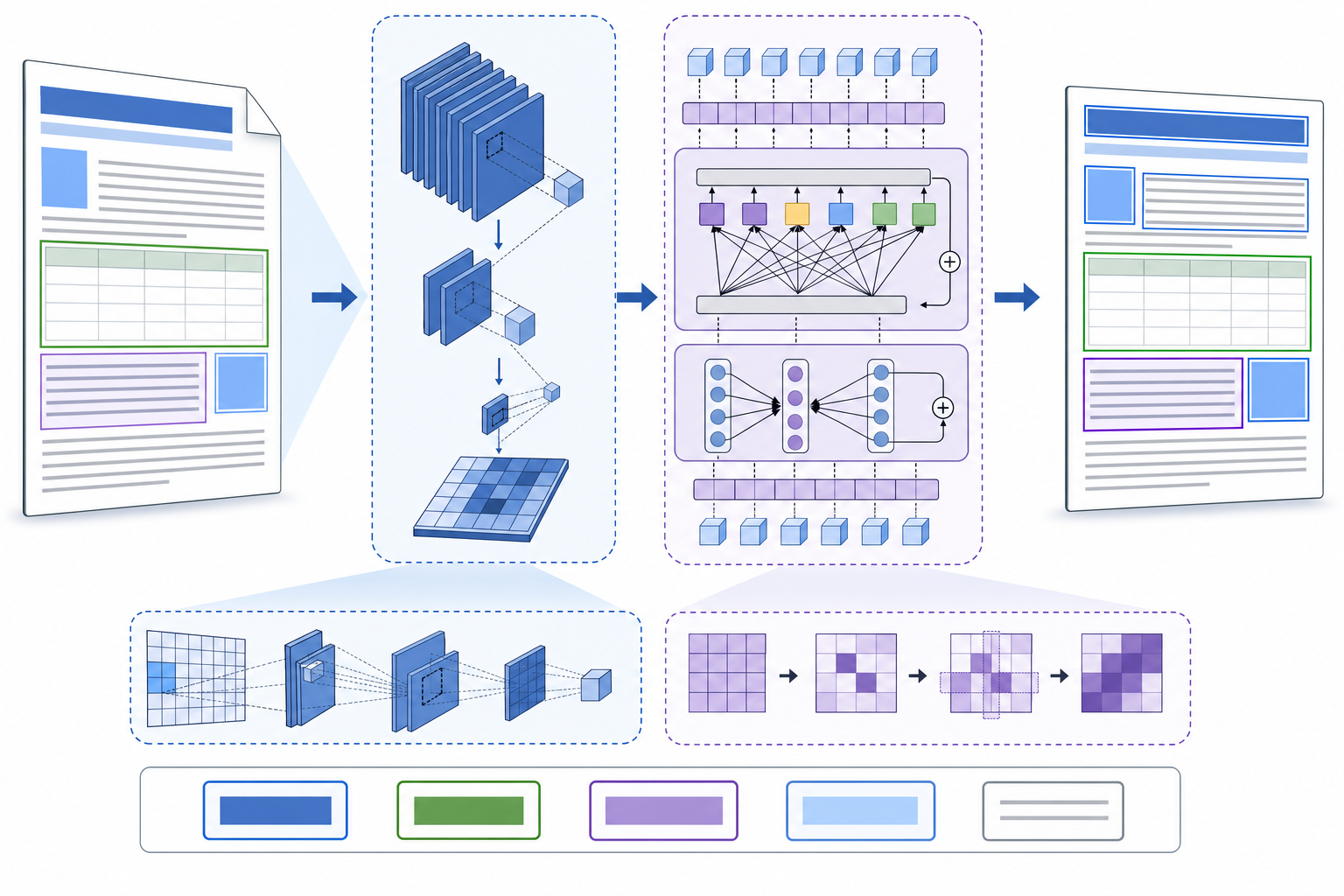
Transformer-based models now achieve state-of-the-art results by treating layout analysis as an object detection problem over document image patches.
Key Model Families in Production Use
Several architectures see regular deployment across research and production pipelines:
- LayoutLM and successors (LayoutLMv2, LayoutLMv3): jointly encode text, layout coordinates, and visual features, giving the model spatial awareness that text-only transformers lack.
- DiT (Document Image Transformer): applies vision transformer pretraining directly to document images, achieving strong results on PubLayNet and DocBank without relying on OCR as an input stage.
- YOLOv8: trades some accuracy for inference speed, making it practical for high-throughput pipelines where sub-second detection per page matters.
- Vision Grid Transformer (VGT): encodes both token-level and grid-level spatial relationships, improving detection on dense tables and multi-column layouts.
| Model Architecture | Core Approach | Primary Strength | Production Trade-off |
|---|---|---|---|
| LayoutLM and successors | Jointly encodes text, layout coordinates, and visual features for spatial awareness | Combines OCR input with visual and positional context that text-only transformers miss | Depends on OCR as a preprocessing stage before layout analysis runs |
| DiT (Document Image Transformer) | Applies vision transformer pretraining directly to document images | Operates on raw page images without requiring OCR input, achieving strong PubLayNet and DocBank results | Trained primarily on academic papers, transfers poorly to dense financial tables and irregular business forms |
| YOLOv8 for layout analysis | Adapts object detection architecture for region classification on document pages | Delivers sub-second detection per page, making it practical for high-throughput pipelines | Trades fine-grained region classification accuracy for inference speed compared to transformer architectures |
| Vision Grid Transformer | Encodes both token-level and grid-level spatial relationships through parallel streams | Holds spatial context across layout variations through grid encoding, generalizing better when column counts or table density changes | Higher computational cost than single-stream models due to dual encoding paths |
Teams selecting models for production should match pretraining corpus to their target document type before benchmarking, since high mAP on academic papers transfers poorly to financial forms with dense tabular regions.
Document Layout Analysis Datasets and Benchmarks
PubLayNet (360,000+ annotated pages from scientific articles) became the default pretraining dataset for most layout models through the early 2020s. DocBank provides token-level annotations across roughly 500K document pages built through weakly supervised construction. FUNSD and CORD target form understanding and receipt parsing with field-level labels for structured business documents. Benchmark performance varies by document type: a model trained on PubLayNet transfers poorly to insurance policies or mortgage packages because region distribution, font density, and table complexity differ substantially from scientific articles. Extend's RealDoc-Bench closes this gap, covering 1,500 real-world samples across logistics, healthcare, financial services, and real estate. Parse 2.0 leads on layout accuracy at 0.847 Adjusted F1 and 95.7% on document Q&A output accuracy.
Document Layout Analysis in OCR Pipelines
Layout analysis runs before OCR to segment the page into typed regions: text blocks, tables, figures, headers, and footnotes. Without it, tables flatten and headers merge, and multi-column content collapses into a single unreadable stream. Each region feeds the OCR engine in the correct reading order with the appropriate extraction logic applied per region type.
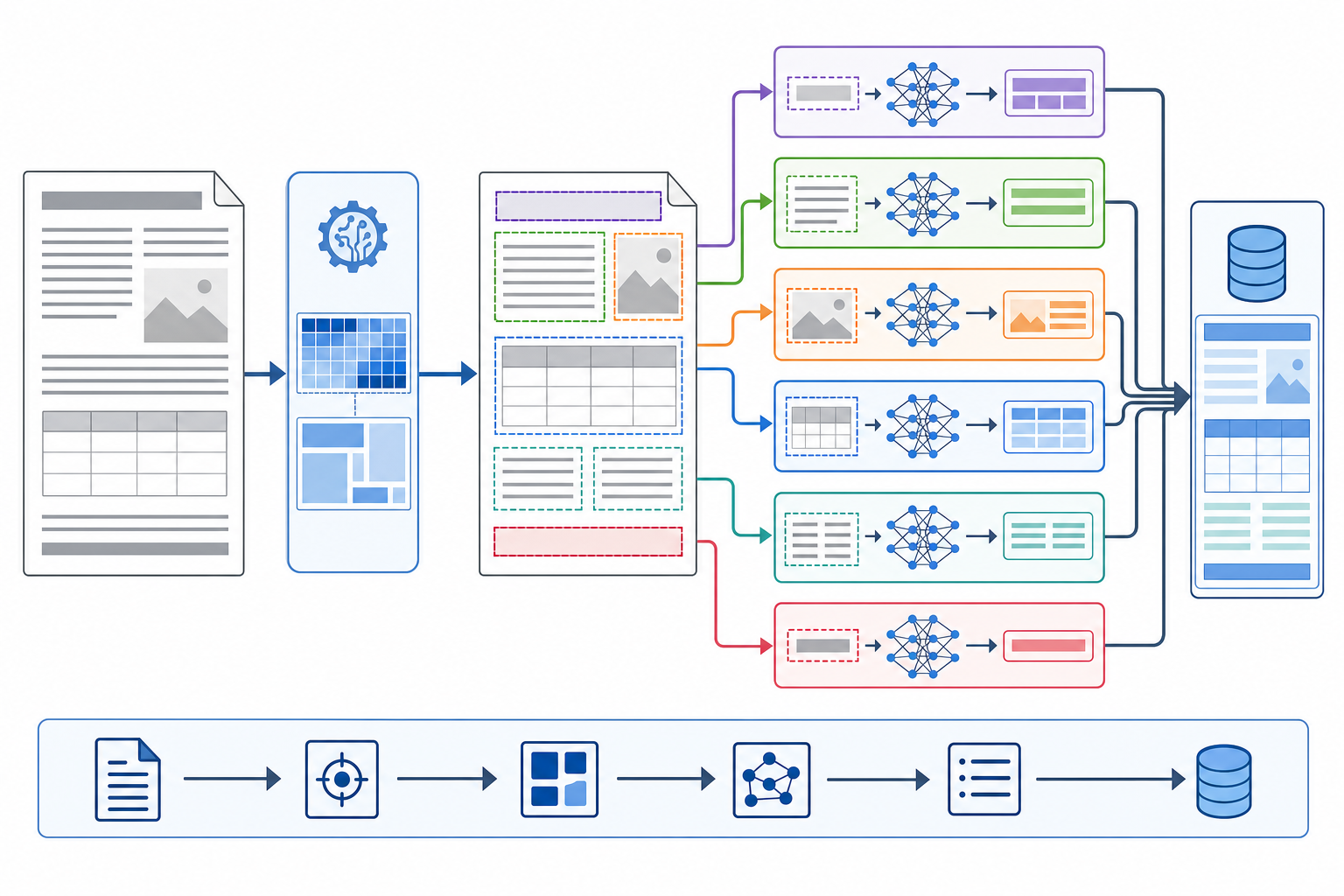
Three region types drive the most extraction failures when misclassified:
- Tables: cell-boundary detection and row/column mapping must run before text extraction, or relational structure is lost
- Figures and charts: embedded text gets parsed as prose, corrupting downstream field extraction
- Section headers: misclassifying them as body text breaks any downstream logic that depends on section-scoped field resolution
Layout analysis before OCR is the architectural prerequisite that determines whether extracted text is usable or requires manual correction.
How Extend Processes Document Layout at Scale
Parse 2.0 runs Extend's layout model as the first pass on every page, localizing and classifying each region into typed blocks before any extraction begins: text blocks, tables, forms, headers, footers, figures, and signatures. Each block routes to a specialized model matched to that region type; table cells don't get parsed as prose and signatures don't register as text noise. Extend is the complete document processing toolkit comprised of the most accurate parsing, extraction, and splitting APIs to ship your hardest use cases in minutes, not months. Extend's suite of models, infrastructure, and tooling is the most powerful custom document solution, without any of the overhead. Agents automate the entire lifecycle of document processing, allowing your engineering teams to process your most complex documents and optimize performance at scale.
Final Thoughts on Building Document Layout Pipelines
Document layout analysis is an architectural decision, not a preprocessing step. Model-based detection generalizes better than rule-based heuristics, but pretraining corpus alignment matters more than raw architecture when target documents differ from academic datasets. Multi-page packages break single-page classifiers because section headers on page three govern tables on page seven, and no per-page model holds that context. Parse 2.0 resolves cross-page relationships by maintaining document-scoped context, confirmed by RealDoc-Bench results at 0.847 Adjusted F1 across logistics, healthcare, financial services, and real estate.
FAQ
Document layout analysis Python vs OpenCV vs Hugging Face?
Python frameworks like layoutparser and unstructured provide higher-level abstractions with pre-trained models suited for prototyping end-to-end pipelines, while OpenCV requires manual implementation of region detection logic without built-in layout understanding. Hugging Face hosts pre-trained DiT and LayoutLM models that teams deploy directly via transformers, but integrating them into production pipelines requires building the surrounding infrastructure for chunking, OCR coordination, and downstream extraction yourself.
Can I run document layout analysis without cloud dependencies?
Yes. surya runs OCR and layout detection locally using transformer-based models, and huridocs/pdf-document-layout-analysis provides a containerized YOLOv8-based service without external API calls. The tradeoff is maintaining model updates and scaling inference infrastructure in-house versus managed services that handle model versioning and throughput automatically.
When does a model trained on PubLayNet fail on production documents?
PubLayNet covers academic papers with five region types (text, title, list, figure, table), which transfers poorly to insurance forms, mortgage packages, or logistics manifests. A model pretrained on scientific articles misclassifies table cells as figures and footnotes as body text on financial documents because layout density, font variation, and structural patterns differ substantially from its training corpus.