Template-based OCR extractors break when a vendor updates an invoice layout or a lender revises a form: coordinate logic resets, fields misattribute, and documents route to manual review queues that consume 1,500+ staff hours per month at 10,000 documents processed with a 15% exception rate.
The failure is architectural. OCR linearizes content before any field extractor sees it, so a two-column insurance declaration flattens into a garbled string and a nested table inside a financial statement breaks row-column logic that assumed fixed positions.
Document parsing that treats spatial relationships, font weight, and element hierarchy as first-class features inverts that dependency: structure is recovered at the parsing layer, so field extraction operates on representations that already encode column boundaries and table hierarchies.
TLDR:
- OCR returns text strings; layout-first parsers return structured JSON with spatial metadata that LLMs and agents consume directly without intermediate cleaning.
- Template-based extractors reset on layout changes, causing field mismatches; VLMs resolve structure from spatial relationships, so extraction holds across format variation.
- Layout detection errors propagate through every downstream step; when a parser misidentifies a table header as body text, field extractors receive malformed input and LLMs reason over scrambled context.
- Teams processing 10,000 invoices monthly with a 15% exception rate staff roughly 1,500 manual reviews per cycle: a recurring FTE cost built into the operating model because the parser breaks on format variation.
- Extend's Parse 2.0 scored 0.847 Adjusted F1 on layout accuracy and 95.7% on document Q&A across production documents in the RealDoc-Bench benchmark, powering a 140-customer insurance deal that required parsing capabilities prior versions could not deliver.
What Is Document Parsing?
Document parsing converts raw files into structured, machine-readable representations that downstream systems consume directly. A parser ingests a PDF, image, Word document, or HTML file and outputs field-level data, structured JSON, or normalized text that an LLM, orchestration agent, or ERP pipeline can act on without additional preprocessing. The core challenge is layout variability: invoices from different vendors, loan packages across lenders, and clinical forms across health systems share no fixed structure, so extraction logic that assumes stable column positions or consistent field labels breaks on the first format deviation.
Traditional OCR vs Layout-First Document Understanding
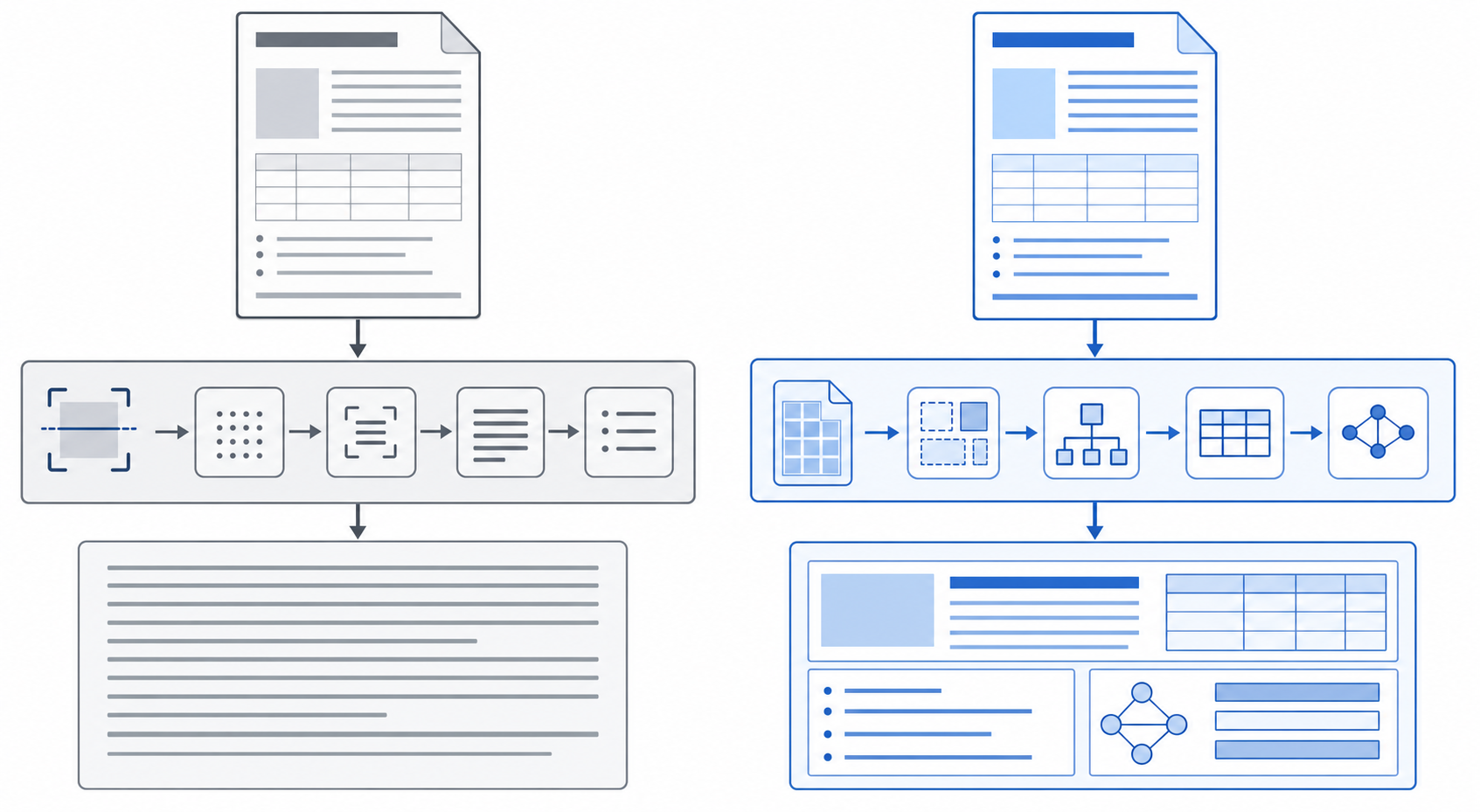
Traditional OCR reads pixels and returns text strings. Layout-first document understanding reads pixels, infers spatial relationships, and returns a structured representation where each element carries positional context, type classification, and confidence scoring.
The architectural gap matters in production. OCR misclassifies fields when a vendor moves a label from left-aligned to centered, or when a table gains a merged header row. Layout-first models treat position, font weight, and surrounding elements as features, so extraction holds across format variation.
| Dimension | Traditional OCR | Layout-First Parsing |
|---|---|---|
| Output | Raw text string | Structured JSON with spatial metadata |
| Table handling | Flattens rows, drops column context | Preserves cell relationships and header hierarchy |
| Multi-column layouts | Reads left-to-right across columns | Segments columns independently before extraction |
| Format variation | Resets on layout change | Generalizes across unseen formats |
| Downstream usability | Requires post-processing before LLM handoff | Delivers LLM-ready output directly |
Extend's Parse 2.0 engine scored 0.847 Adjusted F1 on layout accuracy across 1,500 samples in the RealDoc-Bench benchmark, which measures parsing performance on complex real-world documents across logistics, healthcare, financial services, and real estate. That score reflects what layout-first architecture does that character recognition alone structurally cannot.
How Vision Language Models Changed Document Processing
Traditional OCR reads pixels left to right, top to bottom, with no understanding of what a table cell, a header row, or a nested form field actually means structurally. When a multi-column insurance form or a rotated logistics manifest arrives, character recognition succeeds but field attribution fails: the extracted text is present, the structure is lost.
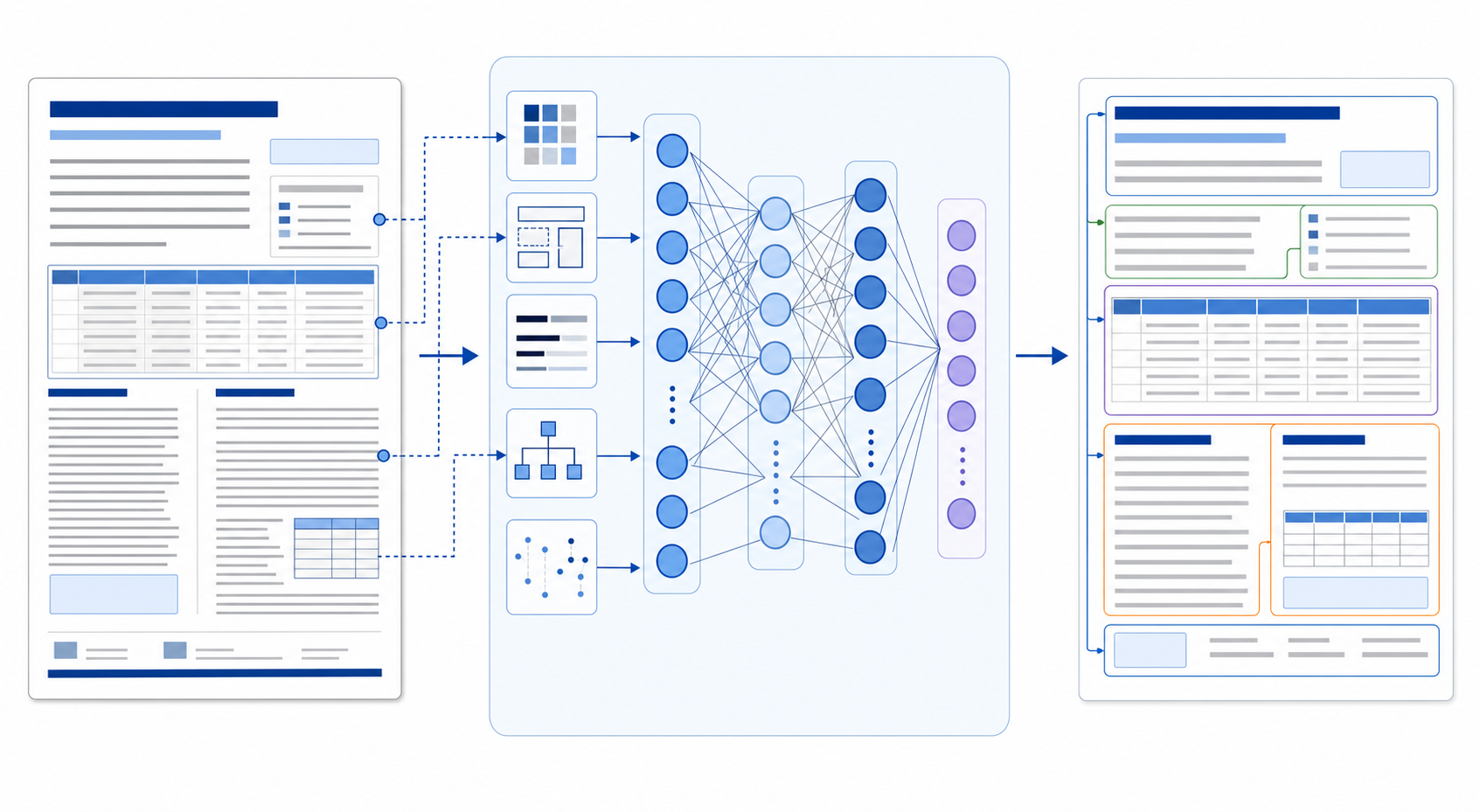
Vision language models approach the same document differently. Instead of linearizing content, VLMs read the full visual page and resolve field identity from spatial relationships, visual hierarchy, and semantic context simultaneously. A consignee location spanning two lines under a merged table header gets attributed correctly because the model reads layout as signal, not noise.
Why Layout-First Parsing Outperforms OCR Pipelines on Complex Documents
The failure mode in OCR-based pipelines is architectural. OCR produces a character stream; every downstream field extractor then has to reconstruct structure from that stream using heuristics, regexes, or rigid templates. Any layout variation resets those heuristics.
Layout-first parsing inverts that dependency. Structure is recovered at the parsing layer, so field extraction operates on a representation that already encodes spatial relationships. The result is a structured, LLM-ready output that downstream agents consume without intermediate cleaning or schema normalization.
Why Layout Detection Determines Parsing Quality
Layout detection errors propagate beyond the parsing layer. When a parser misidentifies a table header as body text or reads a two-column layout as a single column, those misattributions corrupt every downstream extraction step: field extractors receive malformed input and LLMs reason over scrambled context. Applied AI's PDF parsing benchmark shows accuracy varying by 55+ percentage points by document type, with legal contracts reaching 95% while academic papers sit at 40-60%. Parsers that treat layout as a post-processing concern produce downstream extraction errors that prompt engineering cannot recover.
The Limitations of Pipeline-Based Parsing
Pipeline-based parsers treat document structure as a fixed contract. A rule fires when coordinates match; when the layout changes, the rule misfires and the field goes missing or routes to the wrong entity. At scale, a vendor template update or a lender form revision sends hundreds of extraction jobs returning malformed output with no automated signal that anything broke. These systems infer structure from position, not semantic relationships: a two-column table that reflows into three columns breaks the coordinate logic entirely, and context resets per page, so a field reference on page one has no path to the value that resolves it on page four.
Where the Queue Builds
When extraction confidence is low or fields are missing, the document routes to manual review. Teams processing 10,000 invoices per month with a 15% exception rate staff roughly 1,500 manual reviews per cycle: a recurring FTE cost built into the operating model because the parser breaks on format variation. Human-in-the-loop review is a valid safety layer for genuinely ambiguous cases; it becomes a structural liability when it exists to compensate for parser failure.
Document Parsing Benchmarks That Actually Matter
Most benchmarks test parsing on clean, digitally-native PDFs. Production documents include scanned insurance certificates with skewed alignment, multi-page loan packages where borrower fields span page breaks, and logistics manifests with merged cells and rotated headers. Extend built RealDoc-Bench to measure parsing on documents that actually show up in production workflows.
What RealDoc-Bench Measures
Two dimensions separate layout fidelity from downstream usability:
- Layout accuracy (Adjusted F1): measures whether the parser correctly reconstructs tables, columns, and reading order across 1,500 samples. Parse 2.0 scores 0.847.
- Document Q&A accuracy: measures whether extracted output supports correct answer retrieval across 1,359 prompts spanning 581 documents. Parse 2.0 hits 95.7%, meaning downstream LLM agents get accurate inputs without additional cleaning.
Both datasets are publicly available on Hugging Face and GitHub.
Complex Document Challenges: Tables, Forms, and Multi-Column Layouts
Three document types break traditional OCR in repeatable ways: multi-column layouts, nested tables, and structured forms with variable field positions.
- Multi-column PDFs cause sequential text extractors to read across columns instead of down them, collapsing two data streams into a garbled string.
- Nested tables inside financial statements fail template matchers entirely: when a cell contains another table, positional rules built on row-column coordinates produce misaligned fields at scale.
- Forms compound the problem: a W-9 from one vendor and a W-9 from another share a schema but not a layout, so template-based extractors reset on the first deviation.
Layout-first parsing APIs resolve these failures structurally. The parser reads spatial relationships before text, so column boundaries are respected, nested tables are traversed correctly, and form fields are resolved by semantic context instead of fixed coordinates.
Industry-Specific Document Parsing Requirements
Each industry presents distinct failure patterns when document parsing systems hit format variability at scale.
- Financial services: multi-page loan packages with mixed handwritten and machine-generated content break per-page context extraction
- Healthcare: provider-variable form layouts cause field misclassification across EHR-originated documents
- Insurance: nested tables and multi-column declarations flatten incorrectly under standard OCR
- Logistics: variable column counts in carrier documents produce consignee field errors at shipment volume
Extend: Production-Ready Layout-First Document Parsing APIs
Extend is the complete document processing toolkit comprised of the most accurate parsing, extraction, and splitting APIs to ship your hardest use cases in minutes, not months. Extend's suite of models, infrastructure, and tooling is the most powerful custom document solution, without any of the overhead. Agents automate the entire lifecycle of document processing, allowing your engineering teams to process your most complex documents and optimize performance at scale.
Parse 2.0 is the core parsing engine powering all downstream workflows. The output is structured, LLM-ready JSON that feeds directly into approval engines, ERP ingestion pipelines, and orchestration agents: no intermediate cleaning or schema normalization required. Layout accuracy holds across multi-column reports, nested tables, and variable-format forms. The extraction layer Extend provides is what makes automated decisioning possible downstream; nothing in the approval or compliance stack runs reliably without it.
Final Thoughts on Document Parsing
Layout changes are the norm in production, and template-based extractors keep breaking on them. Layout-first parsing reads spatial relationships as signal, so extraction holds where coordinate logic would reset. That difference shows up in the numbers: Parse 2.0 reached 0.847 Adjusted F1 on layout accuracy across real-world documents. Run your production document set through the same benchmark to find out where your current parser falls down.
FAQ
What's the main difference between traditional OCR and layout-first document parsing?
Traditional OCR extracts text strings but loses spatial context, causing field misattributions when layouts vary. Layout-first parsing treats position, font weight, and element relationships as features, so extraction holds across format changes without template reconfiguration.
Document parsing using LLM vs traditional OCR: which handles multi-column PDFs better?
LLM-based layout-first parsers process the full visual representation of a page and resolve structure from spatial relationships, so multi-column layouts are segmented correctly before text extraction. Traditional OCR reads sequentially left-to-right and collapses columns into garbled text before any downstream field extraction begins.
Can I use document parsing Python libraries for production extraction workflows at scale?
PyPDF2, pdfplumber, and pytesseract work for digitally-native PDFs with consistent formatting, but they extract text without understanding layout context. Tables flatten, headers separate from their field blocks, and multi-column documents scramble. For scanned forms, variable-format invoices, or documents spanning 200+ pages, library-based approaches require substantial custom engineering to recover structure that layout-aware APIs deliver directly.
How accurate is Extend's Parse 2.0 on complex real-world documents?
Parse 2.0 scored 0.847 Adjusted F1 on layout accuracy across 1,500 samples and 95.7% on document Q&A across 581 documents in the RealDoc-Bench benchmark, which tests parsing performance on production document types from logistics, healthcare, financial services, and real estate. Those results landed a 140-customer insurance deal requiring parsing capabilities prior versions could not deliver.
When should teams use a commercial document parsing API instead of open source tools?
When scanned carrier BOLs, multi-page loan packages with handwritten addenda, or prior auth forms with checkbox grids hit production volume, open source models trained on general document distributions degrade without fine-tuning. Commercial APIs maintain that accuracy internally and ship updated models without requiring teams to retrain, which matters when field-level correctness determines downstream system reliability.