When compliance teams process HIPAA authorizations, SOC 2 evidence bundles, or regulatory filings, every extracted field carries legal weight and demands a strict audit trail. Standard template matchers and regex scripts break on variable layouts like handwritten intake forms or multi-page audit reports, generating unseen errors that corrupt data records before auditors even arrive. Solving this format variability requires document parsing for compliance that preserves context across page boundaries and routes low-certainty results to human review queues. By generating structured JSON with field-level provenance, organizations replace manual reconciliation with automated extraction that satisfies the strict demands of regulatory oversight.
TLDR:
- Template-based extractors reset context at page boundaries; multi-page HIPAA forms lose field associations, forcing manual reconciliation across EHR systems.
- Audit prep for HIPAA and SOC2 requires structured, timestamped field-level data; unstructured PDFs cost days of staff time per audit cycle.
- Confidence scoring routes low-certainty fields to human review before downstream ingestion, cutting error rates while preserving throughput.
- Cross-framework extraction prevents field duplication; a single PHI record feeds HIPAA, SOC2, and state privacy validators without re-parsing.
- Extend's Parse 2.0 delivers 95.7% document Q&A accuracy and field-level provenance logs that satisfy regulatory audit trail requirements.
What Document Parsing for Compliance Means in Compliance-Driven Industries
Healthcare, finance, and legal sectors process documents under legal obligation. A misread field in an 835 remittance file, a misclassified data element in a SOC 2 audit log, or a missed disclosure in a loan agreement is a compliance failure with real liability attached.
Document parsing for compliance means extracting structured, auditable data from documents that carry regulatory weight: HIPAA-covered PHI in clinical notes, PCI-scoped cardholder data in payment records, or GLBA-protected financial information in mortgage packages. The parsing layer is where compliance either holds or breaks.
What makes this hard isn't document volume alone. It's that compliance-governed documents arrive in formats that weren't designed for machine extraction: handwritten physician notes, multi-page EOBs with inconsistent table layouts, scanned 1003 loan applications where field positions vary between lenders. Template-based extractors break on the first layout variation and require manual correction on every new format, which compounds audit risk at scale.
Teams running compliance workflows need extraction that produces field-level confidence scores, maintains chain-of-custody metadata, and routes low-confidence outputs to human review before they enter a downstream system of record.
Why Compliance Frameworks Require Structured Document Data
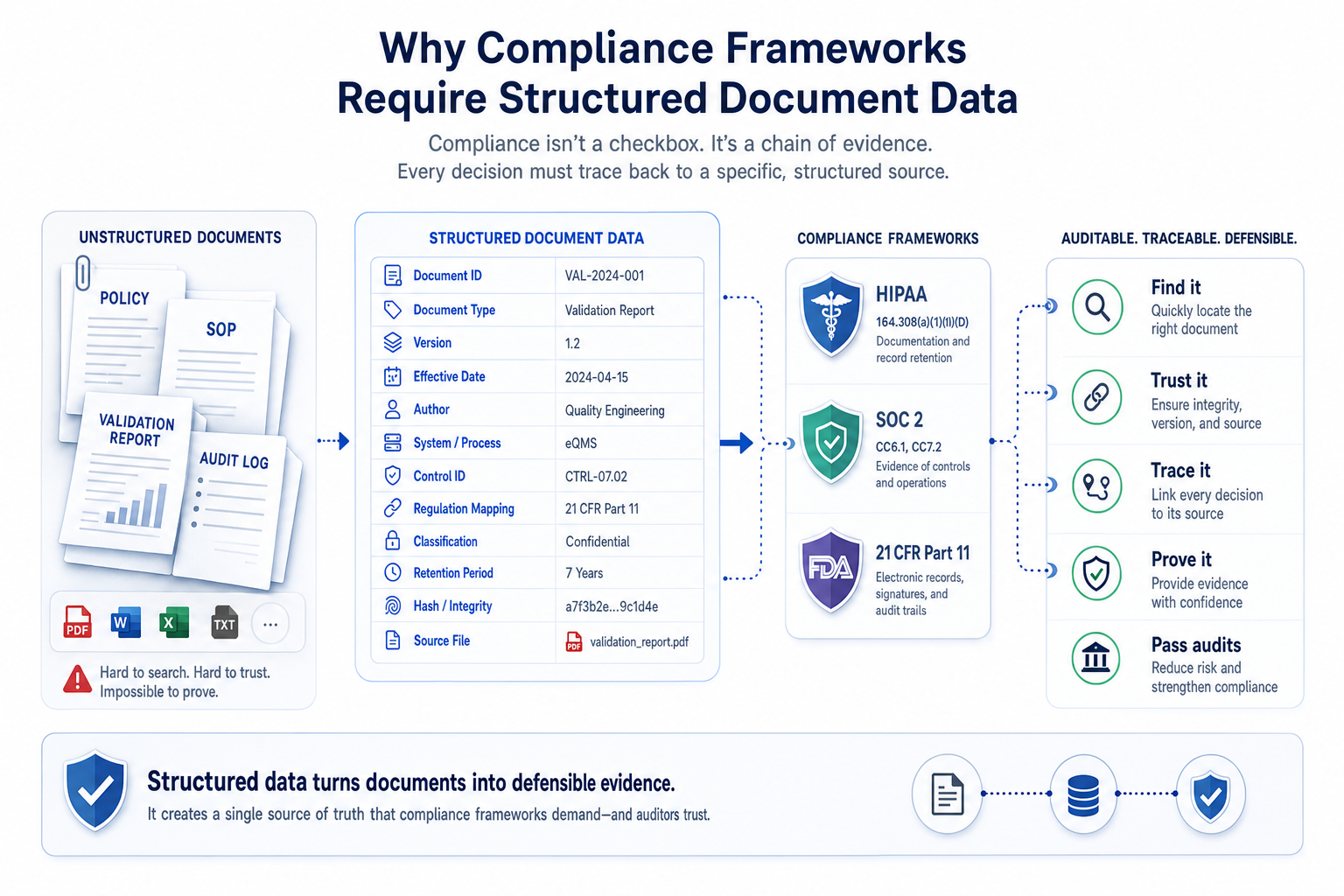
HIPAA, SOC2, and sector-specific regulations like FDA 21 CFR Part 11 share a structural requirement: every compliance decision must trace back to a source field. Audit trails, access logs, and policy attestations only satisfy regulators when the underlying data is structured, timestamped, and attributable. Unstructured document dumps do not meet that bar.
The failure shows up in audit prep. Teams pulling records for a HIPAA audit find that scanned intake forms, handwritten consult notes, and faxed referrals live as image blobs with no queryable fields. Reconstructing a patient timeline from 400-page chart bundles manually costs days of staff time per audit cycle.
SOC2 Type II has the same dependency. Continuous control monitoring requires that access logs, vendor agreements, and policy documents feed into evidence pipelines as structured data. When those documents arrive as unstructured PDFs, compliance teams build manual extraction steps that introduce exactly the gaps auditors flag.
Document parsing for compliance converts those unstructured inputs into structured, timestamped, field-level records that feed directly into audit pipelines, access control systems, and reporting layers. The structured output is what makes automated compliance monitoring architecturally possible.
HIPAA Documentation Requirements and Protected Health Information Handling
HIPAA compliance forces teams to extract PHI scattered across intake forms, clinical notes, insurance authorizations, and discharge summaries, each with different layouts, handwriting quality, and field placement. Regex extractors misclassify patient identifiers when name fields span two lines; template matchers reset on the first unfamiliar form layout.
HIPAA's 18 PHI identifiers must be located, extracted, and handled with full audit trails across every document type in a health system's intake pipeline. Teams building compliant workflows need extraction that holds accuracy across variable layouts and handwritten intake forms alike.
What Breaks Without Structured PHI Extraction
- Patient matching failures: Name and date-of-birth fields extracted incorrectly from handwritten consult notes produce mismatched records that require manual reconciliation across EHR systems like Epic or Cerner.
- Context loss across pages: Insurance authorization numbers parsed from multi-page bundles lose association at boundaries, causing downstream eligibility checks to run against incomplete identifiers.
- Incomplete audit trails: Extraction pipelines lacking confidence scoring leave compliance teams unable to prove which fields were reviewed versus auto-populated during a regulatory audit.
Structured extraction with confidence scoring per field, human-in-the-loop review routing for low-confidence PHI fields, and output delivered as validated JSON gives downstream EHR ingestion pipelines and compliance validators the data fidelity HIPAA requires.
SOC2 Trust Service Criteria and Document Retention Policies
SOC2 compliance requires that document retention policies map directly to the Trust Service Criteria (TSC): availability, confidentiality, processing integrity, privacy, and security. For compliance-driven SaaS teams, that mapping breaks down in practice when retention schedules live in spreadsheets, audit logs span multiple storage systems, and evidence collection for Type II audits requires manual assembly across quarters.
Document parsing for compliance automates the extraction of retention-relevant metadata: document type, creation date, data classification, and system of record. Parsed outputs feed directly into retention policy engines, so documents are categorized and scheduled for deletion or archival without manual triage.
Where Retention Workflows Break at Scale
Three failure points show up consistently in SOC2 audit prep:
- Evidence collection gaps: Pulling logs, configuration records, and incident reports from different systems manually introduces assembly errors that auditors flag.
- Data classification errors: Confidentiality controls depend on accurate tagging at ingestion; manual classification lets mislabeled documents persist in storage longer than policy allows.
- Mapping blind spots: Without parsed, structured metadata, locating all records for a subject for Privacy TSC mapping requires searching across unstructured repositories by hand.
Parsing pipelines that produce structured JSON outputs resolve all three failure points by making retention metadata queryable at the point of ingestion, before documents reach long-term storage.
The Technical Challenge of Parsing Complex Compliance Documents
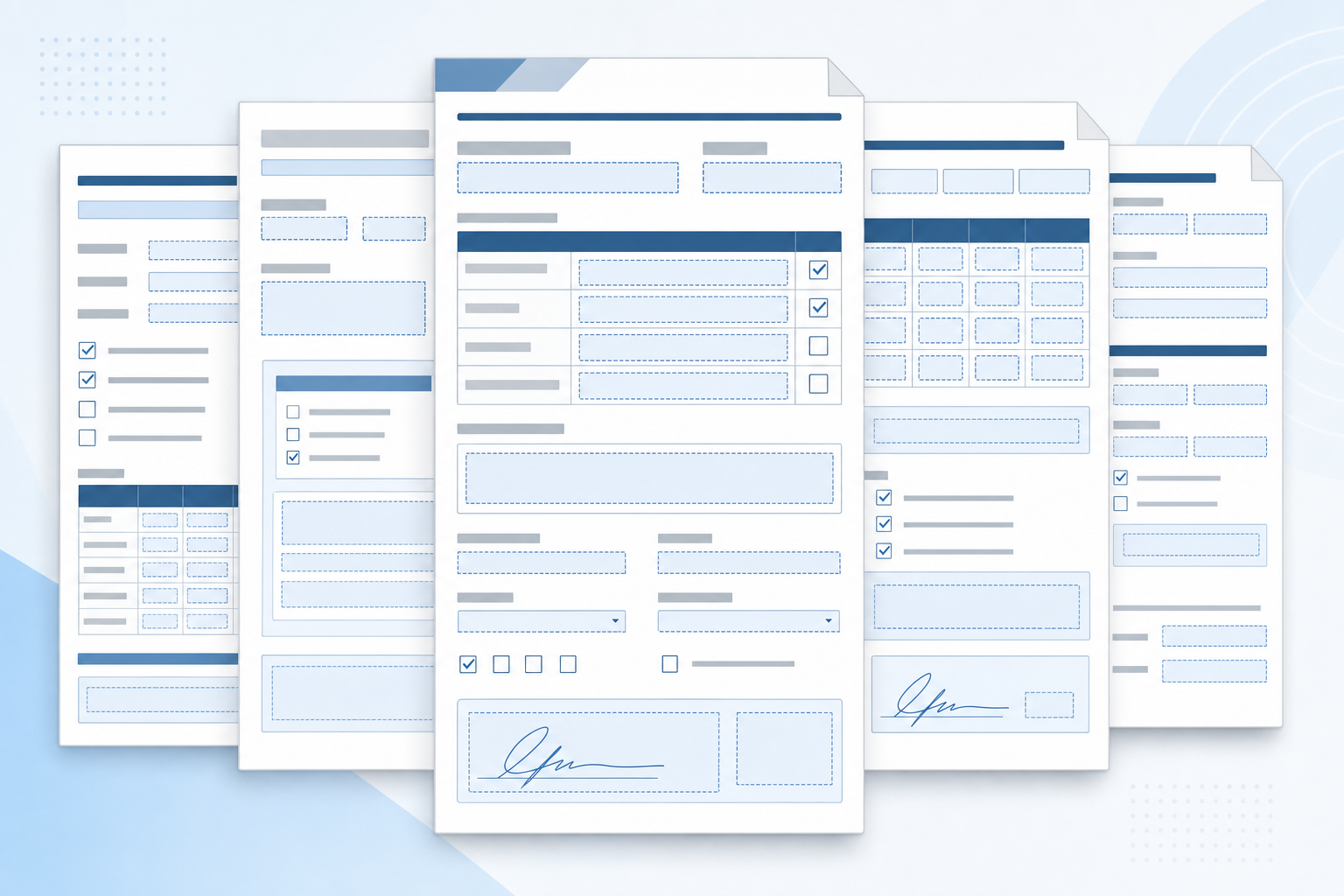
Compliance documents break extractors in ways that general-purpose parsing tools are not built to handle. A HIPAA authorization form spans multiple pages with signature blocks, checkboxes, and handwritten amendments layered on top of printed fields. A SOC 2 audit report contains nested tables, multi-column layouts, and cross-referenced control identifiers that regex extractors misclassify when column boundaries shift by even a few pixels. A BAA pulled from a contract management system may arrive as a scanned PDF with degraded OCR quality, where field boundaries are inferred instead of explicit.
Where Standard Extractors Break
The failure modes are specific. Template-based extractors reset context at page boundaries, so a patient consent form where the signature block appears on page 4 fails field association with the authorization language on page 1. Regex patterns built for one insurer's EOB layout misfire on a second insurer's format, producing silent extraction errors that pass downstream validation without triggering any review flag.
Compliance-driven industries compound this with document volume. A mid-sized health system processing prior authorization requests handles thousands of multi-page submissions weekly, each with layout variation across payers. Teams routing those documents manually into compliance queues spend reviewer hours on classification work that extraction infrastructure should handle.
| Dimension | Template-Based Extractors | Document Parsing for Compliance |
|---|---|---|
| Multi-page context | Loses context at page boundaries, causing cross-page fields to break. | Maintains full context across pages to connect related fields accurately. |
| Layout variation handling | Demands new templates for every format variation, creating heavy setup debt. | Extracts data from variable formats without any manual template configuration. |
| Extraction error detection | Creates silent errors that pass validation and corrupt downstream systems. | Assigns confidence scores and routes low-certainty data to human reviewers. |
| Audit trail completeness | Produces no extraction metadata, leaving compliance teams with blind spots. | Logs timestamps, confidence scores, and review actions to satisfy audit rules. |
| Processing time per document | Demands hours of manual correction per document type, causing review backlogs. | Processes documents instantly, routing only flagged fields for human review. |
How Document Parsing Supports Audit Trail Requirements
Regulators auditing HIPAA or SOC2 compliance need more than a signed policy document. They need a time-stamped record of who accessed what, when a field was extracted, and whether reviewers flagged or approved outputs. Document parsing systems that produce no extraction metadata leave audit trails incomplete by design. HHS HIPAA audit protocols require documented review procedures across selected standards.
Structured parsing outputs carry field-level provenance: which page a value came from, the confidence score assigned at extraction time, and the reviewer action taken before the record moved downstream. That metadata feeds directly into audit log systems without requiring manual reconstruction after the fact.
Human-in-the-loop review steps, logged at the field level, satisfy the access control documentation requirements that both HIPAA Security Rule audits and SOC2 Type II assessments look for in production workflows.
Validation, Confidence Scoring, and Human-in-the-Loop Workflows
Extraction outputs without confidence scores are not auditable. In compliance workflows, every field value needs a reliability signal attached, the result alone is insufficient.
Confidence scoring assigns a numeric certainty value to each extracted field. Fields that clear a defined threshold pass automatically; fields that fall below it route to a human reviewer. This keeps high-volume throughput intact while preserving accuracy on the fields that carry regulatory weight, such as patient identifiers in HIPAA submissions or control evidence in SOC2 audits.
Human-in-the-loop review is not a fallback for broken extraction; it is a designed checkpoint in the pipeline. Reviewers see flagged fields, the surrounding document context, and the confidence value, which is why correction decisions are faster and more defensible than reviewing documents cold.
Extend ships this as part of its core infrastructure: confidence scoring, human review queues, and correction logging all run within the same pipeline. Corrections feed back into the system, so extraction accuracy on recurring document types improves over time without manual retraining cycles.
For compliance teams, the audit trail matters as much as the extraction result itself. Every field decision, whether automated or human-reviewed, is logged with a timestamp and source document reference. That log is what satisfies auditor requests for documented review procedures across HIPAA, SOC2, and similar frameworks.
Cross-Framework Data Mapping and Unified Compliance Architectures
Compliance frameworks rarely map cleanly onto each other, and that gap creates real work. A PHI field protected under HIPAA 45 CFR §164.514 may also appear inside a SOC 2 audit log, a state privacy filing, and an internal risk register, each requiring different handling rules, retention schedules, and access controls. Without a unified extraction layer, teams build separate parsing pipelines per framework, which means the same patient identifier gets extracted four times by four different tools with four different error rates.
Document parsing for compliance works best when the extraction layer produces a single structured output that downstream validators consume across frameworks simultaneously. Teams map one extracted field to multiple compliance rules without re-parsing the source document for each audit.
What a Unified Extraction Layer Handles
Three concrete problems show up when teams run framework-specific pipelines in parallel:
- Inconsistent audit trails: Field duplication across pipelines means a single error in source extraction propagates differently through each downstream validator for the same underlying document.
- Retention schedule conflicts: HIPAA's six-year minimum and SOC 2's shorter log retention windows pull on the same extracted record with no single source of truth governing which rule applies.
- Access control fragmentation: PHI fields tagged in one pipeline carry no metadata into the next, forcing manual re-classification at every handoff.
A parsing layer that outputs validated, schema-normalized JSON resolves all three by making the structured record the authoritative input across every downstream compliance check.
Extend: Production-Ready Document Parsing for Compliance Workflows
Compliance failures in document workflows rarely come from bad intent. They come from extraction gaps: a date field misread on a HIPAA authorization form, a control description missed in a SOC2 evidence packet, an expiration timestamp dropped from a regulatory filing. At scale, these are not edge cases. They are the expected output of systems that were not built to handle layout variability, multi-page context, or the structural diversity of compliance-governed documents.
For compliance workflows, Extend's Parse 2.0 engine delivers the field-level accuracy that compliance-driven industries require. Validated on RealDoc-Bench, Parse 2.0 leads on layout accuracy with an Adjusted F1 of 0.847 across 1,500 samples and 95.7% accuracy on document Q&A output across 581 documents. Those numbers matter in compliance contexts where a missed field is not a UX problem; it is an audit finding.
Teams processing HIPAA authorizations, SOC2 evidence bundles, or multi-jurisdiction regulatory filings get confidence scoring on every extracted field, human-in-the-loop review routing for low-confidence results, and structured JSON output that feeds directly into downstream compliance validators and audit trail systems without intermediate cleaning or schema remapping.
Final Thoughts on Document Parsing for Compliance Workflows
Extraction accuracy in compliance contexts isn't a performance metric, it's an audit requirement. When parsing fails on variable-layout documents, the resulting data gaps show up as findings in HIPAA audits and SOC2 assessments. Teams processing compliance-governed documents need infrastructure that produces confidence scores per field, logs every extraction decision, and routes uncertain outputs to review queues before downstream validators run. Extend handles the parsing layer where compliance either holds or breaks. See Parse 2.0 process authorization forms with the accuracy compliance-driven industries require.
FAQ
Can I build document parsing for compliance without maintaining specialized vision models in-house?
Yes. Extend's Parse 2.0 engine delivers production-ready parsing for HIPAA authorizations, SOC2 evidence bundles, and multi-jurisdiction regulatory filings through REST API integration, eliminating the need for teams to train, host, or maintain custom vision models for document types.
Document parsing for compliance vs template-based OCR, what's the actual difference in workflows?
Template-based OCR breaks on the first layout variation and requires manual template creation for every new document format, which compounds audit risk when processing variable-format documents like multi-payer EOBs or state-specific disclosure forms. Document parsing for compliance maintains document-scoped context across pages and handles layout variation without template configuration, producing field-level confidence scores and audit trails that regulators require.
How do I verify extraction accuracy meets HIPAA or SOC2 audit requirements?
Extend produces confidence scores on every extracted field, routes low-confidence results to human-in-the-loop review queues before they enter downstream systems, and logs every extraction decision with timestamps and source document references, the audit trail that HIPAA Security Rule and SOC2 Type II assessments look for in production workflows.
What breaks when processing 400-page patient charts or multi-jurisdiction legal document bundles at scale?
Template extractors reset context at page boundaries, so cross-page references and exhibit chains fail. Smart chunking strategies that maintain document-scoped context resolve entity relationships across 1,000+ page files without hitting token limits or producing incomplete extraction outputs that create compliance exposure.