When your EOB parser breaks on a new payer format, your revenue cycle team falls back to manual data entry until someone builds a new template. EOB parsing solutions that rely on pixel coordinates and pattern matching can't handle documents where tables span multiple pages, cells merge across columns, or formatting changes between batches. The core issue is that EOBs are more than simple forms with predictable fields. They're complex documents with nested structures, continuation tables, and context-dependent data that requires understanding document layout beyond what traditional OCR can capture.
TLDR:
- Manual EOB processing costs healthcare organizations $125 billion annually through data entry errors
- AI-driven parsing reduces error rates from 8-12% to under 2% by understanding document structure
- Multi-page EOBs with 1,000+ rows require smart chunking and array extraction to maintain accuracy
- Automated validation and confidence scoring catch errors before they reach financial systems
- Extend processes millions of healthcare pages daily with vision models that handle any payer format
What Is EOB Parsing and Why It Matters for Healthcare Revenue Cycles
An Explanation of Benefits (EOB) document arrives from payers after they process a healthcare claim. It breaks down the billed amount, insurance coverage, patient responsibility, and any denials or adjustments applied to the claim. EOB parsing refers to automated extraction of financial and clinical data from EOBs into structured formats that downstream systems can process.
For healthcare organizations, EOB parsing sits at the center of revenue cycle management. The data extracted from EOBs feeds directly into payment posting, denial management, and accounts receivable reconciliation. When parsing fails or introduces errors, payments get posted incorrectly, denials go unnoticed, and revenue leakage follows. Manual processing of EOBs creates bottlenecks that delay reimbursement and strain day-to-day resources.

The High Cost of Manual EOB Processing
Manual EOB processing drains healthcare organizations through multiple financial channels. 80% of medical bills contain errors, costing providers approximately $125 billion annually through data entry mistakes, payment posting issues, and reconciliation failures.
| Metric | Manual Processing | Automated AI Parsing |
|---|---|---|
| Error Rate | 8-12% | Under 2% |
| Processing Time per EOB | 15-20 minutes | Under 1 minute |
| Payment Posting Delays | 3-7 days | Same day |
| Staff Cost per 1,000 EOBs | $1,250-$2,500 | $100-$300 |
| Format Adaptation | Requires retraining staff | Automatic handling |
| Multi-page EOB Support | High error risk | Smart chunking |
| Audit Trail | Manual documentation | Automatic logging |
The shift from manual to automated AI parsing delivers a 4-6x reduction in error rates while cutting per-EOB processing costs by over 80%. Organizations processing 1,000+ EOBs monthly see immediate impact through same-day payment posting and eliminated format adaptation overhead.
Core Challenges That Make EOB Parsing Complex
EOBs range from structured templates with predictable layouts to completely unstructured documents where payers apply arbitrary formatting choices. Traditional OCR and template-based tools struggle because they rely on fixed field positions and pattern matching. When a payer moves a column, reformats a table header, or adds a new adjustment code section, templates break. Healthcare organizations face more than 1,500 unique payer-specific EOB formats, each with its own quirks around spacing, fonts, and field labels.
Nested tables create another extraction barrier. EOBs frequently embed adjustment details within service line rows, with spanning cells that merge across columns. When multiple patient records appear on a single EOB, separating one patient's data from another requires understanding document structure beyond what pixel coordinates can capture.
Key Data Points Healthcare Organizations Must Extract From EOBs
Revenue cycle teams rely on extracting specific data fields from each EOB to post payments, identify discrepancies, and manage denials. Patient and provider identifiers such as member ID, NPI, and tax ID link EOB data to the correct claim records. Service line details including procedure codes, diagnosis codes, and allowed amounts verify payer adjudication logic. Financial amounts like deductible, copayment, and adjustments determine what gets posted, while adjustment codes and remark codes explain payment reductions and guide appeal workflows.

How AI Changes EOB Data Extraction
AI-driven EOB parsing replaces template matching with models that understand document structure and context. Vision models analyze spatial relationships between headers, rows, and columns to reconstruct table hierarchies even when cell borders are missing or formatting inconsistencies appear.
LLMs bring contextual understanding to field extraction by reading surrounding text to determine whether a dollar amount represents a deductible, copayment, or adjustment. AI systems reduce error rates from 8-12% to under 2% by recognizing that "patient responsibility" in one format corresponds to "member owes" in another.
Handling Multi-Page EOBs and Large Table Extraction
Multi-page EOBs with hundreds of service lines create unique extraction challenges. A single EOB covering bundled procedures or monthly summaries can span 50+ pages with dense tables that continue across page breaks. Traditional parsing systems fail because they treat each page independently, losing context about table continuity.
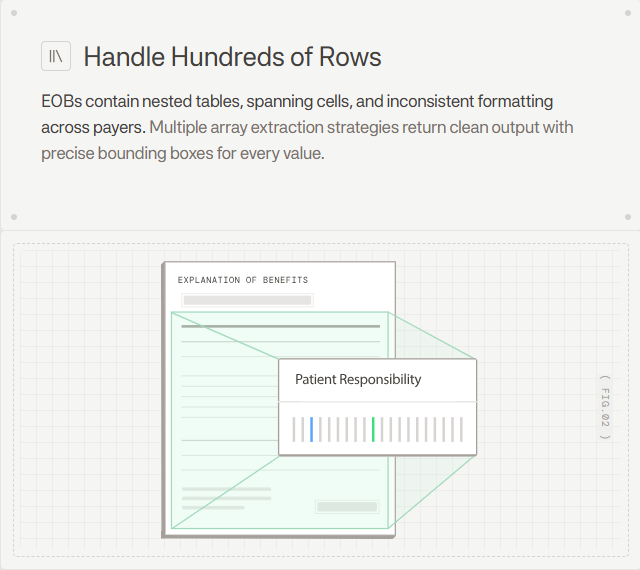
The core issue is maintaining table structure when rows split mid-page. Smart chunking strategies solve this by detecting table boundaries and creating overlapping context windows. Array extraction methods reconstruct full tables by tracking column headers across pages and merging row data intelligently.
EOB Parsing Workflow Integration and Payment Posting
EOB parsing delivers value when extracted data flows directly into revenue cycle systems without manual intervention. The workflow begins when payers deliver EOBs via EDI 835 files, paper mail, or payer portals. Document ingestion APIs capture these files and route them through parsing and extraction pipelines that convert unstructured EOBs into structured JSON or XML outputs.
Once extraction completes, validation rules check for required fields, flag missing data, and verify format consistency. The matching engine then uses patient identifiers, claim numbers, service dates, and procedure codes to locate corresponding open claims in the practice management system.
Automated payment posting writes approved EOB data directly to patient accounts, updating account balances, recording adjustments, and closing paid claims.
Maintaining Accuracy with Validation and Quality Controls
Production EOB parsing requires validation mechanisms that catch errors before they reach financial records. Confidence scoring flags uncertain extractions by assigning probability scores to each field, routing low-confidence results for human verification before posting to accounts.
Multi-pass review agents re-check extractions using different model strategies to verify consistency. Discrepancies between passes trigger escalation protocols that prevent incorrect data from entering billing systems.
Bounding boxes trace every extracted value back to its source location in the document. When a payment amount appears incorrect during review, staff can instantly see which table cell or line item produced that number, catching OCR errors and verifying field accuracy.
Human-in-the-loop review interfaces present low-confidence extractions alongside source documents. Corrections feed back into the system, creating improvement loops where models learn from validated outputs and reduce future error rates.
Compliance and Audit Requirements for EOB Processing
Healthcare organizations processing EOBs must meet HIPAA standards protecting patient data. Automated parsing systems require encryption for data at rest and in transit, role-based access controls, and audit logs recording every document access and extraction event.
Audit trails create forensic records showing which staff member reviewed an EOB, when extraction occurred, and what changes were made during validation. These logs satisfy payer audits and compliance reviews while providing evidence chains when payment disputes arise.
Version control tracks schema changes and extraction logic updates. When extraction rules evolve, version history lets teams trace which configuration processed a specific EOB batch, reproducing results for audit inquiries.
Implementation Considerations for EOB Parsing Solutions
Organizations deploying EOB parsing systems must match processing capacity to document volume. Revenue cycle teams processing 10,000+ EOBs monthly require high-throughput APIs and batch processing capabilities. Lower-volume practices need real-time extraction with fast response times for immediate payment posting decisions.
Integration architecture determines deployment success. APIs must connect to existing practice management systems, EHRs, and clearinghouses without requiring custom middleware. Pre-built connectors for major billing systems reduce implementation timelines from months to weeks.
Testing methodology should measure parsing accuracy against the organization's actual EOB formats before production deployment. Revenue cycle leaders should submit sample EOBs from their top payers and measure field-level accuracy across patient identifiers, service lines, and payment amounts.
How Extend's Document Processing Handles EOB Parsing at Scale
Extend's vision models and layout-aware OCR process tables, nested structures, and document sections across any payer format without template configuration. The platform combines OCR, specialized computer vision models, and VLMs to analyze spatial relationships between headers, rows, and columns, reconstructing table hierarchies even when cells merge across columns or formatting changes between batches. This structural understanding works across the 1,500+ unique EOB formats healthcare organizations encounter, from single-page summaries to complex bundled statements spanning 50+ pages.
Array extraction strategies capture service line tables with hundreds of rows while smart chunking maintains context across multi-page EOBs. When tables continue across page breaks or column headers disappear mid-document, the system detects table boundaries and creates overlapping context windows that preserve row integrity. Intelligent merging reconstructs full tables by combining data from multiple chunks while eliminating duplicate entries in overlap zones. Citation models generate bounding boxes that trace each extracted dollar amount to its source cell, creating forensic trails for audit requirements and allowing revenue cycle staff to verify data against source documents instantly.
Confidence scoring routes uncertain extractions for review while automatically posting high-confidence data to payment systems. The multi-pass review agent checks outputs through different model strategies and flags discrepancies before data reaches financial records. When revenue cycle staff validate or correct flagged extractions, that feedback improves future accuracy through continuous learning loops that reduce false positives while catching genuine errors.
Healthcare organizations process millions of pages daily through Extend's APIs and SDKs, replacing manual workflows that took days with automated pipelines that complete in minutes. The platform maintains 95-99% field-level accuracy across any payer format while handling state-specific variations from Medicaid programs and format changes from commercial payers without requiring manual intervention. Pre-built connectors for major practice management systems reduce integration time from months to weeks, allowing teams to deploy production-grade EOB parsing that works on their actual documents from day one.
Final Thoughts on Healthcare EOB Parsing Technology
Manual EOB processing creates bottlenecks that EOB parsing technology removes by handling format variations your team encounters daily. You need extraction systems that work across all your payers without building custom templates for each one. Revenue cycle performance improves when payment data flows into billing systems within hours instead of days. Start by measuring current error rates and processing times, then compare against automated extraction benchmarks.
FAQ
How does AI-driven EOB parsing handle different payer formats without template configuration?
Vision models analyze spatial relationships and document structure instead of relying on fixed field positions, allowing them to extract data from new payer formats without manual template creation. LLMs read surrounding context to interpret fields correctly even when labels and layouts vary across the 1,500+ unique EOB formats in use.
What accuracy rates should healthcare organizations expect from automated EOB extraction?
Modern AI-powered EOB parsing reduces error rates from the 8-12% typical in manual processing to under 2%. Field-level accuracy for critical data points like payment amounts, adjustment codes, and patient identifiers typically reaches 95-99% when confidence scoring and validation workflows are properly configured.
Can EOB parsing systems handle documents with hundreds of service lines across multiple pages?
Yes, smart chunking strategies and array extraction methods maintain table context across page breaks, accurately extracting tables with 1,000+ rows spanning 50+ pages. These techniques detect table boundaries, create overlapping context windows, and merge row data while preserving column relationships throughout multi-page EOBs.
How long does it take to implement an EOB parsing solution for a revenue cycle team?
Implementation timelines depend on document volume and system integration requirements. Organizations with pre-built connectors to major practice management systems can deploy in weeks instead of months, though teams should allocate time to test parsing accuracy against their actual payer EOB formats before production use.
What validation mechanisms prevent incorrect EOB data from reaching billing systems?
Confidence scoring flags uncertain extractions for human review, multi-pass review agents verify consistency across different model strategies, and bounding boxes trace extracted values to source locations for verification. Human-in-the-loop interfaces allow staff to correct low-confidence results before payment posting, with corrections feeding back to improve future accuracy.