Template-based extractors fail on financial documents before the second batch clears. A 200-page loan packet where the income section is sequenced differently by every originator breaks coordinate-based rules on first contact; a bank statement where Chase encodes debits as signed integers and Bank of America splits them across separate debit and credit columns produces misclassified fields that ship into underwriting systems as ground truth, with no error surfaced until downstream. Parsing financial documents at production volume requires an extraction layer that resolves fields from document context, not fixed position, holds page-scoped state across multi-page bundles, and attaches per-field confidence scores so low-confidence values route to human review before any figure reaches a decisioning engine. Loan packets, tax forms, and bank statements each break template-based extraction in distinct ways, and this guide covers what the extraction layer needs to handle each one in production.
TLDR:
- Template-based extractors fail on financial documents because layout varies per issuer; fields get misclassified silently and errors reach underwriting systems before anyone catches them.
- Loan packets spanning 80-200 pages require document-scoped splitting before extraction runs; a single schema applied across a 1003, pay stubs, and Schedule E produces incorrect income totals.
- Tax form parsing fails at cross-form validation, not field extraction; EIN mismatches and missing K-1s pass through template extractors as successfully parsed records.
- Production pipelines attach per-field confidence scores and route low-confidence extractions to human review queues; without thresholds, errors ship into decisioning systems as ground truth.
- Extend's Parse 2.0 scores 0.847 Adjusted F1 on layout accuracy across 1,500 real-world samples, delivering structured JSON directly to underwriting systems and LLM reasoning layers.
Why Financial Documents Resist Standard Parsing
Three structural properties make financial documents resistant to standard parsing approaches:
- Variable schema across issuers: A 1099 data extraction attempt on a 1099-INT from one financial institution finds box values in a different spatial position than the same form from another, even though both are IRS-compliant. Regex and coordinate-based extractors break on the first unseen layout.
- Multi-page context dependencies: Loan packets reference borrower entities defined on page 3 in schedules that appear on page 47. Extractors that reset context per page produce orphaned fields with no entity association.
- Mixed content types within a single document: A single mortgage packet contains typed text, handwritten annotations, embedded tables, and scanned signature pages. Each content type requires a different extraction strategy, and a single-model extractor applied uniformly produces high error rates on at least one of them.
Loan Packets: Splitting, Sequencing, and Income Calculation
Loan packets arrive as multi-document bundles: a 1003 application, pay stubs, W-2s, bank statements, 1099s, and title documents, often spanning 80 to 200 pages in a single PDF. Before any field extraction runs, the bundle has to be split into constituent document types and sequenced correctly. Template-based document splitting tools fail here because document boundaries shift depending on the lender, the borrower's employment situation, and whether documents were scanned in a consistent order.
Income Calculation Across Document Types
Income calculation breaks when a single schema spans document types with incompatible field definitions. A borrower with mixed income sources requires pulling base salary from a Fannie Mae Form 1003, YTD earnings from two pay stubs across separate employers, dividend income from a 1099-DIV, and rental income from a Schedule E, then cross-checking figures that may not align due to timing differences or reporting periods. Each document type carries different field schemas and income definitions, so a single extraction schema applied across all document types produces incorrect totals.
Teams running financial services document processing pipelines at volume hit manual review queues that grow faster than staff headcount scales to clear them, which is why extraction accuracy on income fields directly determines underwriting throughput.
Tax Forms: Field Density, Schedules, and Cross-Form Dependencies
Tax forms present a different parsing challenge than loan packets. The document set is standardized, the field positions are known, and the issuing authority publishes explicit specifications. The difficulty is relational: a W-2 form references an employer EIN that must match the 1099-NEC from the same issuer, Schedule B interest totals must align against the 1040 line entry, and K-1 pass-through amounts cascade into multiple downstream schedules. Regex and template extractors pull individual fields accurately but have no mechanism to validate cross-form consistency, so discrepancies accumulate silently until a downstream system or human reviewer catches them.
Cross-Form Dependency Resolution
Production parsers handling tax form sets need three properties:
- Field-level extraction with position anchoring: Schedule D line 16 maps to the correct capital gains carry-forward regardless of whether the filer used tax software or filled by hand.
- Cross-form entity resolution: Ties employer EINs, SSNs, and entity names across W-2s, 1099s, and the base 1040 into a single validated record.
- Schedule dependency tracking: Flags missing forms before downstream systems receive incomplete data, instead of propagating gaps silently into underwriting or compliance workflows.
Bank Statements: Transaction Tables and Multi-Institution Format Variation
Bank statements arrive in hundreds of layout variations across institutions, and no two format transaction tables the same way. Chase encodes debits and credits as signed integers in a single amount column; Bank of America splits them across separate debit and credit columns; Wells Fargo embeds running balance inline with each transaction row. A regex extractor built for one schema misclassifies fields the moment a second institution's statement enters the queue.

The structural problem compounds at scale. Multi-page table extraction with template-based extractors that reset context per page produces duplicate header rows, orphaned transaction entries, and balance totals that don't match the extracted line items.
Teams parsing bank statements for lending, underwriting, or fraud review need extractors that resolve column semantics from document context, not fixed positional rules, which is why model-based approaches that maintain page-scoped representations outperform template matchers on real production volumes.
Parsing Approaches: Rules-Based, ML, and AI Models
Each approach trades off maintenance cost, inference overhead, and tolerance for layout variation differently. The right choice depends on how many distinct document formats enter the pipeline and whether those formats are stable over time.
| Approach | Works Best For | Breaks When |
|---|---|---|
| Rules-based | Single stable form at high volume; no inference overhead | A new layout variant enters the queue; each variant needs a new rule set |
| ML models | Moderate layout variability within a known document distribution | Document structure moves outside the training distribution |
| AI / VLM | High layout variability, multi-page bundles, mixed content types | Inference cost is overkill for a single stable form at fixed layout |
Table Extraction: The Hardest Problem in Financial Parsing
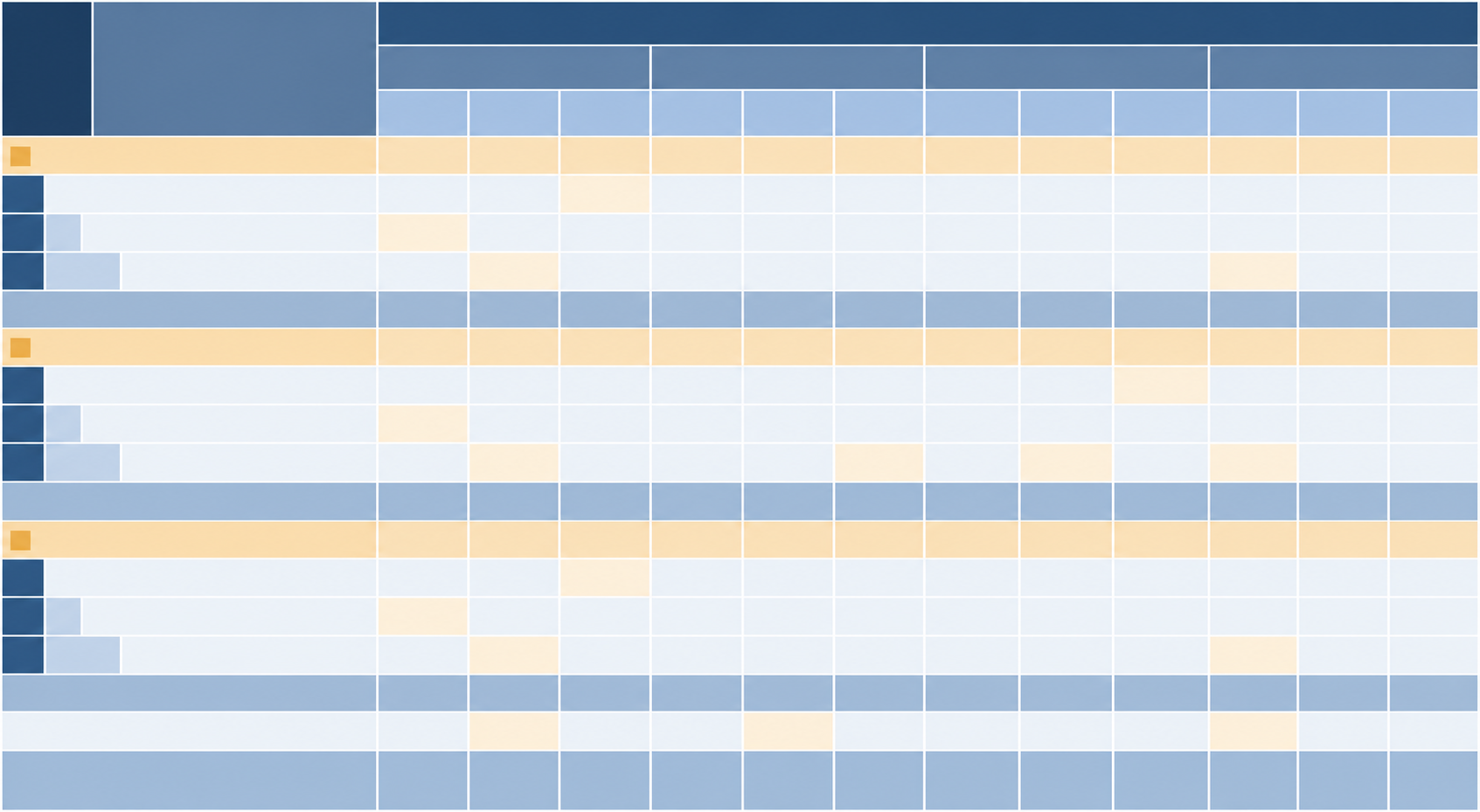
Tables in financial documents are structurally compound problems. A multi-period income statement carries merged column headers spanning three fiscal years, subtotal rows that encode section hierarchy, and position-dependent blank cells where the absence of a value is itself data. A transaction ledger requires sequential row context because balance columns become wrong the moment row order changes. Standard extraction approaches treat tables as grids of independent cells, which is why they misread running totals, collapse merged headers into single-row values, and drop subtotal hierarchy entirely.
Where Cell-Level Extraction Breaks
Three failure patterns show up repeatedly in financial table extraction:
- Merged headers: Get flattened into the first cell they span, so downstream systems see "Q1" as a column label when the actual label is "Fiscal Year 2024 Q1 Actuals."
- Blank cells in running balance columns: Get skipped instead of preserved, shifting every downstream value one position left and corrupting the entire ledger sequence.
- Subtotal rows: Lose their hierarchical relationship to detail rows, so aggregation logic double-counts line items that were already summed.
Validation, Confidence Scoring, and Human-in-the-Loop Review
Extraction accuracy degrades before teams notice it. A confidence score below a set threshold on a borrower's debt-to-income ratio field means an underwriter catches the error; no score at all means it ships into a decisioning system as ground truth.
Production-grade financial document pipelines attach a confidence score to every extracted field. Fields that fall below threshold route to a human review queue; fields that clear threshold pass directly to the approval engine, ERP ingestion layer, or LLM reasoning step waiting for them.
Routing Logic at the Field Level
The threshold is configurable per field type. Numeric fields on tax forms typically carry tighter thresholds than free-text contact fields. Teams set the cutoff per document type and per field, so a Schedule C net profit line gets a stricter gate than a secondary phone number.
Reviewers see the extracted value, the confidence score, and the source region in the original document. They correct the field inline. That correction feeds back into the model, so patterns show up in aggregate over time and review queue volume drops as the system accumulates labeled corrections.
Human-in-the-loop review works as a quality gate, not a fallback for a broken extractor.
Compliance, Audit Trails, and Data Security in Financial Parsing
Financial document parsing in compliance-driven environments carries obligations that go well beyond extraction accuracy. Every field pulled from a loan packet, tax form, or bank statement becomes part of an audit trail that regulators, auditors, and compliance teams will inspect.
What Audit Trails Must Capture
Production pipelines need per-field provenance: which model extracted a value, at what confidence score, whether a human reviewer overrode it, and when. Without that metadata, teams cannot reconstruct decisions during a regulatory examination.
Data Security Requirements
Parsed financial data falls under SOC 2, GDPR, and often state-level financial privacy statutes. Pipelines must encrypt data in transit and at rest, enforce role-based access to extracted fields, and support data residency constraints for cross-border document flows.
Human-in-the-Loop as a Compliance Control
Low-confidence extractions routed to human review function as more than a fallback for accuracy. They are a documented control point. When a reviewer accepts or corrects a field, that action is timestamped and tied to the extraction event, producing the evidence chain compliance teams need.
How Extend Handles Financial Document Parsing at Scale
For financial document parsing, Extend ships OCR, specialized computer vision models, VLMs, ingestion pipelines, confidence scoring, and human-in-the-loop review as a unified stack. Teams processing loan packets, tax forms, and bank statements get structured JSON output that downstream underwriting systems, compliance validators, and LLM reasoning layers consume directly without intermediate cleaning or schema normalization.
Parse 2.0 is Extend's core parsing engine, validated against the RealDoc-Bench benchmark across 1,500 real-world document samples. It leads on layout accuracy with an Adjusted F1 of 0.847 and scores 95.7% on document Q&A output accuracy across 1,359 prompts and 581 documents. Financial documents with nested tables, multi-column layouts, and handwritten annotations sit inside the benchmark's test distribution, so those scores reflect production conditions, not curated samples.
Financial documents break template-based extractors on layout variation alone. A W-2 from one employer uses a different column order than another; a loan packet from a regional lender structures the income section differently than a national bank's packet. Parse 2.0 maintains document-scoped context across pages, so field resolution holds across a 200-page closing disclosure the same way it holds on a single-page 1099. Teams can review extraction results, flag low-confidence fields, and route corrections through human-in-the-loop queues using the Parse API infrastructure without rebuilding the pipeline.
Final Thoughts on Parsing Financial Documents
Template-based extractors degrade quietly on financial documents, and the errors they produce don't surface until they're already downstream in a decisioning system. The extraction layer must hold across layout variation, multi-page context dependencies, and table structures where blank cells and subtotal rows carry meaning. Getting that right at the base layer is what makes confidence scoring, human-in-the-loop routing, and audit trail generation actually useful. See how Extend brings these layers together on real document volumes.
FAQ
What's the best way to handle income calculation across mixed document types in a loan packet?
Pull each document type through a separate extraction schema, 1003 for base salary, pay stubs for YTD earnings, 1099-DIV for dividend income, Schedule E for rental income, then run a reconciliation pass that flags timing mismatches across reporting periods before any figure reaches an underwriting system. Template-based extractors applied uniformly across all document types produce incorrect totals because each form carries a different income definition and field schema. Teams processing at volume need field-level confidence scoring on every income field so low-confidence values route to human review before they reach a decisioning engine.
Should I use rules-based extraction or a VLM-based approach for financial documents?
Rules-based systems work for a single stable form at high volume, one carrier's invoice or a specific county's tax statement, but break the moment a new layout variant enters the queue, and each variant requires a new rule set to fix. VLM-based approaches like Parse 2.0 resolve fields from document context, not position, so a W-2 with a non-standard employer layout or a bank statement reformatted mid-year remains parseable without template updates. For financial documents sourced from multiple lenders, servicers, or jurisdictions, the maintenance cost of rules-based systems scales directly with format diversity until it exceeds the cost of a model-based approach.
How do audit trails work in a financial document parsing pipeline?
Every extracted field needs per-field provenance attached at write time: which model produced the value, the confidence score assigned, whether a human reviewer overrode it, and a timestamp for each event. When a reviewer corrects a low-confidence field, that correction is logged as a discrete action tied to the original extraction event, producing the evidence chain regulators inspect during examination. Without that metadata, teams cannot reconstruct which value entered a decisioning system, at what confidence level, or whether human review occurred, gaps that create compliance exposure in SOC 2 and GDPR-governed environments