Multi-page loan packages and insurance submissions break extraction pipelines the moment context needs to carry across page boundaries. AWS Textract resets that context per page, handing back raw JSON blocks that require custom schema mapping, review routing, and orchestration before any field is usable downstream. Extend ships the full pipeline instead, resolving cross-page references through a document-scoped context graph and delivering structured JSON that LLMs and agents consume directly. This AWS Textract alternative comparison breaks down where the two diverge on parsing accuracy, file support, pricing, and total cost of ownership, so engineering teams can pick the tool that fits their document types and layout variability instead of losing weeks to infrastructure that doesn't move the product forward.
TLDR:
- Textract resets context per page, causing field mismatches in multi-page loan packages and insurance submissions that span dozens of pages
- Textract's page-scoped extraction model breaks on variable layouts; Extend's document-scoped context graph resolves cross-page references, scoring 0.847 Adjusted F1 across 1,500 real-world samples
- Textract returns raw JSON requiring custom normalization before any downstream system consumes it; Extend delivers structured JSON that LLMs and agents consume directly
- Teams processing 100,000 invoice pages monthly hit roughly $1,000 in Textract fees alone, before Lambda, S3, SQS, and API Gateway costs required to build a working pipeline
- Extend ships OCR, VLMs, confidence scoring, and human-in-the-loop review as a single toolkit, so teams ship production integrations in days instead of spending weeks building orchestration infrastructure
What Is AWS Textract?
AWS Textract is a managed machine learning service from AWS that automatically extracts printed text, handwriting, layout elements, and data from scanned documents. It targets teams looking to automate extraction from forms, tables, and unstructured documents without standing up OCR infrastructure from scratch.
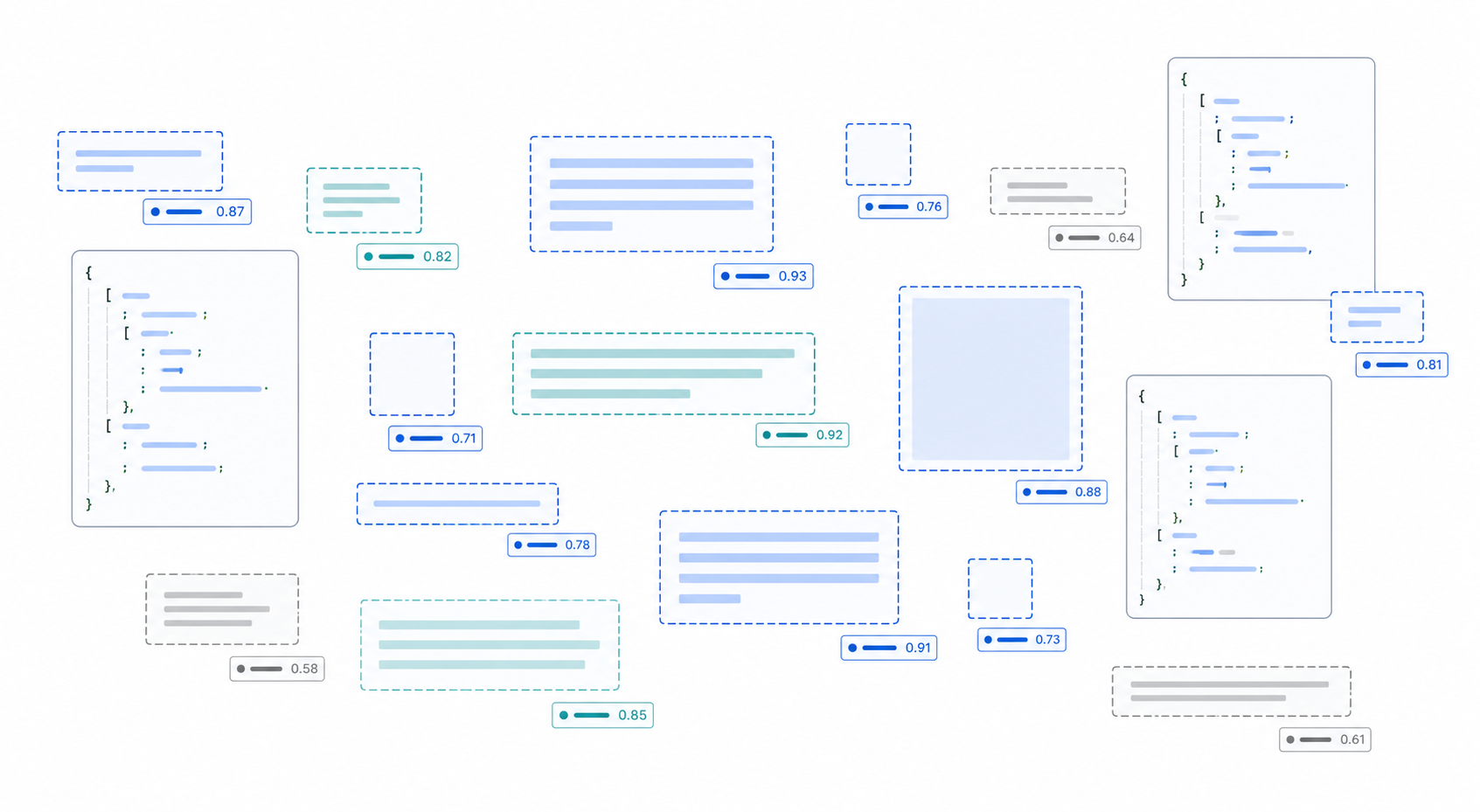
Supported input formats are JPEG, PNG, PDF, and TIFF. The API returns a graph of Block objects, a low-level representation of every detected element on the page. From that point, the work falls to the engineering team: mapping those blocks to a usable schema, building evaluation pipelines, implementing review operations, and constructing workflow orchestration around the raw response. Textract handles extraction; everything downstream is the team's responsibility to build and maintain.
What Is Extend?
Extend is the complete document processing toolkit comprised of the most accurate parsing, extraction, and splitting APIs to ship your hardest use cases in minutes, not months. Extend's suite of models, infrastructure, and tooling is the most powerful custom document solution, without any of the overhead. Agents automate the entire lifecycle of document processing, allowing your engineering teams to process your most complex documents and optimize performance at scale.
Extend's models, infrastructure, and tooling cover the document processing lifecycle, including OCR, VLMs, confidence scoring, and human-in-the-loop review. Agents handle extraction, validation, and review routing, so engineering teams configure schemas and thresholds instead of building orchestration, review queues, and normalization logic themselves.
Parsing Accuracy: How the Two Compare
Parsing accuracy separates production-ready extraction from systems that require constant manual correction. Extend's Parse 2.0 engine was validated through RealDoc-Bench, a benchmark measuring performance on complex, real-world documents across logistics, healthcare, financial services, and real estate. Parse 2.0 achieves 0.847 Adjusted F1 across 1,500 real-world samples for layout accuracy and 95.7% on document Q&A across 1,359 prompts.
AWS Textract performs reliably on clean, structured documents with consistent formatting. On variable layouts, handwritten fields, or multi-page packages where context spans page boundaries, accuracy degrades and manual review queues grow.
Where the Gap Shows in Production
| Condition | Extend Parse 2.0 | AWS Textract |
|---|---|---|
| Variable-layout documents | VLMs maintain document-scoped context across layout changes | Template assumptions break on first unseen format |
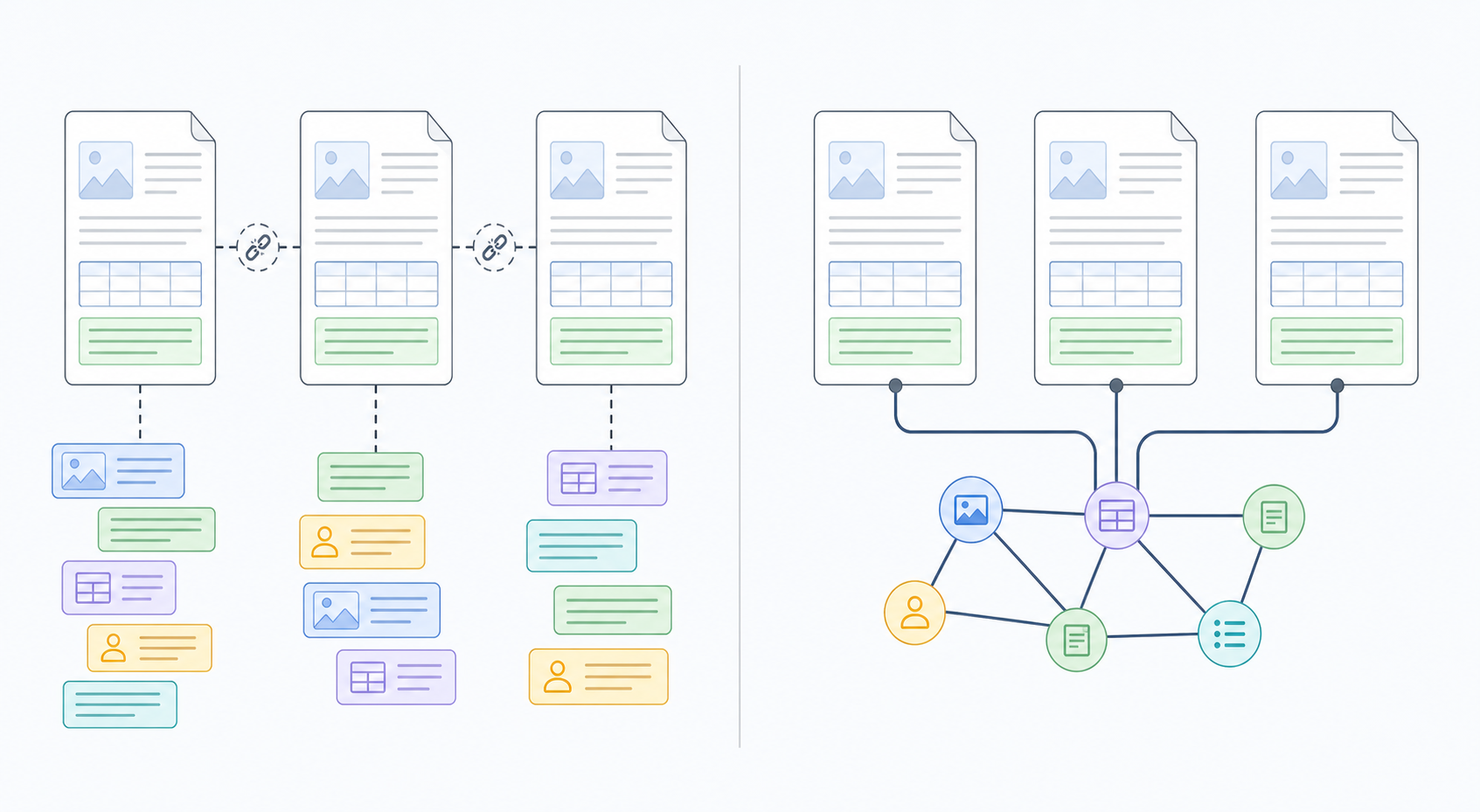
| Multi-page context resolution | Cross-page entity references resolved within a single context graph | Context resets per page, causing field mismatches |
| Handwritten fields | Specialized computer vision models trained on degraded inputs | Accuracy drops sharply on non-printed text |
| Document Q&A accuracy | 95.7% across 1,359 prompts on real-world documents | 70.5% (RealDoc-Bench) |
| Layout accuracy (Adjusted F1) | 0.847 across 1,500 real-world samples | 0.709 (RealDoc-Bench) |
The architectural difference is the context model. Textract processes documents as page-scoped regions; Extend maintains a document-scoped representation through superior document layout analysis so fields that reference entities defined elsewhere in the package resolve correctly without post-processing.
File Type and Document Support
Extend ingests PDFs, scanned images, Excel files, Word documents, and mixed-format bundles without preprocessing. A single API call handles multi-page packages whether they arrive as digitally-native PDFs or low-resolution scans from a fax machine.
AWS Textract just focuses on PDFs and common image formats (JPEG, PNG, TIFF), reflecting traditional OCR limitations. Teams routing Excel files or Word documents through a Textract pipeline hit an immediate gap: those files require conversion before ingestion, which adds an intermediate step and a new failure surface before extraction even begins.
For teams processing mixed document types in a single workflow, that conversion requirement compounds at volume. A loan package arriving as a ZIP file containing PDFs, scanned images, and a Word-based cover sheet forces three separate preprocessing paths before Textract processes a single field.
Implementation Burden and Pipeline Ownership
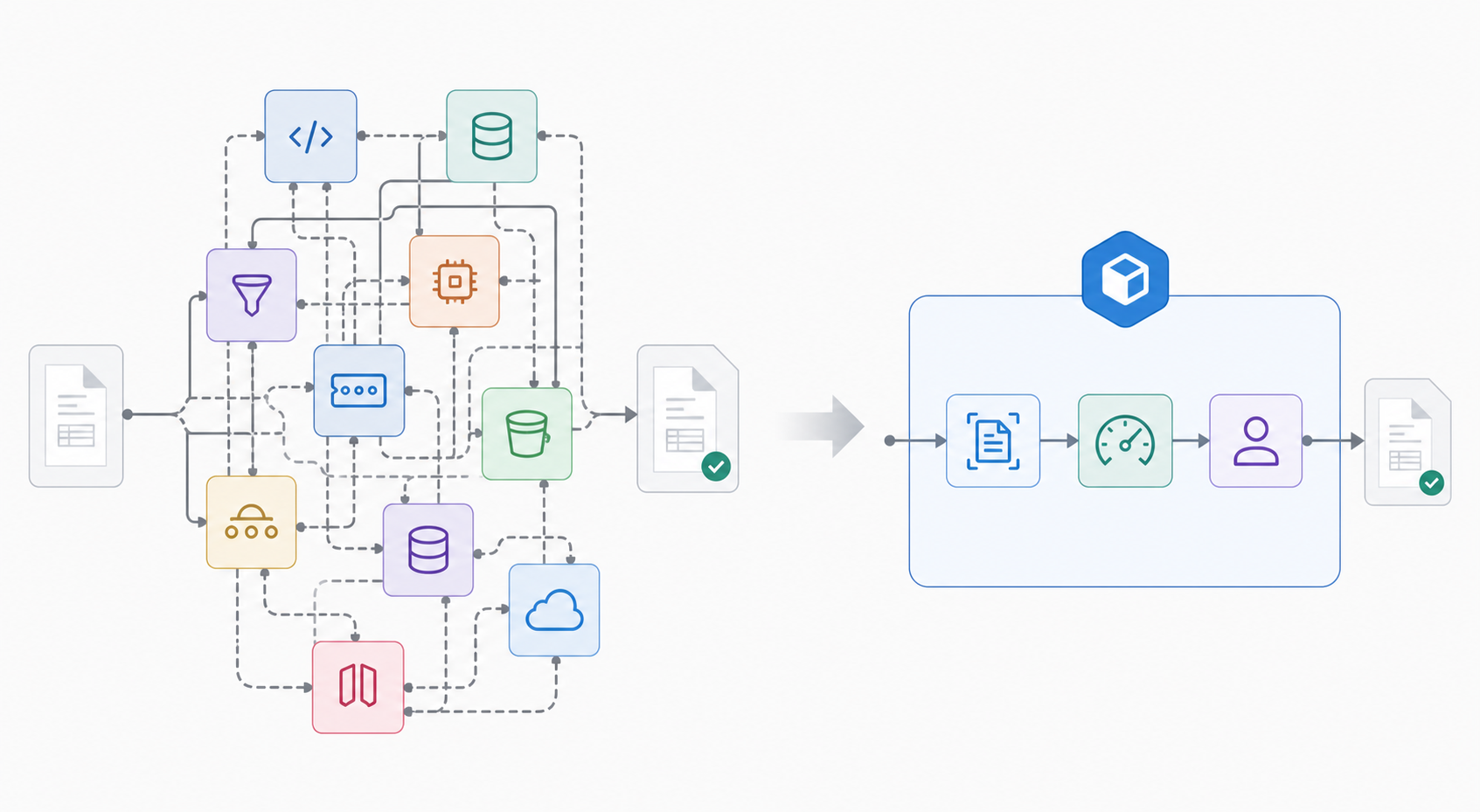
AWS Textract ships as a managed extraction service: teams send documents to the API, receive structured output, and own everything downstream. Field validation logic, confidence threshold routing, exception handling, multi-page document orchestration, and human review queues all require custom build work. For teams running high document volume across variable layouts, that pipeline grows quickly into a dedicated engineering investment.
Extend ships the full pipeline. OCR, VLMs, confidence scoring, human-in-the-loop review tooling, and ingestion infrastructure are included. Teams configure extraction schemas, set confidence thresholds, and route low-confidence fields to review without writing orchestration code. The implementation surface is the API and a configuration layer, not a distributed set of custom services.
Time to Production
Teams integrating Textract into a production document workflow typically spend weeks building the surrounding infrastructure before the first document clears end-to-end. Extend's REST API ships production-ready extraction in days. Brex reviewed every major vendor and selected Extend; HomeLight achieved 99% accuracy and eliminated manual review entirely after integration.
That gap compounds at scale. Each new document type added to a Textract pipeline may require validation updates, template adjustments, and regression testing. Extend's model-based extraction generalizes across layout variation without per-format maintenance.
Extraction Quality and Output Format
Extraction quality determines whether downstream systems receive data worth acting on. AWS Textract returns bounding-box coordinates, raw text blocks, and confidence scores at the character and word level, which is useful for structured forms but breaks down on semi-structured or handwritten content where field boundaries are ambiguous. Output arrives as JSON with positional metadata, so teams must write their own normalization layer before any downstream system can consume it.
Extend delivers structured JSON output through document extraction AI that LLMs and AI agents consume directly, with no intermediate cleaning or schema normalization required before agent handoff. OCR, specialized computer vision models, and VLMs work together to resolve field references across page boundaries, so a loan package or insurance submission that spans 40 pages doesn't produce fragmented output requiring reassembly. Parse 2.0, validated on RealDoc-Bench across 1,500 real-world samples, leads on layout accuracy with an Adjusted F1 of 0.847 and 95.7% document Q&A accuracy across 1,359 prompts. On OCR benchmarks for complex documents, Textract trails by a wide margin, scoring 0.709 Adjusted F1 on layout and 70.5% on document Q&A on the same benchmark.
Pricing and Total Cost of Ownership
Pricing structures for document processing tools reflect their underlying architecture. AWS Textract charges per page: $0.0015 per page for text detection, $0.05 per page for forms analysis, and $10 per 1,000 pages for expense or identity document processing. At scale, those per-page fees compound fast. A team processing 100,000 invoice pages monthly hits roughly $1,000 in Textract expenses alone, before factoring in the Lambda functions, S3 storage, SQS queues, and API Gateway costs required to build a functioning pipeline around it.
Extend pricing is usage-based and scales with document volume, without the hidden infrastructure tax. There are no separate charges for forms versus expenses versus identity docs. Teams pay for processing, not for assembling the surrounding architecture themselves.
Where Total Cost of Ownership Diverges
Per-page fees are only part of the picture. AWS Textract requires substantial engineering investment to reach production: custom post-processing logic, confidence threshold tuning, retry handling, and human review routing all require bespoke implementation. That engineering time translates directly into FTEs and calendar weeks.
Extend ships OCR, VLMs, confidence scoring, human-in-the-loop review, and ingestion pipelines as a single integrated toolkit. Teams skip the infrastructure assembly layer entirely, which is why customers typically ship production integrations in days instead of quarters. That reduction in time-to-production changes the total cost calculation more than any per-page rate comparison does.
Workflow Orchestration and Deployment Options
Extend ships agents that automate the full document processing lifecycle, from ingestion through extraction, validation, and downstream delivery. Teams configure extraction schemas, set confidence thresholds, and route low-confidence fields to human review without rebuilding pipeline logic each time a new document format appears. The human-in-the-loop layer integrates directly into the agent workflow, so reviewer corrections feed back into model performance over time.
AWS Textract sits earlier in the stack. It delivers raw OCR output and structured form data, but orchestration, routing, validation logic, and downstream integration are left to the team building on top of it. Teams running Textract in production typically build and maintain that document automation orchestration layer themselves.
For teams that need a managed, end-to-end document workflow, Extend's agent infrastructure reduces the engineering surface area. For teams that already have orchestration infrastructure and just need reliable OCR output, Textract fits that scoped role.
Final Thoughts on Extend vs AWS Textract
Textract fits AWS-native teams running clean, consistently formatted documents who are prepared to own schema mapping, review queues, and orchestration themselves. Per-page pricing on basic text detection and the familiar AWS procurement path are genuine advantages for that scoped use case.
Outside that narrow fit, the calculation changes fast. Teams processing variable-layout documents in healthcare, financial services, logistics, or real estate encounter complexity that Textract's page-scoped extraction model was not designed for. Parse 2.0 outperforms Textract by 25.2 percentage points on field-level accuracy on real-world documents, validated against 581 real-world documents across those verticals via the RealDoc-Bench benchmark. Structured JSON with confidence scores and source citations ships by default, with no normalization layer required before downstream systems consume it. Extend ships that same output as a single integrated toolkit alongside human-in-the-loop review and confidence scoring, so your team spends time on the use case, not the pipeline.
See the full Extend vs AWS Textract breakdown for a detailed side-by-side, or run a demo on your documents to see what production output looks like from day one.
FAQ
Should teams choose Extend or AWS Textract for processing variable-layout documents like loan packages or insurance submissions?
Teams processing variable-layout documents across healthcare, financial services, logistics, or real estate should use Extend. AWS Textract's page-scoped extraction model resets context per page, causing field mismatches on multi-page packages; Extend's document-scoped context graph resolves cross-page entity references without post-processing, and Parse 2.0 outperforms Textract by 25.2 percentage points on field-level accuracy across 581 real-world documents validated on RealDoc-Bench.
What is the core architectural difference between how Extend and AWS Textract handle multi-page documents?
Textract processes documents as page-scoped regions and returns raw Block objects that teams must normalize, map to schemas, and reassemble across pages with custom logic. Extend maintains a document-scoped context graph so fields referencing entities defined elsewhere in a package resolve correctly, delivering structured JSON that LLMs and AI agents consume directly with no intermediate cleaning required before agent handoff.
Who is AWS Textract best suited for, and where does Extend fit better?
Textract fits AWS-native teams running clean, consistently formatted documents who already have orchestration infrastructure and want scoped OCR output they own end-to-end. Extend fits teams that process complex, variable-layout documents at scale and cannot absorb the engineering cost of building custom validation logic, confidence threshold routing, review queues, and orchestration pipelines on top of raw extraction output.
How much engineering work does a production Textract pipeline require compared to integrating Extend?
A production Textract pipeline requires custom build work for field validation logic, confidence routing, exception handling, multi-page orchestration, and human review queues, typically weeks of engineering before the first document clears end-to-end. Extend ships OCR, VLMs, confidence scoring, human-in-the-loop review tooling, and ingestion pipelines as a single integrated toolkit; teams configure extraction schemas and set confidence thresholds through the API and a configuration layer instead of assembling a distributed set of custom services.
How does Extend's pricing differ from AWS Textract's per-page model in practice?
AWS Textract charges $0.0015 to $0.05 per page depending on document type, which compounds to roughly $1,000 monthly for 100,000 invoice pages before factoring in Lambda, S3, SQS, and API Gateway costs required to build a functioning pipeline around it. Extend's usage-based pricing scales with document volume without separate charges by document category, and teams skip the infrastructure assembly layer entirely, reducing total cost of ownership beyond what any per-page rate comparison captures.