Your quality control process for document extraction probably looks like this: AI pulls data, someone reviews flagged results, corrections get applied, and then nothing changes. Next week you're reviewing the same error types because your system isn't learning from feedback.
The platforms worth using treat human review as a training signal, not just a quality gate. They score confidence at the field level so you're only reviewing what actually needs attention, make corrections fast with good UI, and automatically improve extraction accuracy as your team validates more documents. We tested the solutions that actually deliver this feedback loop in production.
TLDR:
- HITL combines AI automation with manual review to maintain 95%+ accuracy on mission-critical documents.
- Confidence scoring routes high-confidence extractions straight through while flagging edge cases for human validation.
- Continuous learning systems feed corrections back into model training to reduce manual review over time.
- Extend delivers integrated review UI, automated confidence scoring, and agentic optimization that learns from feedback.
- Extend is the complete document processing toolkit with the most accurate parsing, extraction, and splitting APIs.
What is Human-in-the-Loop Document Processing?
Human-in-the-loop document processing combines AI automation with manual review to ensure extraction accuracy. The concept is straightforward: AI models handle the initial document parsing and data extraction, while humans validate, correct, or approve outputs before they enter downstream systems.
This approach matters because even the best AI models can struggle with edge cases like poor scan quality, handwritten notes, or unusual document layouts. For mission-critical workflows in finance, healthcare, or legal operations, a single extraction error can trigger compliance issues or costly mistakes.
HITL workflows typically route documents based on confidence scores. High-confidence extractions flow straight through to automation, while low-confidence or flagged results get queued for human review. This selective escalation maintains speed and scale while preserving accuracy where it matters most.
The goal isn't to replace human judgment entirely. Instead, HITL creates a feedback loop where human corrections improve the AI over time, gradually reducing manual intervention as the system learns from validated outputs. HITL systems boost accuracy from ~80% to 95%+ by combining automation with human oversight, while reducing document processing costs by up to 70%.
How We Ranked Human-in-the-Loop Document Processing Solutions
We evaluated each solution across five criteria that directly impact HITL effectiveness in production environments.
Accuracy and Automation Rates
Accuracy and automation rates determine how much work actually gets automated. Solutions that achieve 95%+ extraction accuracy with 80%+ straight-through processing rates minimize manual review burden. Document processing automation rates vary widely across vendors, making this a critical differentiator.
Review Workflow Capabilities
These capabilities define how efficiently teams can validate flagged documents. The best solutions offer intuitive interfaces where reviewers can quickly spot and correct errors without context switching. Queue management, priority routing, and bulk actions all affect reviewer throughput.
Confidence Scoring Mechanisms
Confidence scoring mechanisms determine which documents require human attention. Granular field-level confidence scores enable smarter routing than binary pass-fail thresholds. Solutions that calibrate confidence accurately reduce both false positives and missed errors.
Continuous Learning from Corrections
This separates static systems from adaptive ones. Solutions that feed validated outputs back into model training improve over time, gradually reducing manual review volumes as the system learns from real production data.
Integration Flexibility
Integration flexibility matters for downstream automation. APIs, webhooks, and pre-built connectors determine how easily extracted data flows into your existing systems without manual data entry or file transfers.
Best Overall Human-in-the-Loop Document Processing Solution: Extend
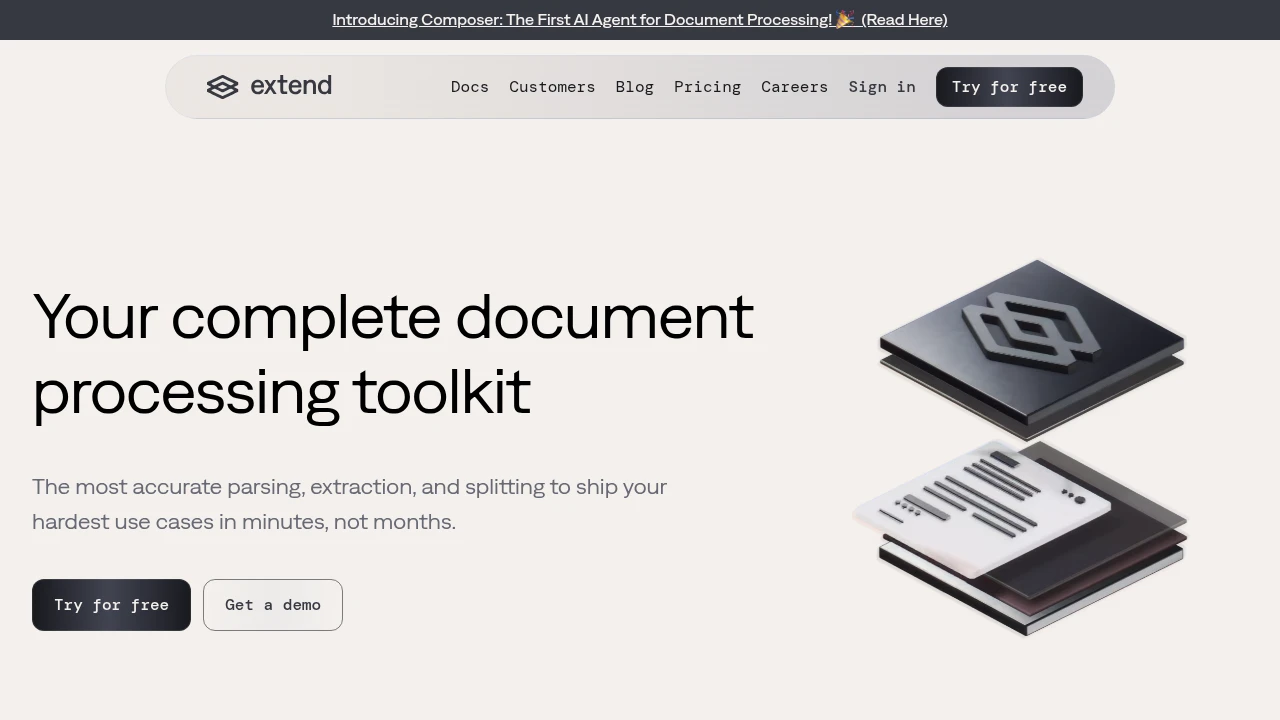
Extend is the complete document processing toolkit comprised of the most accurate parsing, extraction, and splitting APIs to ship your hardest use cases in minutes, not months. Extend's suite of models, infrastructure, and tooling is the most powerful custom document solution, without any of the overhead.
Key Features:
- Built-in Review UI for inspecting, correcting, and approving results with human-in-the-loop workflows.
- Confidence scoring and Review Agent that automatically flags low-confidence outputs for human validation before delivery.
- Continuous improvement loops where corrections feed directly into evaluation sets for ongoing model refinement
- Comprehensive evaluation framework with automated accuracy reports at field and document levels.
- Agentic orchestration with conditional routing based on confidence thresholds and validation signals.
Bottom Line:
Extend delivers the most complete human-in-the-loop solution by combining automated confidence scoring, integrated review interfaces, and agentic optimization that continuously learns from human feedback to maintain production-grade accuracy at scale.
Rossum
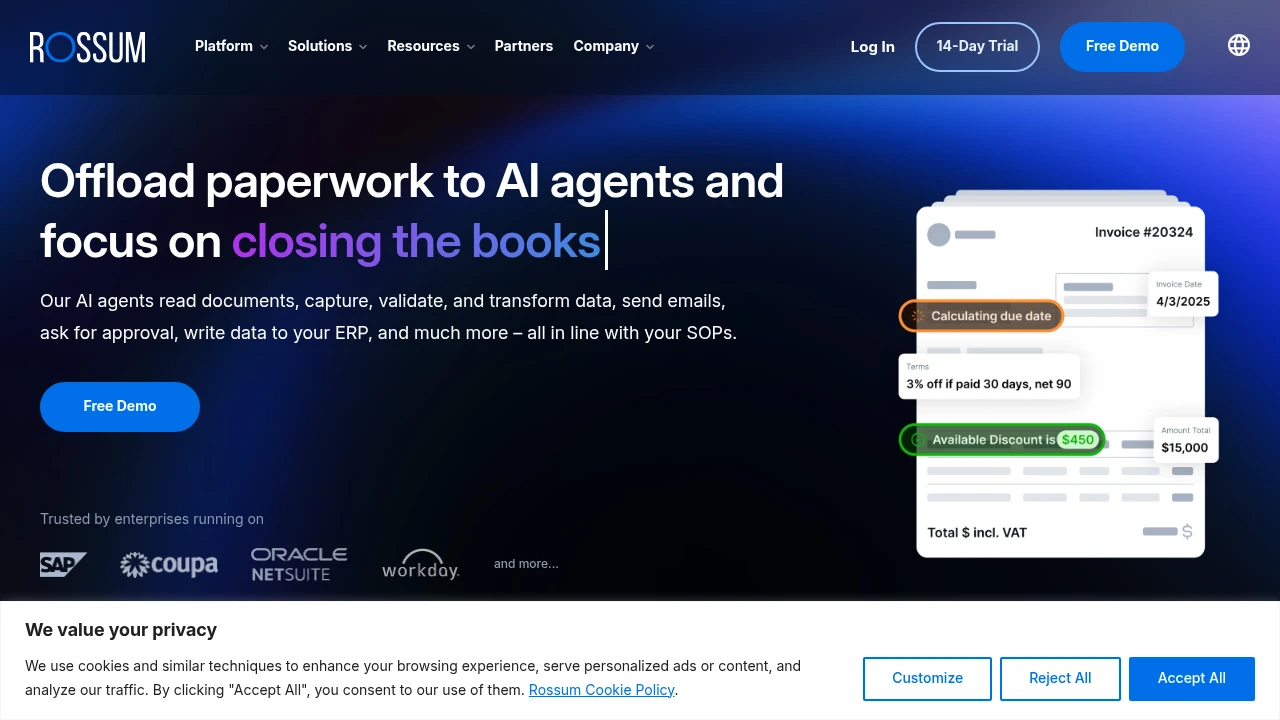
Rossum focuses on transactional document automation with AI-powered extraction and validation workflows for invoices, purchase orders, and similar business documents.
Key Features:
- AI-powered data extraction with validation interface for reviewing and correcting extracted data.
- Automatic learning capabilities that improve from user interactions and feedback corrections.
- Document workflow reporting to track processing metrics and team performance.
- Cloud-based deployment with integration to ERP systems like SAP, NetSuite, and Workday.
Limitations:
The main limitation is the lack of dedicated evaluation frameworks or version control for schemas. Teams must test changes directly in production without systematic regression testing capabilities, increasing risk when updating extraction logic.
Bottom Line:
Rossum handles transactional document validation workflows effectively, but Extend provides broader document processing capabilities with systematic evaluation, schema versioning, and agentic optimization for teams that need to maintain accuracy across diverse document types.
Pulse

Pulse provides a document extraction service focused on converting documents into markdown or HTML with optional structured JSON extraction via schemas.
Key Features:
- Schema-based extraction with structured JSON output for defined data models.
- Async job processing with webhook configuration for production workloads.
- Bounding box coordinates for extracted data with citation support.
- Multilingual OCR and extraction capabilities across various document formats.
Limitations:
The limitation is the absence of workflow orchestration, evaluation sets, schema versioning, or human review interfaces. Teams must build their own state management and quality assurance systems separately.
Bottom Line:
Pulse delivers extraction as a service, but Extend provides the complete infrastructure including workflow orchestration, versioned schemas, evaluation frameworks, and integrated review UI that production document pipelines require.
Reducto
Reducto offers OCR and document extraction APIs focused on parsing documents into structured data outputs.
Key Features:
- OCR-based text extraction from PDFs and images with layout recognition.
- Schema extraction capabilities for pulling structured data from documents.
- Cloud deployment with API access for integration into applications.
- Support for various document formats and multilingual content.
Limitations:
The limitation is providing only one processing mode without cost-optimized or fast extraction options, no evaluation capabilities or schema versioning, no agentic features, and minimal audit logs or version history.
Bottom Line:
Reducto handles straightforward extraction needs, but Extend offers multiple performance tiers, comprehensive evaluation tools, schema lifecycle management, and agentic optimization for teams building production-grade document workflows.
ABBYY FlexiCapture

ABBYY FlexiCapture is an enterprise document capture and data extraction software designed for processing structured and semi-structured documents at scale.
Key Features:
- Machine learning-enhanced OCR with layout-aware text extraction capabilities.
- Template-based field extraction with point-and-click configuration interfaces.
- Distributed processing architecture for high-volume enterprise deployments.
- Integration with business process management and RPA systems.
Limitations:
The limitation is extensive template configuration and training required for each document type, with setup typically extending to weeks or months, and no native schema versioning or automated optimization agents.
Bottom Line:
ABBYY FlexiCapture serves enterprise template-based workflows, but Extend eliminates template dependencies with AI-powered understanding that achieves production accuracy within days and includes automated optimization without ongoing maintenance.
Hyperscience
Hyperscience provides document automation software focused on machine learning-based extraction with validation workflows for structured documents.
Key Features:
- Machine learning models for document classification and data extraction.
- Human-in-the-loop validation interface for reviewing uncertain extractions.
- Low-code workflow builder with blocks for document processing tasks.
- Integration capabilities with enterprise systems including ERP and CRM.
Limitations:
The limitation is requiring significant training and tuning to reach target accuracy levels, with deployments often taking months for complex document types, and needing ongoing expert configuration despite low-code features.
Bottom Line:
Hyperscience handles form-based workflows after extensive setup, but Extend delivers production-ready accuracy within days using AI-powered document understanding with automated schema optimization that eliminates lengthy training cycles.
Feature Comparison Table of Human-in-the-Loop Document Processing Solutions
| Solution | Integrated Review UI | Confidence Scoring | Evaluation Framework | Schema Versioning | Workflow Orchestration |
|---|---|---|---|---|---|
| Extend | Yes | Yes | Yes | Yes | Yes |
| Rossum | Yes | Yes | No | No | Yes |
| Pulse | No | No | No | No | No |
| Reducto | No | No | No | No | No |
| ABBYY FlexiCapture | Yes | Yes | No | No | Yes |
| Hyperscience | Yes | Yes | No | No | Yes |
Extend provides the only complete human-in-the-loop infrastructure with integrated evaluation, versioning, and agentic optimization. Most alternatives offer basic review interfaces but lack systematic quality control or automated improvement capabilities that production workflows require.
Why Extend is the Best Human-in-the-Loop Document Processing Solution
Extend delivers the most complete human-in-the-loop infrastructure by integrating three capabilities that other solutions treat as separate concerns: automated confidence scoring, production-ready review interfaces, and continuous optimization from feedback.
The Review Agent automatically flags low-confidence extractions for validation, surfacing updates to team members, and eliminating manual triage work. Composer then incorporates corrections directly into schema optimization experiments, improving accuracy without manual prompt engineering. The evaluation framework quantifies these improvements across your actual document corpus, not synthetic test sets.
This integrated approach means you ship production-grade accuracy faster while maintaining it with less ongoing effort. As document variations emerge or requirements change, Extend adapts through the same feedback loops rather than requiring new templates or retraining cycles.
Final Thoughts on Implementing Quality Control for Document Automation
Effective quality control in document processing means catching errors before they reach downstream systems while keeping throughput high. Solutions that combine automated confidence scoring with integrated review interfaces let you validate only what needs attention. Extend's approach goes further by turning every correction into a training signal that improves future extractions. You get accuracy that compounds over time without building custom feedback loops or evaluation infrastructure yourself.
FAQ
How do I choose the right human-in-the-loop solution for my document processing needs?
Start by evaluating your accuracy requirements and document complexity—if you need 95%+ extraction accuracy on varied document types with minimal setup time, prioritize solutions with automated optimization and evaluation frameworks. For standardized forms with predictable layouts, template-based systems may suffice, but complex documents with handwriting or irregular layouts require AI-powered understanding with confidence scoring and integrated review workflows.
Which human-in-the-loop platform works best for teams without dedicated ML engineers?
Solutions with automated schema optimization and built-in evaluation frameworks work best for teams without ML expertise, as they eliminate manual prompt tuning and model training cycles. Platforms that provide integrated review interfaces with confidence-based routing let domain experts validate outputs without requiring technical configuration, while agentic systems that learn from corrections improve accuracy automatically without ongoing engineering effort.
Can I reduce manual review volumes over time with human-in-the-loop systems?
Yes, but only if the solution feeds corrections back into model training through continuous learning loops. Systems with automated optimization agents and evaluation frameworks progressively improve accuracy as they learn from validated outputs, gradually increasing straight-through processing rates from 80% to 95%+ over time and reducing the volume of documents requiring human review.
What's the difference between confidence scoring and evaluation frameworks in HITL workflows?
Confidence scoring determines which individual documents get routed to human review in real-time based on extraction certainty, while evaluation frameworks systematically measure accuracy across your entire document corpus to quantify model performance. Confidence scoring drives operational routing decisions, whereas evaluation frameworks validate that your system maintains target accuracy levels and quantify improvements from schema changes or model updates.
When should I consider switching from template-based document processing to AI-powered extraction?
Switch when you're spending weeks configuring templates for each document variant, when new document layouts break existing templates frequently, or when you need to process documents with variable structures that don't fit rigid templates. AI-powered extraction eliminates template maintenance overhead and handles layout variations automatically, reducing deployment time from months to days for complex document types.