Biomarker extraction from NGS reports fails the moment a lab vendor changes a column header: regex pipelines misclassify TMB scores and MSI status fields, and template matchers reset entirely on the first unfamiliar layout. The reason is architectural, not incidental; Foundation Medicine, Tempus, and Guardant each structure variant tables differently across report versions, so tools built on the assumption of a fixed layout hit a wall before reaching production volume. For oncology teams processing hundreds of reports weekly, that failure compounds into manual review queues that grow faster than any team can clear them, which is why NGS report extraction tools are ranked here on whether they actually hold at that volume and format variability.
Flatiron Health used Extend to scale NGS report extraction across its network of more than 5 million patients, replicating six months of in-house work in two weeks before expanding the pipeline to process 100M+ pages. That production result is a useful benchmark for evaluating whether an extraction tool can handle real-world report variation rather than a curated test set.
TLDR:
- Regex extractors misclassify TMB scores and MSI status fields when lab vendors update report layouts; model-based extraction handles format variation without rebuilding field mappings per vendor
- NGS reports from Foundation Medicine, Tempus, and Guardant each structure biomarker tables differently, so template-based pipelines reset on the first unseen layout and send jobs back to manual review queues
- AWS Textract, Google Document AI, and Azure AI Document Intelligence all require custom training or post-processing scripts to handle multi-gene tables and vendor format variation
- Misclassified variant pathogenicity delays clinical trial matching by days and leaves molecular tumor boards running on incomplete data, which is why confidence scoring with human-in-the-loop routing is a hard architectural requirement
- Extend combines OCR, specialized computer vision models, and VLMs to resolve cross-page variant table references and deliver validated JSON to downstream trial matching engines and EHR pipelines without intermediate schema normalization
What Are NGS Report Extraction Tools?
NGS reports pack variant calls, coverage metrics, fusion events, and quality scores into formats that vary by sequencer manufacturer, pipeline version, and lab configuration. Understanding how to read an NGS report makes the extraction challenge concrete. Regex-based extractors misclassify fields when column headers shift between report versions; template matchers reset entirely when a new assay panel introduces an unfamiliar layout.
NGS report document extraction AI tools parse these outputs and return structured, LLM-ready data that downstream systems consume directly. The extraction target is specific: allele frequencies, gene-biomarker pairings, TMB scores, MSI status, and copy number variants pulled from PDFs, structured text reports, and semi-structured lab exports.
At scale, the failure mode is systematic. A team processing hundreds of oncology reports weekly accumulates misclassified biomarker fields faster than any review queue clears them, which is why the architectural choice between template-based and model-based extraction determines whether the pipeline holds at volume.
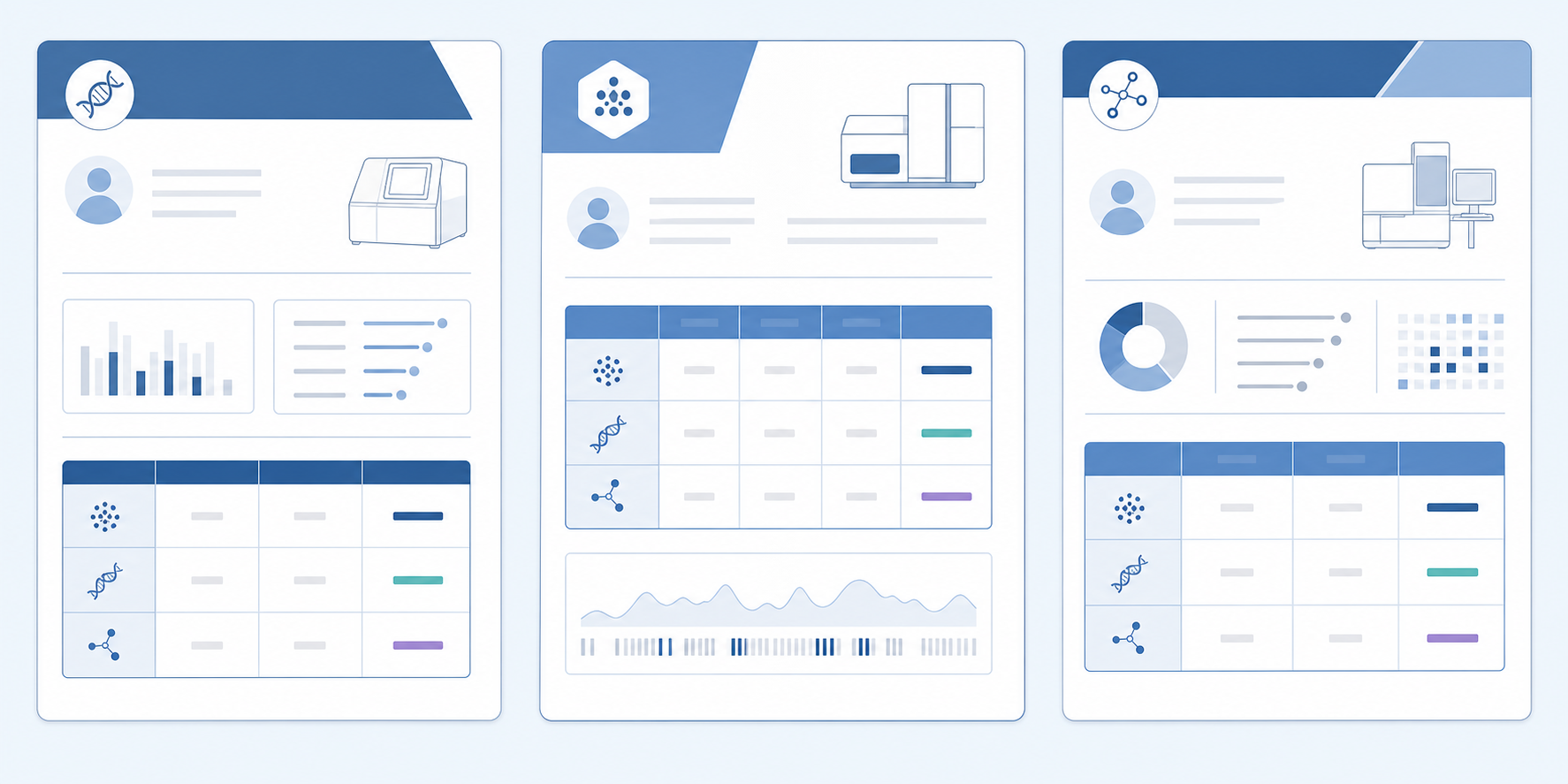
Why NGS Report Extraction Matters for Life Sciences Teams
NGS reports arriving from sequencing labs rarely follow a single format, and that variability compounds into a clinical bottleneck: oncology teams wait on manual biomarker abstraction before treatment decisions get made, clinical trial matching is delayed by days, and molecular tumor boards run on incomplete data.
Life sciences teams processing high NGS report volumes need intelligent document processing that handles layout variability without rebuilding field mappings on every format change.
How These Tools Were Ranked
The tools ranked here were assessed on criteria built to test for where these failures occur in production genomics workflows.
Evaluation Criteria
- Accuracy on variable-format reports: performance on multi-page outputs from Foundation Medicine, Tempus, and Guardant, where biomarker tables, variant annotations, and therapy associations appear in structurally inconsistent positions across report versions.
- Template independence: the ability to extract structured fields from dense clinical layouts without requiring a new template per lab vendor or report revision.
- Integration surface: whether the tool ships REST APIs, SDKs, or workflow connectors that fit into existing LIMS and bioinformatics pipelines without months of custom build work.
- Confidence scoring and human review: human-in-the-loop review support for fields where extraction uncertainty is high, since misclassified variant pathogenicity or incorrect MSI status has direct downstream consequences.
- Throughput at scale: oncology teams processing hundreds of patient reports weekly need extraction that keeps pace with ingestion volume, not batch jobs that bottleneck triage.
Best Overall NGS Report Extraction Tool: Extend
The architectural gap behind every misclassified biomarker field is the same: template and regex-based tools assume document structure stays constant, and NGS reports from Foundation Medicine, Tempus, and Caris never hold still long enough to prove that assumption right. Extend ranks first because it extracts TMB scores, MSI status, variant allele frequencies, and co-mutation panels from non-standardized layouts spanning dozens of pages without pre-built templates, delivering structured JSON that downstream trial matching engines and clinical decision systems consume directly. Extend's Composer agent automatically optimizes extraction schemas against production data, so teams don't hand-tune field mappings every time a lab vendor updates a report layout.
AWS Textract
AWS Textract handles OCR, key-value form extraction, and table parsing across synchronous and asynchronous processing modes, with native integration across S3, Lambda, and SQS. It carries HIPAA eligibility and SOC compliance, making it a workable foundation for teams already operating AWS-native infrastructure on standardized healthcare document types. The structural gap for NGS workflows is architectural: Textract ships no specialized processor for genomics reports, no agentic schema optimization for new vendor formats, and no built-in confidence scoring pipeline for routing low-quality extractions to human review. Teams processing multi-vendor NGS outputs at scale end up writing and maintaining substantial custom logic around Textract before reaching production-grade agentic document extraction accuracy, which largely defeats the purpose of using managed extraction infrastructure in the first place. See Extend vs AWS Textract for a detailed architectural comparison.
Google Document AI
Google Document AI handles structured and semi-structured document types reasonably well within Google Cloud environments, with pre-trained processors covering invoices, receipts, and identity documents without custom model configuration; teams already running GCP workloads get straightforward integration and get the most value treating it as general-purpose document infrastructure, not as a purpose-built biomarker extraction layer. The processors train on general document categories, which is why genomic report layouts, biomarker tables, variant classification fields, and clinical annotation structures fall outside that training distribution: teams processing sequencing output from Illumina, Foundation Medicine, or Tempus reports hit field misclassification and missed extractions before reaching meaningful volume. Custom processors exist, but building one for NGS-specific extraction requires labeled training data, model iteration cycles, and ongoing maintenance as report formats evolve (see vision AI document processing tools for how complex layouts are handled differently across platforms), and that overhead lands on engineering teams, not on Google.
Azure AI Document Intelligence
Azure AI Document Intelligence handles structured form extraction well across Microsoft-native environments, with tight integration into existing Azure infrastructure that reduces setup overhead for standard form types like invoices and receipts; teams already committed to Azure who need extraction on moderate-complexity documents get the most from it. The extraction model performs reliably on documents with predictable layouts, but accuracy degrades and template maintenance increases as layout variability rises, which is why NGS reports break the model: biomarker tables shift position across lab vendors, multi-page genomic summaries carry variable-position fields and handwritten annotations, and the tool's layout-dependent extraction model requires substantial custom model training to handle field drift across formats. Maintenance costs for teams building extraction pipelines on high-variability clinical documents scale with document format diversity, beyond document volume alone.
Feature Comparison Table of NGS Report Extraction Tools
| Feature | Extend | AWS Textract | Google Document AI | Azure AI Document Intelligence |
|---|---|---|---|---|
| Pre-built NGS Report Support | Yes | No | No | No |
| Multi-Gene Table Extraction | Yes | Partial, requires custom post-processing | Partial, requires custom processor | Partial, requires custom model training |
| Handles Varying Vendor Formats Without Retraining | Yes | No | No | No |
| Confidence Scoring + Human Review Routing | Yes | No | No | No |
| Agentic Schema Optimization | Yes | No | No | No |
| 1,000+ Page Document Support | Yes | No | No | No |
| HIPAA Compliance | Yes | Yes | Yes | Yes |
| End-to-End Extraction and Validation Pipeline | Yes | No | Partial, extraction only | Partial, extraction only |
| Self-Hosted Deployment Option | Yes | No | No | No |
The gaps above show up most sharply in two areas: format handling and pipeline completeness. AWS Textract, Google Document AI, and Azure AI Document Intelligence each require custom training, post-processing scripts, or additional model configuration to handle multi-gene tables and vendor format variation. That means engineering overhead accumulates every time a new lab report layout shows up in production. Extend handles format variation without retraining, and ships the full extraction and validation pipeline, including document processing confidence scores with human review routing that general-purpose tools omit, so downstream clinical decision systems receive validated, structured output, not raw text that still requires schema normalization before it is usable.
Why Extend Is the Best NGS Report Extraction Tool
NGS reports from Foundation Medicine, Tempus, and Guardant Health arrive in formats that resist automation, and that structural inconsistency is exactly what breaks template-based and regex extractors, which is the layer Extend was built to resolve.
How Extend Handles NGS Report Structure
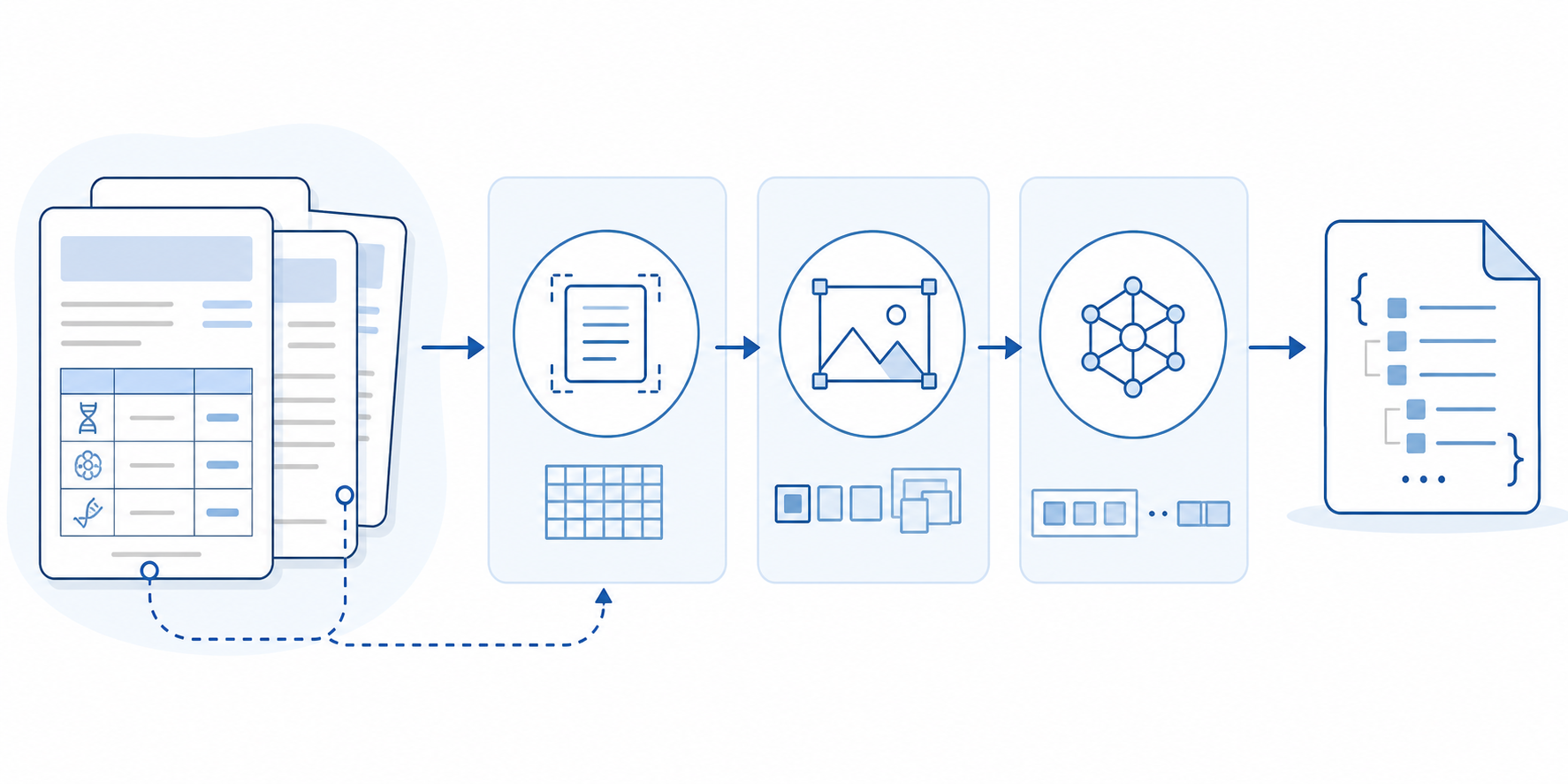
NGS reports are structurally heterogeneous. A FoundationOne CDx report organizes TMB scores and MSI status differently than a Tempus xT report presenting the same biomarkers. Extend combines OCR, specialized computer vision models, and VLMs to resolve field locations across variable layouts, maintaining document-scoped context so cross-page variant tables map to the correct gene, transcript, and alteration type without per-page context resets.
Extraction outputs from the Parse API for AI document agents arrive as validated JSON consumed directly by downstream trial matching engines, EHR ingestion pipelines, and LLM reasoning layers. No intermediate schema normalization or field remapping is required before agent handoff.
Extend is the complete document processing toolkit comprised of the most accurate parsing, extraction, and splitting APIs to ship your hardest use cases in minutes, not months. Extend's suite of models, infrastructure, and tooling is the most powerful custom document solution, without any of the overhead. Agents automate the entire lifecycle of document processing, allowing your engineering teams to process your most complex documents and optimize performance at scale.
Parse 2.0 Accuracy on Complex Documents
Parse 2.0, Extend's core parsing engine, leads on layout accuracy with an 0.847 Adjusted F1 score across 1,500 real-world documents and 95.7% document Q&A accuracy across 1,359 prompts spanning 581 documents, validated on the RealDoc-Bench benchmark covering healthcare, financial services, logistics, and real estate. For life sciences teams processing high-complexity NGS reports at volume, that accuracy delta compounds: as an illustrative example, at 10,000 reports monthly, even a 2% misclassification rate would generate 200 records requiring manual adjudication per cycle.
Human-in-the-loop review routes low-confidence extractions to annotators without interrupting the primary pipeline, and correction patterns feed back into model behavior so accuracy improves as report volume grows.
Final Thoughts on NGS Report Extraction Tools
Template-based extractors reset on the first unseen format, and general-purpose tools offload the NGS-specific training burden to your team. That maintenance cost compounds with every new lab vendor and panel version your pipeline encounters. Extend's model-based approach handles layout variability without retraining, and the validated JSON output drops directly into your downstream LLM and clinical decision layers. See how Extend fits your extraction pipeline.
FAQ
How do teams choose between Extend, AWS Textract, Google Document AI, and Azure AI Document Intelligence for NGS report extraction?
The decision turns on format variability and pipeline completeness. AWS Textract, Google Document AI, and Azure AI Document Intelligence require custom model training or post-processing scripts to handle multi-vendor NGS layouts, meaning engineering overhead scales with every new lab format. Extend handles format variation without retraining and ships the full extraction and validation pipeline, so downstream clinical decision systems receive validated JSON, not raw text requiring schema normalization before use.
When does template-based NGS extraction break down in production genomics workflows?
Template-based extractors reset on the first unseen layout. When a lab vendor updates their report format, changes column headers, or introduces a new assay panel, the extraction job returns to manual review. Teams processing hundreds of oncology reports weekly accumulate misclassified biomarker fields faster than any review queue clears them, which is why the architectural choice between template-based and model-based extraction determines whether the pipeline holds at volume.
How does Extend handle biomarker extraction across multi-page NGS reports from different vendors?
Extend combines OCR, specialized computer vision models, and VLMs to resolve field locations across variable layouts, maintaining document-scoped context so cross-page variant tables map to the correct gene, transcript, and alteration type without per-page context resets. Extraction outputs arrive as validated JSON consumed directly by downstream trial matching engines, EHR ingestion pipelines, and LLM reasoning layers, with no intermediate schema normalization required before agent handoff.
What accuracy benchmarks validate Extend's parsing performance on complex clinical documents?
Parse 2.0, Extend's core parsing engine, achieves an 0.847 Adjusted F1 score across 1,500 real-world documents and 95.7% document Q&A accuracy across 1,359 prompts spanning 581 documents on the RealDoc-Bench benchmark, validated across healthcare, financial services, logistics, and real estate document types.
How does confidence scoring work in Extend's NGS extraction pipeline for routing low-quality extractions?
Extend's confidence scoring system takes a multi-pass review over every extraction output, flagging potential errors before they reach downstream systems. Low-confidence extractions, such as ambiguous MSI status fields or variant pathogenicity calls where multiple document values could match a schema field, route automatically to human review without interrupting the primary pipeline, and correction patterns feed back into model behavior so accuracy improves as report volume grows.