If you're processing complex document layouts at scale, you've probably noticed that basic OCR breaks on the documents that matter most. Multi-page tables where headers change structure partway through. Forms with handwritten annotations overlaying printed fields. Contracts where redlines need to be distinguished from valid text. The challenge isn't just extraction accuracy in demos but having the infrastructure to iterate safely, measure improvements, and handle schema drift as templates evolve. Some platforms give you models and APIs, then leave you to build evaluation, versioning, and workflow orchestration yourself. Others integrate those capabilities from the start. Let's compare what you actually get with six solutions.
TLDR:
- Vision AI interprets document layouts spatially, handling multi-page tables and nested forms that break traditional OCR
- Extend achieves production-ready accuracy in minutes through Composer agent's automated schema optimization and learns from different document types with Memory
- Extend automates HITL feedback with Review Agent
- Most solutions lack evaluation suites and versioning, forcing teams to build quality infrastructure themselves
- Extend combines custom VLMs, agentic optimization, and workflow orchestration in a single platform
- Extend processes complex edge cases like handwriting over printed text and irregular layouts at 95-99%+ accuracy
What is Vision AI for Document Processing?
Vision AI for document processing uses computer vision models to interpret the spatial and structural elements of documents, not just the text. Where traditional OCR reads characters sequentially, vision AI understands how content is arranged: tables spanning multiple pages, nested forms, redlined sections, handwritten annotations overlaying printed text.
This matters for complex layouts because text alone doesn't capture meaning. A table cell's value depends on its position relative to headers. A form field's label might be positioned above, beside, or inside its input box. Vision AI analyzes these spatial relationships to extract data correctly. Research on AI-driven IDP platforms shows these systems achieve up to 10× faster data extraction while maintaining 99.9% accuracy across various document formats.
Multimodal document processing combines vision AI with LLMs to handle both visual structure and semantic context. The vision component identifies where elements are and how they relate spatially. The language component interprets what those elements mean and how they connect logically across pages.
How We Evaluated Vision AI Document Processing Solutions
When evaluating vision AI document processing solutions, teams need to assess several critical capabilities based on publicly available documentation and performance benchmarks.
Layout understanding is the foundation. Can the solution accurately interpret multi-column layouts, nested tables, form structures with varying field arrangements, and documents where spatial positioning determines meaning? Research on AI document processing shows this capability separates basic OCR from true vision AI.
Accuracy on real-world edge cases matters more than benchmark scores. Look for how solutions handle handwritten annotations on printed forms, poor quality scans with shadows or warping, redlined or crossed-out text, and tables that span multiple pages with changing header structures.
Schema flexibility determines deployment speed. Some intelligent document processing tools require rigid templates for each document variant, while others adapt to new layouts without retraining. The ability to define custom extraction schemas and iterate quickly separates solutions built for production from research prototypes.
Integration depth affects long-term viability. API design, SDK availability, webhook support, and workflow orchestration capabilities determine how easily a solution fits into existing document pipelines.
Human review tooling is often overlooked during evaluation but becomes critical at scale. Solutions that provide confidence scoring, field-level citations, and built-in review interfaces reduce the operational burden of quality control.
Best Overall Vision AI Document Processing: Extend
Extend is the complete document processing toolkit comprised of the most accurate parsing, extraction, and splitting APIs to ship the hardest use cases in minutes, not months. Extend's suite of models, infrastructure, and tooling is the most powerful custom document solution, without any of the overhead.
Key Features:
- Spatial relationship understanding for multi-page table extraction
- Layout-aware field detection for irregular form structures
- Visual confidence scoring with bounding box precision
- Multimodal edge case handling with specialized routing
- Vision-first schema optimization for layout drift
Bottom Line:
While other solutions provide extraction APIs and leave teams to build quality infrastructure, Extend integrates evaluation frameworks, versioning systems, and agentic optimization from day one—treating them as core capabilities rather than optional extras. Extend is purpose-built for teams shipping mission-critical workflows where accuracy and iteration speed are non-negotiable. The combination of custom VLMs, agentic optimization, evaluation infrastructure, and workflow orchestration delivers what competitors can't: production-grade document processing that ships in days and improves continuously without engineering overhead.
Reducto
Reducto is an AI document intelligence solution that combines traditional OCR with vision-language models to handle complex document layouts. Built by MIT researchers, Reducto's architecture processes over 1 billion documents through a hybrid pipeline that routes content through specialized models based on document characteristics.
Key Features:
- Agentic OCR using a multi-pass self-correction framework for complex scans and handwritten notes
- Accurate bounding boxes and segmented layout types for each block including headers, tables, text, and figures
- Hybrid pipeline processing over 1 billion documents by combining specialized vision-language models, traditional OCR, and layout detection models
- Vision-first parsing that treats documents as visual objects with contextual meaning
Limitations:
Reducto lacks a native versioning system for safely making and deploying schema changes in production, forcing risky updates directly to live systems. No evaluation capabilities or framework for measuring accuracy improvements over time exists.
Bottom Line:
Reducto delivers strong parsing accuracy for document-to-text workflows, particularly on complex layouts with mixed content types. However, teams building production pipelines that require safe iteration, continuous quality measurement, and automated optimization will find Extend provides the necessary infrastructure and tooling that Reducto treats as external concerns rather than core capabilities.
Pulse
Pulse converts complex information into LLM-ready inputs supporting all document formats from PDFs to Word and Excel, integrating with existing data pipelines.
Key Features:
- Vision language models and OCR techniques achieve strong performance on documents and spreadsheets
- Accurate bounding boxes with precise OCR on tables and graphs
- Multiple output formats including markdown, HTML, and optional structured JSON via schemas
- Both synchronous and asynchronous extraction endpoints with webhook support for job completion
Limitations:
Single processing mode for parsing, extraction, and splitting regardless of use case requirements—no low-latency or cost-optimized modes exist, meaning teams either over-pay for low-value documents or under-serve real-time workflows. No built-in evaluation suite or regression testing capabilities for measuring accuracy improvements over time. Lacks schema versioning system for safely deploying changes to production schemas. No agentic optimization or automated schema tuning—teams must manually iterate through prompt engineering and configuration testing. Limited workflow orchestration capabilities for building end-to-end document processing pipelines.
Bottom Line:
Pulse provides solid extraction APIs for teams comfortable building their own quality infrastructure and optimization workflows. However, organizations processing mission-critical documents that require continuous accuracy measurement, safe schema iteration, and automated optimization will find Extend's integrated evaluation suite, versioning system, and Composer agent deliver production-ready results in minutes rather than weeks of manual tuning.
AWS Textract
AWS Textract is a machine learning service that automatically extracts text, handwriting, layout elements, and data from scanned documents, going beyond simple OCR to identify contents of fields in forms and information stored in tables.
Key Features:
- Layout feature that automatically extracts layout elements such as paragraphs, titles, subtitles, headers, and footers from documents
- Table extraction including cells, merged cells, column headers, titles, section titles, footers, and table type classification
- Queries feature pre-trained on paystubs, bank statements, W-2s, loan applications, and insurance cards
- Managed service with synchronous and asynchronous processing modes integrated with S3, SNS, SQS, and Lambda
Limitations:
Layout analysis operates separately from extraction, requiring custom post-processing to connect visual structure with semantic understanding. No agentic capabilities for schema optimization or automated accuracy improvement exist.
Bottom Line:
AWS Textract delivers reliable extraction for AWS-centric architectures processing common document types, but teams requiring advanced layout understanding for complex documents and agentic optimization will need additional layers that Extend provides natively.
Google Document AI
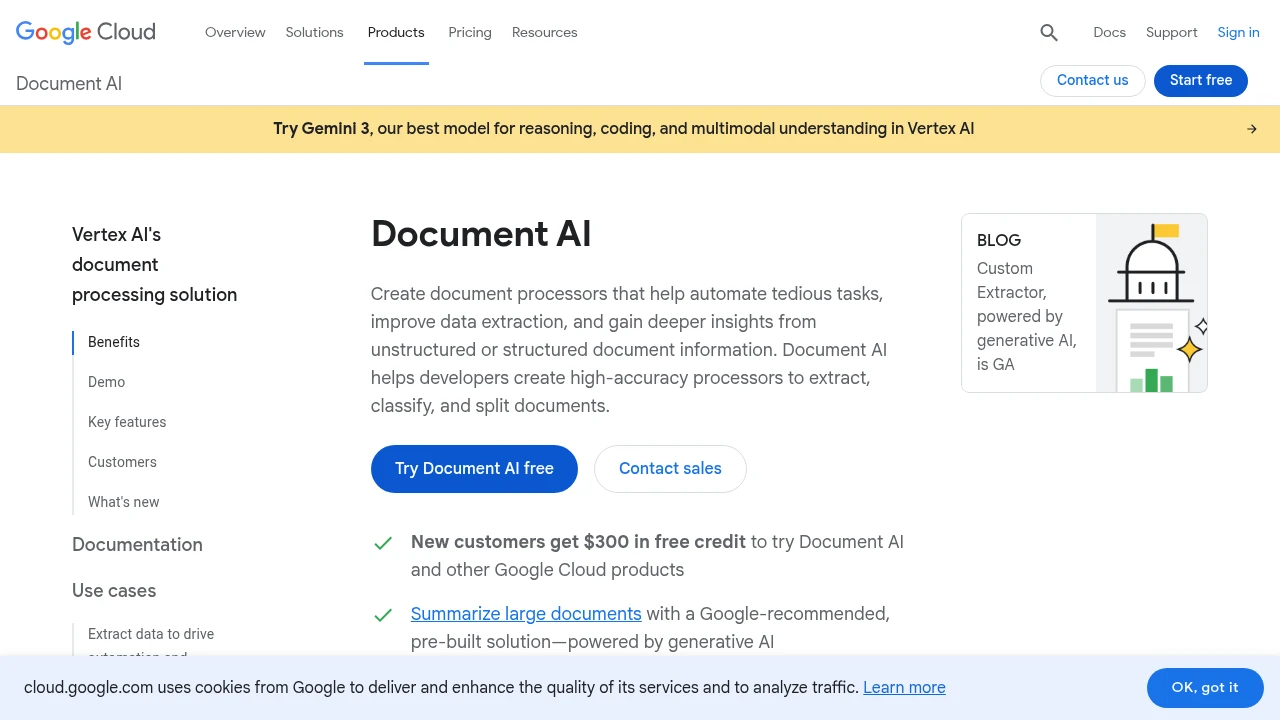
Google Document AI Form Parser applies machine learning to extract key-value pairs, checkboxes, and tables from documents in over 200 languages, leveraging deep learning models to extract generic entities common in various document types.
Key Features:
- Computer vision and OCR creating pre-trained models for high-value, high-volume documents
- Document understanding capabilities transforming semi-structured data into structured data sets
- Layout parser converting HTML documents into structured JSON showing content breakdown into blocks and classifications
- Multilingual support across 200+ languages for global document processing workflows
Limitations:
Form Parser focuses on generic extraction without specialized handling for complex multi-page tables, irregular layouts, or document-specific edge cases. No workflow orchestration, evaluation framework, or human-in-the-loop review capabilities exist. Limited schema versioning and no agentic optimization for continuous accuracy improvement.
Bottom Line:
Google Document AI provides solid baseline extraction for teams already invested in GCP, while Extend delivers the specialized vision models, workflow orchestration, and agentic infrastructure needed for mission-critical document processing where layout complexity and accuracy requirements are high.
Azure Document Intelligence
Azure Document Intelligence is a cloud-based service that applies OCR based on machine learning along with document understanding technologies to extract text, tables, structure, and key-value pairs from documents.
Key Features:
- Advanced document-analysis API combining enhanced OCR with deep learning models to extract text, tables, selection marks, and document structure
- Document structure layout analysis to extract regions of interest and their interrelationships for better semantic understanding
- Prebuilt models requiring no training plus custom models trained with as few as five labeled documents using template-based, neural, or composite approaches
- Document Intelligence Studio providing web interface for testing and analysis
Limitations:
Layout extraction operates as separate feature from semantic extraction, requiring integration work to connect visual structure with field-level understanding. No integrated evaluation suite, workflow orchestration, or agentic capabilities for continuous optimization. Custom model training requires manual iteration without automated schema optimization or background agents for accuracy improvement.
Bottom Line:
Azure Document Intelligence serves Azure-centric teams well for standard document types with compliance requirements, but organizations processing complex layouts that need workflow orchestration, evaluation tools, and agentic optimization will find Extend provides a more complete solution purpose-built for these challenges.
Feature Comparison Table of Vision AI Document Processing Solutions
| Feature | Extend | Reducto | Pulse | AWS Textract | Google Document AI | Azure Document Intelligence |
|---|---|---|---|---|---|---|
| Vision-Based Layout Understanding | Yes | Yes | Yes | Yes | Yes | Yes |
| Multi-Mode Processing (Latency/Cost) | Yes | No | No | No | No | No |
| Agentic Schema Optimization | Yes | No | No | No | No | No |
| Built-in Evaluation Suite | Yes | No | No | No | No | No |
| Schema Versioning | Yes | No | No | No | No | No |
| Human-in-the-Loop Review UI | Yes | No | No | No | No | No |
| Workflow Orchestration | Yes | No | No | No | No | No |
| Complex Table Extraction | Yes | Yes | Yes | Yes | Yes | Yes |
| Handwriting Recognition | Yes | Yes | Yes | Yes | Yes | Yes |
| API Access | Yes | Yes | Yes | Yes | Yes | Yes |
Why Extend is the Best Vision AI Document Processing Solution
Vision AI document processing solutions typically excel in one dimension: strong models, flexible APIs, or workflow tooling. Extend delivers all three without compromise.
The difference shows up when document processing moves from proof-of-concept to production. Other solutions provide extraction APIs that perform well in demos, then leave teams to build their own evaluation frameworks, version control systems, and quality monitoring. Extend ships with these capabilities integrated, treating them as core requirements rather than optional extras.
Agentic automation separates Extend from alternatives that require manual schema tuning. Where competitors force teams to iterate through weeks of prompt engineering and configuration testing, Extend's Composer agent runs these experiments automatically, converging to production-ready accuracy in minutes. When schemas drift as document templates change, the system adapts without manual intervention.
The vision architecture handles edge cases that break other solutions: tables spanning dozens of pages with shifting headers, handwritten annotations overlaying typed text, irregular form layouts where field positions determine meaning. Custom VLMs trained specifically for document understanding outperform general-purpose vision models on these scenarios.
For teams processing complex layouts in mission-critical workflows where accuracy, iteration speed, and operational reliability all matter, Extend provides the complete solution that combines superior models with the infrastructure needed to ship with confidence.
Final Thoughts on Document Processing Solutions
Most visual document AI solutions offer extraction APIs that work well in testing but leave you building evaluation frameworks and version control systems yourself. Teams processing irregular layouts, multi-page tables, or handwritten notes need specialized vision models with agentic schema optimization already integrated. The right choice depends on whether you want to build infrastructure or ship document workflows quickly.
FAQ
How do I choose the best vision AI document processing tool for complex layouts?
Start by testing solutions against your actual edge cases: multi-page tables, handwritten annotations, irregular forms, and poor-quality scans. Look for tools that provide evaluation frameworks and versioning so you can measure accuracy improvements over time, not just initial performance.
Which vision AI solution works best for teams that need fast deployment?
Tools with agentic schema optimization like Extend converge to production-ready accuracy in minutes without manual tuning, while solutions like AWS Textract or Azure Document Intelligence require more iteration but integrate easily if you're already in those cloud ecosystems.
Can vision AI document processing handle documents where layout determines meaning?
Yes, vision AI analyzes spatial relationships to understand how elements connect—table cells relative to headers, form field labels positioned above or beside inputs, and nested structures where position carries semantic meaning that text alone can't capture.
When should I prioritize evaluation tooling over raw extraction accuracy?
If you're building mission-critical workflows where accuracy requirements exceed 95% and you need to prove performance over time, built-in evaluation suites, schema versioning, and human-in-the-loop review become essential for safe production deployments.
What's the difference between cloud provider solutions and specialized document AI platforms?
Cloud providers like AWS Textract and Google Document AI offer managed infrastructure and broad integrations within their ecosystems, but limited workflow orchestration and optimization tooling, while specialized platforms provide deeper document-specific capabilities like agentic optimization and evaluation frameworks.