Production document pipelines break in predictable ways when raw LLMs handle extraction at scale. A 40-page commercial lease returns values that look correct until downstream validation catches a hallucinated clause; a multi-exhibit insurance submission loses table cell relationships the moment the file gets chunked across a context boundary; a mortgage package drops loan covenants on page 147 with no confidence signal to surface the loss. These are architectural failure modes, not prompt engineering problems. The LLM vs document API decision comes down to one question: does the workflow require freeform text reasoning, or deterministic, layout-aware extraction with per-field confidence scores? General-purpose models handle the former well; specialized extraction engines provide the structural reliability that compliance and approval pipelines require at volume.
TLDR:
- LLMs fail at structured extraction: 94% invoice accuracy leaves 600 errors per 10,000 documents, clustering on tables and handwriting where downstream systems break hardest.
- Token costs compound fast: retry overhead (20-40%), prompt engineering tax (1,500-3,000 tokens), and validation passes double per-document spend at scale.
- Document APIs maintain cross-page context; LLMs chunk documents and lose field relationships that span boundaries, hallucinating plausible values that bypass validation.
- Hybrid architecture ships results: document APIs parse layout into structured JSON, LLMs reason over clean input, which is why field accuracy holds across layout variations.
- Extend's Parse 2.0 delivers LLM-ready structured representations at 95.7% document Q&A accuracy, feeding downstream approval engines without intermediate normalization.
What LLMs Actually Do (and Don't Do) for Documents
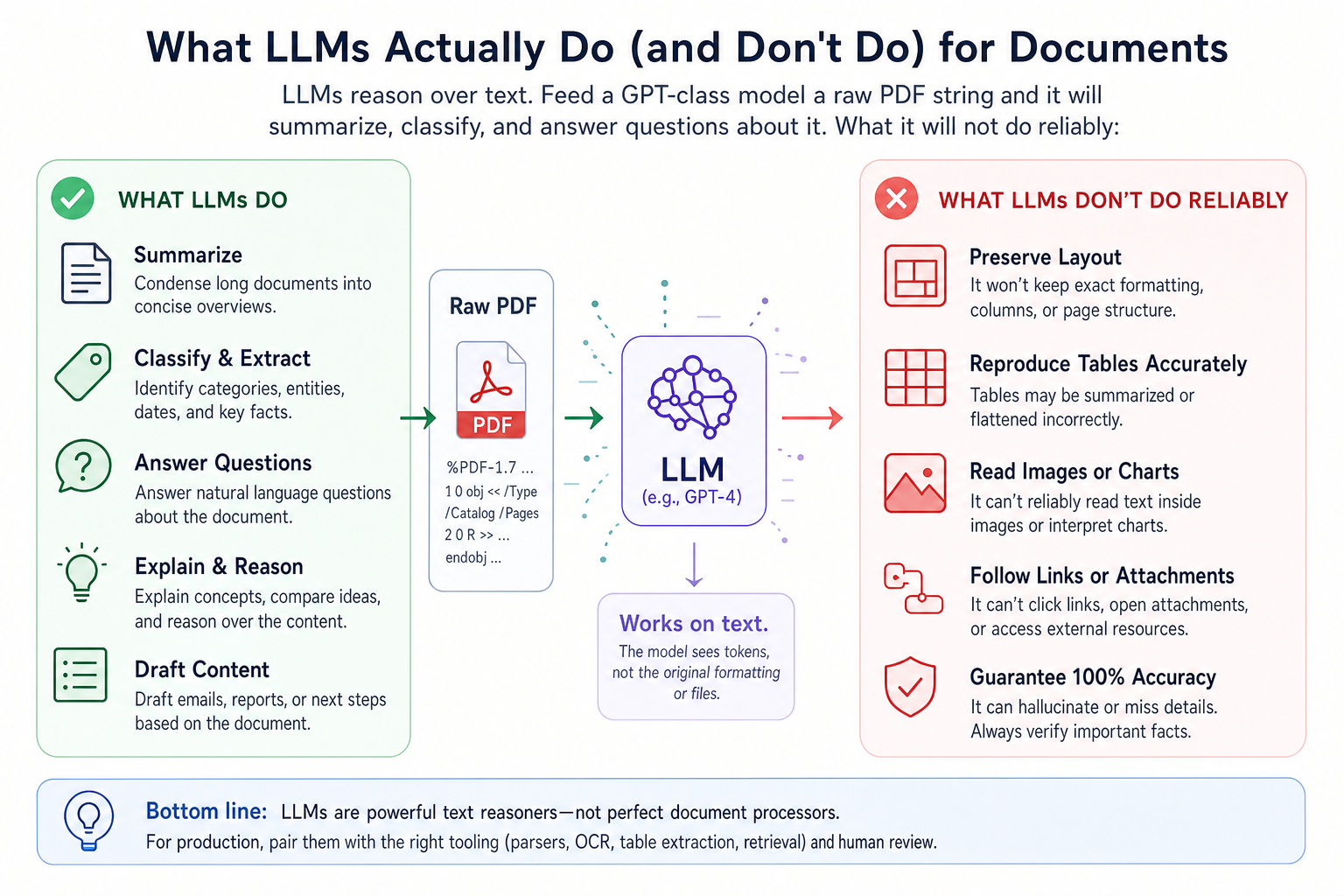
LLMs reason over text. Feed a GPT-class model a raw PDF string and it will summarize, classify, and answer questions about it. What it will not do reliably is return a structured field set with consistent key names, correct data types, and predictable null handling across 10,000 documents.
The failure shows up at scale. A model that extracts invoice totals correctly on 94% of documents leaves 600 errors per 10,000 runs. Those errors do not distribute evenly: they cluster on layout variations, multi-column tables, and handwritten annotations, exactly the document types that volume pipelines encounter most.
These limitations are not edge cases. They are structural properties of how LLMs are built, which is why general-purpose models serve well for reasoning tasks and poorly as document extraction infrastructure.
Where LLMs Fail on Production Document Workflows
Teams scaling document workflows past a few hundred pages per day run into the same architectural wall: LLMs trained for generative reasoning are not built to handle the structural variability that real production documents carry.
The failure modes are consistent and repeatable.
Context Window Exhaustion on Long Documents
A 200-page loan package, a multi-exhibit insurance submission, or a hospital discharge bundle routinely exceeds 100K tokens when converted to text. LLMs process these by truncating, chunking, or summarizing, and each strategy introduces field loss. Loan covenants on page 147 get dropped due to how language models use long contexts. Cross-referenced exhibit numbers lose their anchors. Fields that span a table split across chunks produce mismatched values, and no confidence score surfaces the mismatch.
Layout Blindness
LLMs consume text sequences. They do not reason over spatial relationships between columns, rows, headers, and footers the way a document-aware model does. A two-column W-2, a multi-line consignee field in a bill of lading, or a nested table in a commercial lease produces extraction errors that regex and positional heuristics cannot recover. The document's meaning lives partly in its layout; a text-only model drops that signal entirely.
Hallucination Under Sparse Input
When a field is absent, ambiguous, or partially obscured by a scan artifact, an LLM generates a plausible value. It does not return null or flag low confidence by default. Hallucination rates on enterprise documents remain a primary input quality problem. In mortgage underwriting, insurance intake, or logistics compliance workflows, a hallucinated field value is worse in production than a blank one because it passes downstream validation without triggering review.
No Native Confidence Scoring or Human-in-the-Loop Routing
Production extraction pipelines route uncertain results to human reviewers. LLMs return text; they do not ship a per-field confidence score or a structured review queue by default. Teams building on raw LLM APIs wire that infrastructure themselves, which adds weeks of engineering before the pipeline handles edge cases reliably.
How Document APIs Handle What LLMs Miss
Specialized document APIs are purpose-built to handle the structural complexity that LLMs consistently struggle with at scale. Where a raw LLM call treats a PDF as a flat text stream, a document API maintains awareness of layout zones, table cell boundaries, column headers, and multi-page context across the entire document.
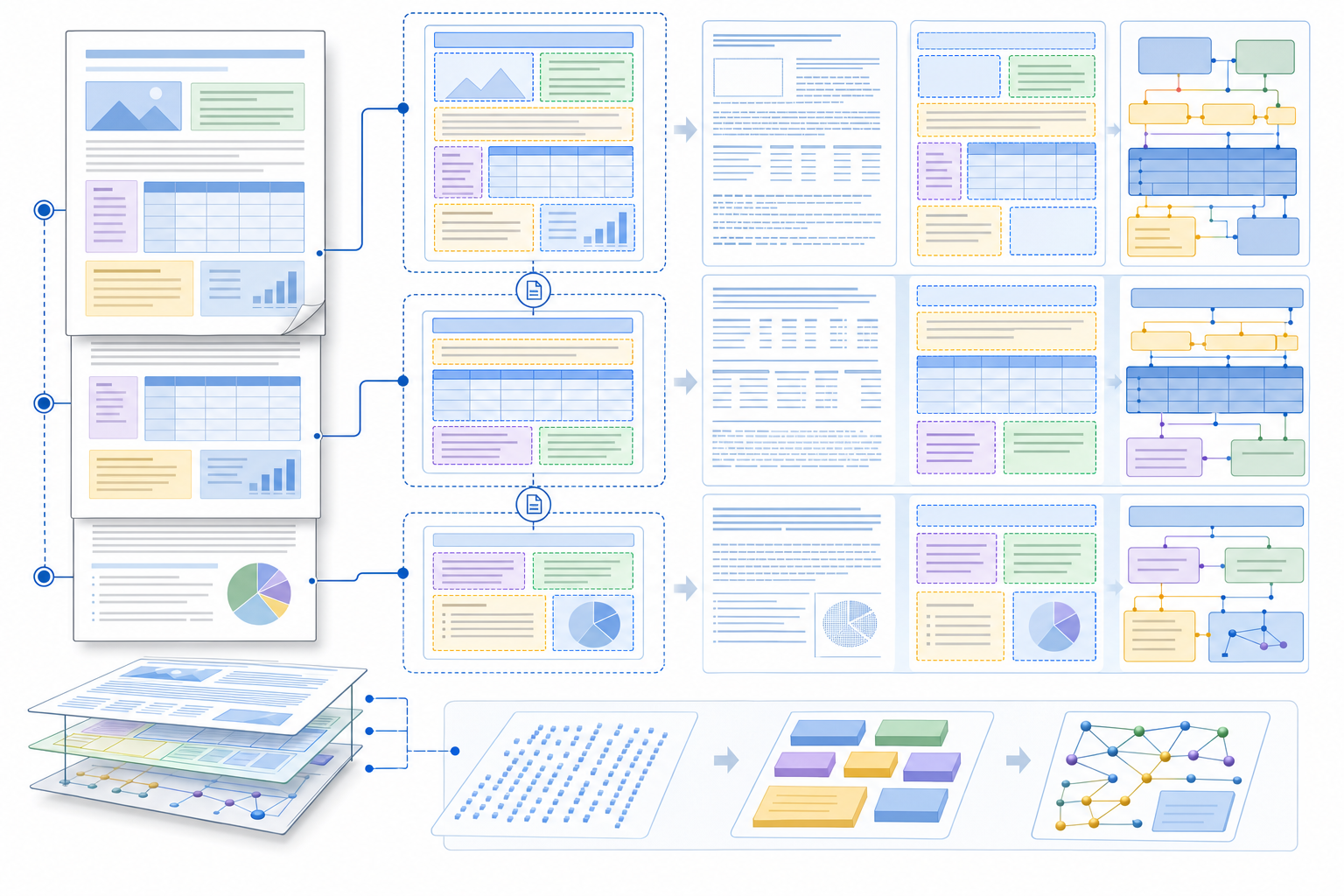
Consider a 40-page commercial insurance submission with embedded loss run tables, handwritten endorsement notes, and scanned ACORD forms. An LLM extracting from this directly will hallucinate cell values when rows wrap across page breaks, lose column alignment in dense tables, and produce confidence scores that don't reflect actual field-level accuracy. A document API built on OCR, specialized computer vision models, and VLMs resolves those structural relationships before extraction ever runs.
Where the Architectural Difference Matters
The gap shows up most clearly across three failure classes:
- Table extraction across page breaks: LLMs lose row-to-column mappings when tables span pages, whereas document APIs maintain a document-scoped context that preserves cell relationships across boundaries.
- Handwritten and low-quality scans: LLMs degrade on noisy inputs without an OCR preprocessing layer, while document APIs normalize the text layer before model inference runs.
- Confidence routing: LLMs return raw text, but document APIs return structured JSON with per-field confidence scores, routing low-confidence extractions to human review automatically.
These aren't preference differences. They are architectural properties that determine whether a pipeline holds at production volume.
| Condition | LLM-Direct Approach | Document API |
|---|---|---|
| Multi-page tables | Loses cell relationships when chunked across pages | Preserves column headers and relationships across page breaks |
| Low-quality scans | Fails on noisy inputs without OCR preprocessing | Normalizes text via OCR before extraction runs |
| Cross-page context | Chunking splits related entities (e.g., names and signatures) | Resolves entities across the entire document |
| Confidence scoring | No per-field signal; all outputs appear certain | Returns field-level scores to route low-confidence results |
| Complex layouts | Lacks spatial awareness; fails on nested tables | Detects layout zones and cells via computer vision |
| Missing fields | Hallucinates plausible values that bypass validation | Returns null or flags low confidence to trigger review |
When LLMs Are Actually the Right Choice
LLMs handle tasks well when the input is unstructured prose and the output requires reasoning instead of field extraction. Summarizing a 40-page legal brief, answering questions over a policy document, or classifying a support ticket by intent are all cases where a general-purpose LLM performs without additional tooling.
The decision point is structural. If the document has no consistent schema and the goal is synthesis or inference, an LLM is the correct architectural choice. Teams asking "what does this contract say about indemnification?" get accurate answers from a well-prompted GPT-4o or Claude call. Teams asking "extract the indemnification cap as a dollar value and map it to field indemnification_limit in a JSON schema" run into reliability problems at scale.
Where LLM-Direct Approaches Hold Up
- Freeform question answering: Ideal for policy documents, legal memos, or research reports where answers require reading comprehension across paragraphs field matching against a schema.
- Document classification: Best for routing by topic or intent where the expected output is a category label, not a structured record with typed fields and confidence scores.
- Narrative summarization: Works well for unstructured narratives where the goal is a human-readable output consumed by a person, not data ingested by a downstream system.
These tasks share a common property: output variability is acceptable. When a downstream pipeline requires deterministic field extraction with typed values, confidence thresholds, and schema validation, a raw LLM call introduces failure modes that compound at volume.
The Hybrid Approach Most Teams Actually Need
Most production document workflows call for both approaches working in sequence:
- LLMs: Handle semantic understanding, free-text reasoning, and unstructured narrative fields.
- Document APIs: Handle layout parsing, table extraction, coordinate-aware field detection, and confidence scoring on structured outputs.
The failure mode teams hit when skipping the specialized layer is predictable: an LLM fed a raw PDF byte stream loses spatial relationships between columns, misreads multi-line table cells, and returns fields with no confidence signal attached. Downstream systems that expect validated structured JSON receive best-guess text instead.
The correct sequence is parsing first, reasoning second. A document API converts the source file into a structured, LLM-ready representation. The LLM then operates on clean, normalized input instead of raw document bytes, which is why field accuracy holds across layout variations that would otherwise break extraction.
Teams building on Extend get this sequencing as the default architecture: OCR, specialized computer vision models, and VLMs run at the parsing layer, producing structured JSON that feeds directly into LLM reasoning steps or downstream automation without intermediate schema normalization.
How Extend Powers Document Processing for AI Agents
Extend is the complete document processing toolkit comprised of the most accurate parsing, extraction, and splitting APIs to ship your hardest use cases in minutes, not months. Extend's suite of models, infrastructure, and tooling is the most powerful custom document solution, without any of the overhead. Agents automate the entire lifecycle of document processing, allowing your engineering teams to process your most complex documents and optimize performance at scale.
Where general-purpose LLMs require teams to build and maintain prompt chains, grounding logic, and output validators from scratch, Extend ships that infrastructure pre-built. OCR, specialized computer vision models, VLMs, ingestion pipelines, confidence scoring, and human-in-the-loop review are available as composable APIs, so teams route documents through the right model for each extraction task without stitching together fragile tooling.
Parse 2.0 and Structured Output for Downstream Agents
Extend's Parse 2.0 engine converts complex documents into structured, LLM-ready representations that AI agents consume directly. No intermediate cleaning or schema normalization is required before agent handoff. Validated on the RealDoc-Bench benchmark across logistics, healthcare, financial services, and real estate, Parse 2.0 leads on layout accuracy at 0.847 Adjusted F1 across 1,500 samples and document Q&A output accuracy at 95.7% across 1,359 prompts and 581 documents.
The structured output Parse 2.0 delivers feeds downstream approval engines, ERP ingestion pipelines, LLM reasoning layers, and compliance validators. The extraction layer is what makes automated decisioning possible; nothing downstream runs reliably without it.
Final Thoughts on LLM vs Document API for Production Pipelines
Raw LLM calls against production documents introduce failure modes that compound with volume: chunking splits cross-page references, layout blindness misreads tabular data, and hallucination replaces missing fields with plausible-looking errors. Teams running high-volume pipelines need specialized extraction infrastructure before LLM reasoning ever starts. Parse 2.0 converts complex documents into LLM-ready structured representations that agents consume directly, handling the layout parsing layer that makes downstream automation reliable.
FAQ
LLM vs document API for 100+ page financial documents?
Document APIs maintain cross-page context and resolve field relationships across boundaries; raw LLM calls chunk long files and lose entity references that span pages. For loan packages or insurance submissions exceeding 100 pages, specialized APIs handle the document as a single structure instead of fragmented chunks.
Can GPT-4o extract tables from multi-page scanned PDFs reliably?
GPT-4o processes text sequences without spatial awareness of column boundaries, row headers, or cell relationships. Multi-page tables with wrapped rows or nested cells produce extraction errors that text-only models cannot recover. Extend combines OCR, specialized computer vision models, and VLMs to preserve table structure across page breaks.
How do you handle hallucinated field values in production extraction workflows?
LLMs generate plausible values when fields are absent or ambiguous, with no native confidence signal to flag uncertainty. Production pipelines require per-field confidence scores that route low-certainty extractions to human review before downstream systems consume them. Extend's Review Agent scores every extraction and surfaces exactly what's uncertain and why.
What breaks when processing documents that exceed context windows?
Chunking splits documents at arbitrary token boundaries, severing relationships between fields that span pages: borrower names on page 1, signature blocks on page 47, guarantor clauses on page 112 never appear together in the same context window. Document APIs maintain document-scoped context across the full file, resolving cross-page references before returning structured output.
Document AI vs LLM for insurance claim processing at scale?
Document AI handles layout-aware extraction, table reconstruction across page breaks, and confidence scoring for human-in-the-loop routing; LLMs return text without spatial understanding or structured validation. At 50,000 documents per month, retry overhead from hallucinated outputs and validation passes compound into real headcount decisions that make specialized APIs the correct architectural choice.