Multi-page contracts and scanned intake forms break most extraction pipelines before agents touch them. Building a document ingestion pipeline that holds in production means knowing what those failures look like: parsing errors that propagate through extraction, validation gaps that let low-confidence data reach downstream systems, and chunking boundaries that cut semantic units mid-sentence.
TLDR:
- Template matchers and regex extractors fail on layout variation and lose cross-page context; a dedicated ingestion pipeline fixes both.
- Five stages: parsing, chunking, embedding and indexing, validation, agent handoff. A failure at any one compounds every stage after it.
- Chunking strategy drives retrieval quality: hierarchical for multi-page contracts, semantic for heterogeneous documents, fixed-size for uniform corpora.
- Validate at three points: post-parse, post-extract, pre-handoff. Confidence thresholds route low-scoring fields to human review before they reach downstream systems.
- Instrument each stage individually. Aggregate pipeline metrics hide the bottleneck; per-stage latency, throughput, and error rates expose it.
What Is a Document Ingestion Pipeline for AI Agents
Raw PDFs, scanned forms, and multi-page contracts are opaque to AI agents. Extracting text alone does not solve the problem: agents need structured, machine-readable representations to classify documents, extract fields, and act on content.
A document ingestion pipeline is the infrastructure layer that produces those representations. It covers every step between a document arriving and an agent being able to reason over it: parsing, chunking, embedding, and indexing. Unstructured data makes up approximately 80% of all organizational data, and 95% of businesses cite unstructured data management as a major problem. The pipeline is the connection point between document sources and agent workflows. Without it, the agent layer has no reliable input.
Core Components of a Document Ingestion Pipeline
A complete pipeline runs through five interdependent stages, each with a defined input, a transformation, and a handoff to the next:
- Parsing: Converts raw files (PDFs, scanned images, Word documents) into structured, LLM-ready representations. No downstream stage runs reliably without clean parser output.
- Extraction: Pulls structured fields from parsed output according to a defined schema. Missed or misclassified fields at this stage propagate as bad data into every downstream system that depends on them.
- Chunking: Splits parsed output into segments sized for embedding and retrieval. Boundaries that cut across semantic units degrade retrieval precision for every query that follows.
- Embedding and indexing: Encodes each chunk as a vector and writes it to a retrieval index. The embedding model's context window and indexing strategy determine which chunks surface when an agent queries the document.
- Validation: Checks extracted fields against schema contracts and confidence thresholds before output leaves the pipeline. Fields that fail route to human review; fields that skip validation propagate silently into downstream systems.
- Agent handoff: Delivers validated, structured output to the agent layer in a format the agent consumes directly, with no additional cleaning, normalization, or field mapping required before agent handoff.
These stages are tightly coupled. A parsing failure propagates through extraction; a weak validation layer lets bad data reach the agent. Treating any stage as optional creates gaps that surface as agent errors at runtime, often in ways that are hard to trace back to their source.
Choosing Between Batch, Real-Time, and Hybrid Ingestion Methods
Getting this wrong means paying for real-time throughput on workloads that don't need it, or introducing delays that break agent workflows that do.
| Method | Trigger | Latency | Cost per Document | Best For |
|---|---|---|---|---|
| Batch | Scheduled intervals (hourly, daily, weekly) | Minutes to hours | Lowest | Nightly reconciliation, bulk imports, historical processing |
| Real-time | Document arrival event | Seconds | Highest | Loan decisioning, fraud detection, customer-facing intake where delays carry direct consequences |
| Hybrid/Micro-batch | Short time windows (seconds to minutes) | Near real-time | Moderate | High-volume queues where per-document overhead accumulates |
Document Parsing: Converting Unstructured Files Into Structured Data
Raw PDFs, scanned images, and multi-column spreadsheets are byte streams with no semantic structure. Parsing converts them into structured, LLM-ready representations that agents route, classify, and act on without additional preprocessing.
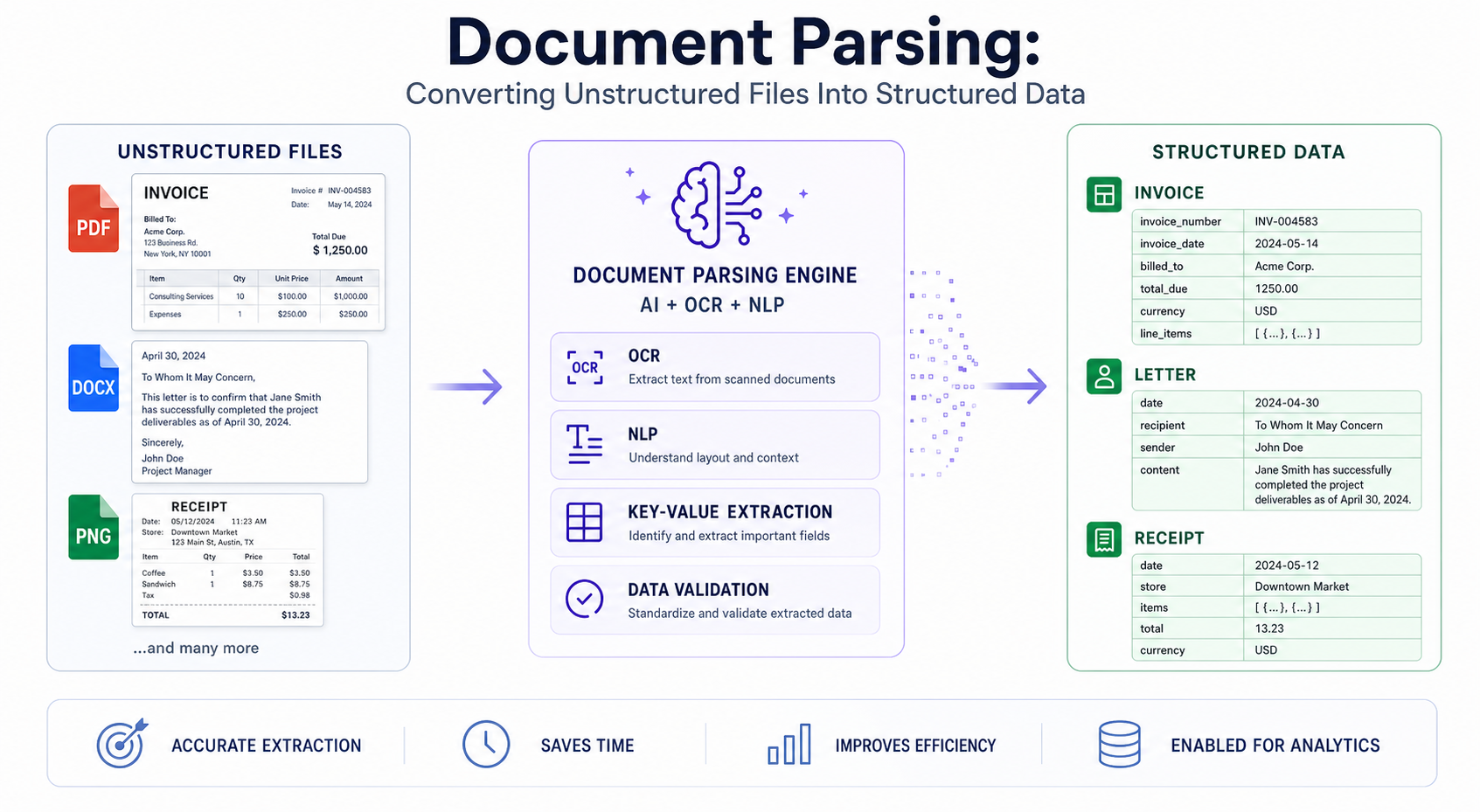
Production parsing handles three failure modes that simpler approaches miss, and the scale of the challenge is growing: 74% of enterprises store 5+ petabytes, a 57% year-over-year increase, while 58% of IT leaders cite classifying unstructured data for AI as their top technical challenge.
Each breaks downstream extraction before a single field is read:
- Layout variation: Document types differ in column structure, header placement, and field density. Extractors trained on one layout misclassify fields when a new format arrives.
- Multi-page context loss: Extractors that treat each page in isolation lose cross-page references. A field resolved on page 2 is invisible to the extractor running on page 5.
- Format fragmentation: A single pipeline ingesting PDFs, Word files, and images simultaneously receives inconsistent text layers, encoding differences, and display artifacts that break uniform extraction logic.
Text Chunking Strategies for Embedding and Retrieval
How documents get split before embedding determines whether retrieval returns the right context or a fragment that leaves an agent unable to act.
Three strategies cover most production pipelines:
- Fixed-size chunking: Splits text at a set token count, typically 256 to 512 tokens, with a small overlap window to preserve sentence continuity across boundaries. Fast and predictable, making it the right default for homogeneous corpora where semantic density is roughly uniform throughout the document.
- Semantic chunking: Groups text by meaning, splitting at detected topic or section boundaries. Retrieval precision improves on heterogeneous documents like contracts or medical records where a single page mixes clause types, definitions, and obligations.
- Hierarchical chunking: Maintains parent-child relationships between document sections and their constituent passages. An agent retrieves the matching passage and walks up the hierarchy to pull surrounding context when the passage alone is insufficient.
Overlap size and chunk length interact directly with retrieval quality. Chunks that are too small lose the surrounding context that makes a fact interpretable. Chunks that are too large dilute the relevance signal: the embedding blends topics into a single vector instead of representing one retrievable concept.
Building Validation and Quality Control Systems
Validation failures show up two ways: fields that extract incorrectly, and errors that reach downstream systems before anyone catches them. Both share the same root cause: no quality gate between extraction and agent consumption.
A structured validation layer runs at three points: post-parse, post-extract, and pre-handoff.
Schema and Confidence Validation
Every field should carry a confidence score after extraction. Route fields below a defined threshold (typically 0.75 to 0.85 in production) to a human review queue instead of letting low-confidence values propagate into downstream workflows. This is how teams avoid silent errors in approval engines or ERP ingestion pipelines.
Cross-Field Consistency Checks
Validation logic should verify relational integrity across extracted fields: invoice totals must match line item sums, date fields must respect logical ordering, and cross-page entity references must resolve to the same canonical value. These checks catch extraction errors that confidence scores alone miss.
Pre-Handoff Contracts
Validate the payload against a strict schema contract before structured output reaches an agent. Required fields must be present, types must match, and values must fall within accepted ranges. Agents that receive malformed input fail in ways that are hard to trace back to the extraction layer; contract enforcement belongs at the pipeline boundary, not inside the agent.
Monitoring, Observability, and Continuous Improvement
A pipeline without instrumentation is a black box. Latency spikes at parsing, throughput drops under load, and extraction accuracy degrades on a new document subtype, with no signal reaching the team. Observability belongs at each stage from day one.
Metrics That Signal Pipeline Health
- Processing latency per stage: Parse, classification, and extraction latency measured independently, so a slow VLM call doesn't disappear into an aggregate pipeline duration.
- Throughput: Documents processed per unit of time. A drop at constant input volume points to a specific stage bottleneck.
- Error rates by document type: Which formats break extraction most often. That's where schema iteration starts.
- Field-level extraction accuracy: Tracked against a held-out ground truth set to catch model drift before it reaches downstream systems.
Distributed Tracing and Logging
Each pipeline stage emits a trace span with its timing, input document identifier, stage name, and outcome status. OpenTelemetry composes traces across services without a custom tracing layer. A loan package that fails validation on page 47 produces a trace showing exactly which stage received it, what schema it matched, and what confidence score triggered human review.
Structured JSON logs per document run let teams query by document type, confidence band, or routing outcome. Unstructured log lines don't scale; debugging a pattern across 10,000 runs via grep stops being viable fast.
Alerting and Feedback Loops
A parser returning malformed output on one document subtype degrades every downstream extraction silently until the alert fires.
Corrections from human review are ground truth. Every field a reviewer corrects identifies a gap between the extraction model's behavior and the document class it failed on. That signal feeds schema evaluation: field definitions tighten, prompt configurations update, and confidence thresholds recalibrate against real divergence data. Pipelines that close this loop see extraction accuracy increase with volume. Pipelines that don't accumulate document subtypes the model consistently misses until a rebuild is the only path forward.
How Extend Powers Document Ingestion for AI Agents
Extend is the complete document processing toolkit comprised of the most accurate parsing, extraction, and splitting APIs to ship your hardest use cases in minutes, not months. Extend's suite of models, infrastructure, and tooling is the most powerful custom document solution, without any of the overhead. Agents automate the entire lifecycle of document processing, allowing your engineering teams to process your most complex documents and optimize performance at scale.
Extend's Parse 2.0 engine, powered by OCR, specialized computer vision models, and VLMs, forms a hybrid architecture that converts raw documents into structured JSON representations agents consume directly. Validated by RealDoc-Bench as a top-performing pipeline with 0.847 Adjusted F1 for layout accuracy and 95.7% document Q&A accuracy, it resolves cross-page entity references through a document-scoped context graph, so agents reason over multi-page contracts and loan packages without losing field continuity between pages. Template-matching and regex-based extractors structurally cannot replicate this.
Final Thoughts on Document Processing Infrastructure for Agents
Knowing how to build a document ingestion pipeline for AI agents means more than wiring five stages together. A production-grade pipeline converts raw documents into validated, LLM-ready representations before the agent layer runs. Without it, layout variation, field misclassification, and low-confidence data reach downstream systems before anyone catches them.
Ready to process your most complex documents with high accuracy and scale? Start building with Extend today.
FAQ
What is the difference between batch and real-time document ingestion?
Batch ingestion processes documents on a schedule (hourly, nightly, or weekly) and costs the least per document. Real-time ingestion triggers on document arrival and delivers structured output in seconds, which is required for workflows where delays carry direct consequences: loan decisioning, fraud detection, customer-facing intake. Micro-batch sits in between, processing short time windows to handle high-volume queues without the per-document overhead of pure real-time processing.
How do you process unstructured data for AI agents?
The pipeline runs in five stages. First, a parser converts the raw file (PDF, scanned image, Word document) into a structured, LLM-ready representation. Second, a chunking strategy splits that output into segments sized for embedding and retrieval. Third, each chunk gets embedded and indexed. Fourth, a validation layer checks extracted fields against a schema contract and confidence thresholds. Fifth, validated output passes to the agent layer in a format the agent consumes directly, with no additional cleaning or field mapping required before agent handoff. Skipping any stage produces input the agent cannot reliably act on.
What chunking strategy works best for multi-page documents?
Hierarchical chunking is the strongest default for multi-page contracts, loan packages, and medical records. It maintains parent-child relationships between document sections and their constituent passages, so an agent retrieves the matching passage and walks up the hierarchy for surrounding context when the passage alone is insufficient. Semantic chunking improves retrieval precision on heterogeneous documents where a single page mixes clause types and definitions. Fixed-size chunking at 256 to 512 tokens with overlap works for homogeneous corpora where semantic density is roughly uniform.
How do confidence scores work in a document extraction pipeline?
After extraction, each field carries a numeric confidence score representing model certainty about the extracted value. In production pipelines, fields below a defined threshold, typically 0.75 to 0.85, route to a human review queue and do not propagate into downstream systems.
What file types does a document ingestion pipeline need to support?
At minimum: scanned PDFs, native PDFs, images (PNG, JPEG, TIFF), and Word documents. Production pipelines serving financial services or logistics also need to handle Excel spreadsheets, multi-page bundles, and low-quality scans with handwriting, stamps, and strikethrough text. A single parsing layer that handles 35+ file types through one API removes the need to maintain separate preprocessing logic per format.
How do you validate extracted data before it reaches an AI agent?
Validation runs at three points. Post-parse checks confirm the document converted without structural errors. Post-extract checks apply confidence thresholds, cross-field consistency rules (invoice totals matching line item sums, date fields in logical order, cross-page entity references resolving to canonical values) and catch what confidence scores alone miss. Pre-handoff schema contracts enforce that required fields are present, types match, and values fall within accepted ranges. Validation belongs at the pipeline boundary; agents that receive malformed input fail in ways that are difficult to trace back to the extraction layer.