Andrew Ng's computer vision platform excels at manufacturing defect detection, but document teams run into constraints fast. While the platform supports document extraction, advanced automation and production workflows typically require API or Python-based integration. Native ingestion options and prebuilt integrations are more limited compared to document-first platforms. Pricing is usage-based across multiple processing components, which can make cost forecasting less predictable for high-volume pipelines.
Here’s how Landing AI’s document capabilities compare to platforms designed specifically for production-scale document workflows, evaluation frameworks, and transparent pricing models.
TLDR:
- LandingAI requires Python code for automation pipelines and lacks native integrations
- Google, AWS, and Azure offer extraction APIs but lack workflow orchestration and eval tools
- Extend ships production-ready document processing with built-in agents and human review UI
- Extend processes 1,000+ page files and delivers 99%+ accuracy on complex layouts
- Extend's Composer agent auto-tunes schemas while LandingAI requires manual optimization
What is LandingAI and How Does it Work?
LandingAI is a software company focused on data-centric computer vision applications for industries where visual inspection and document processing accuracy are critical. Founded by AI researcher Andrew Ng, the company develops tools that allow organizations to train and deploy custom vision models without deep machine learning expertise.
Its flagship product, LandingLens, is a cloud-based visual AI platform that guides users through uploading images, labeling data, training models, comparing performance across iterations, and deploying to production. The no-code interface supports rapid experimentation and model iteration, while production automation and integration typically require API or developer involvement.
Landing AI also offers an Agentic Document Extraction (ADE) framework designed for complex document workflows. The system converts documents into structured representations and extracts data into machine-readable formats, aiming to preserve layout context across dense or irregular files. It is positioned to handle challenging document elements such as forms, charts, and embedded visual components.
The company primarily serves manufacturers, healthcare organizations, financial institutions, insurers, and other compliance-intensive sectors. Marketing materials cite significant reductions in development time compared to building computer vision systems from scratch.
Why Consider LandingAI Alternatives?
While Landing AI is well known for manufacturing quality inspection and defect detection use cases, document-centric workflows introduce different operational requirements. Company materials cite significant reductions in deployment time for visual AI projects, though document automation often involves additional integration work.
For recurring extraction pipelines, teams typically rely on API or Python-based integrations beyond the point-and-click interface used for individual documents. Native ingestion and integration options may be more limited compared to document-first automation platforms.
The interface separates parsing, splitting, and extraction into distinct processing stages, which can introduce complexity for business users unfamiliar with document pipeline design. Pricing follows a usage-based model across multiple processing components, which may require careful modeling to forecast costs at scale.
Organizations seeking fully managed, end-to-end document automation—with built-in workflow orchestration, evaluation frameworks, human-in-the-loop review, and native ingestion channels—may find Landing AI positioned primarily around extraction capabilities, leaving broader pipeline orchestration and integration to customer implementation efforts.
Best LandingAI Alternatives in March 2026
Extend (Best Overall Alternative)
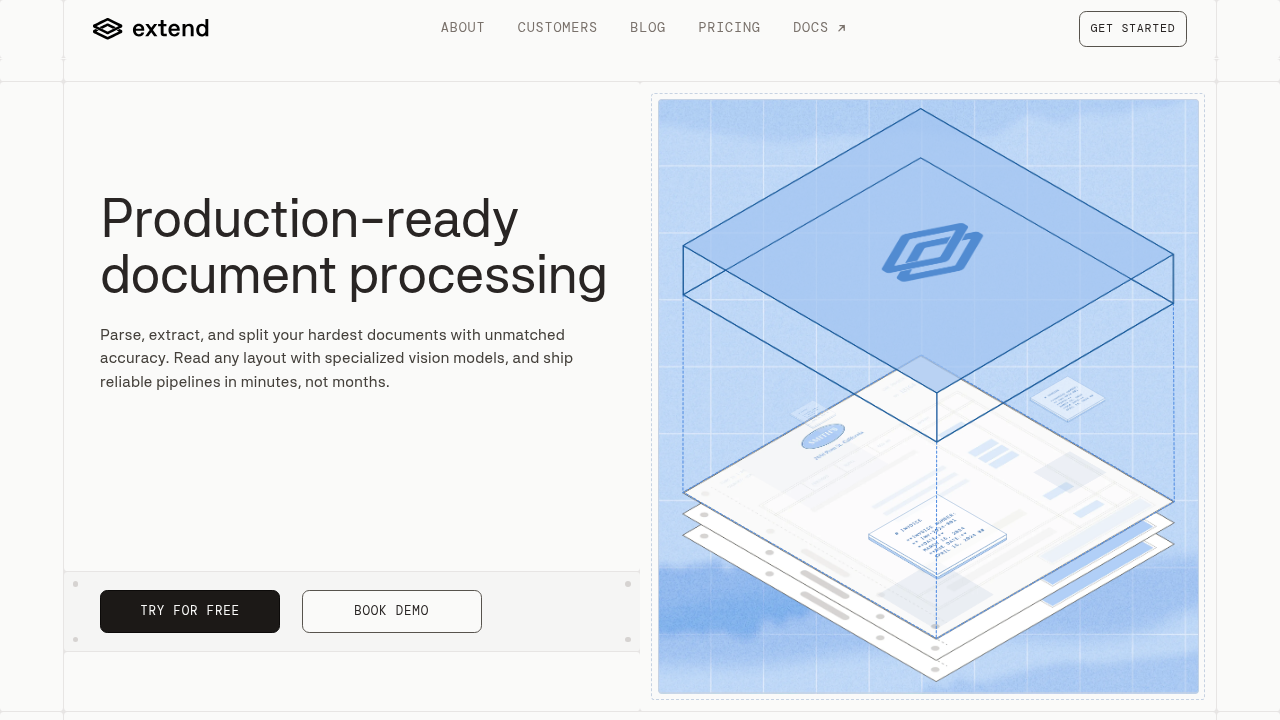
Extend is the complete document processing toolkit comprised of the most accurate parsing, extraction, and splitting APIs to ship your hardest use cases in minutes, not months. Extend's suite of models, infrastructure, and tooling is the most powerful custom document solution, without any of the overhead. Agents automate the entire lifecycle of document processing, allowing engineering teams to process the most complex documents and optimize performance at scale.
Key strengths include agentic OCR with intelligent routing through specialized vision models for handwriting, tables, checkboxes, and signatures. The Composer AI agent automatically experiments with prompt and schema variants to maximize extraction accuracy without manual tuning. Built-in evaluation framework includes Studio, evals, benchmarking, confidence scoring, and human-in-the-loop Review UI.
The system scales to 1,000+ page files with smart chunking and merging strategies. Multiple performance modes optimize for speed, cost, or accuracy. Advanced splitting maintains accuracy on 2,000+ page files with instance detection. Extend's Edit API programmatically detects and fills form fields including checkboxes, signatures, tables, and character-per-box inputs.
Extend is the best LandingAI alternative because it delivers end-to-end document processing infrastructure beyond extraction. While LandingAI requires Python code for automation pipelines and focuses primarily on visual AI for manufacturing, Extend provides tooling for deploying production-grade document workflows with built-in evals, versioning, Composer agent optimization, human review UI, and workflow orchestration that keeps quality high as schemas and documents change.
Google Document AI
Google Document AI extracts insights from documents and images using pre-trained processors for invoices, receipts, forms, and identity documents. Custom document processors with Workbench allow training on specific document types. The layout model extracts text, tables, selection marks and document structure designed for LLM processing.
In benchmarking studies, Document AI delivered strong results among major cloud OCR providers on standard documents. However, the service frequently missed line items and showed inconsistency extracting totals and labels on multi-column or non-standard layouts. Google does not offer workflow orchestration, evaluation frameworks, schema versioning, or human-in-the-loop review interfaces.
AWS Textract
Amazon Textract extracts printed text and handwriting from scanned documents while identifying structure in forms and tables. The service achieves over 95-99% text recognition accuracy on standard printed documents. APIs include DetectDocumentText for basic OCR, AnalyzeDocument for forms and tables, and AnalyzeExpense for invoices and receipts.
Textract does not allow custom data training and relies entirely on Amazon's pre-trained models. The service does not natively support East Asian scripts like Chinese or Japanese. Teams must build workflow orchestration, evaluation frameworks, and quality management systems separately.
Azure AI Document Intelligence
Azure AI Document Intelligence combines OCR capabilities with prebuilt and custom models. Pre-built models handle invoices, receipts, ID documents, and business cards. Custom model training works with as few as 6 sample documents. The service offers containers for hybrid and air-gapped deployments.
Azure does not provide workflow orchestration beyond extraction, no built-in evaluation frameworks, no agentic optimization, and no human-in-the-loop review UI. Teams requiring continuous quality improvement, schema versioning, or automated prompt optimization must build these capabilities themselves.
Feature Comparison: LandingAI vs Top Alternatives
The table below compares core capabilities across LandingAI and leading alternatives. Organizations should evaluate based on workflow needs, page volume requirements, and whether they need built-in optimization and quality management.
| Feature | LandingAI | Extend | Google Document AI | AWS Textract | Azure Document Intelligence |
|---|---|---|---|---|---|
| Automated pipeline setup | Requires Python code | API and SDK integration | Requires custom dev | Requires custom dev | Requires custom dev |
| Native integrations | None | REST APIs, SDKs | Google Cloud | AWS services | Azure services |
| Custom model training | Yes (LandingLens) | No (agentic optimization) | Yes (Workbench) | No | Yes (6+ samples) |
| Workflow orchestration | No | Yes | No | No | No |
| Evaluation frameworks | No | Yes (Studio, evals) | No | No | No |
| Schema versioning | No | Yes | No | No | No |
| Agentic optimization | No | Yes (Composer agent) | No | No | No |
| Human review UI | No | Yes (built-in) | No | Yes (A2I separate) | No |
| Handwriting support | Yes | Yes | Yes | Yes | Yes |
| Complex table extraction | Yes | Yes (1,000+ rows) | Yes | Yes | Yes |
| Form filling/editing | No | Yes | No | No | No |
| Pricing model | Complex block-based | Usage-based | Usage-based | Usage-based | Usage-based |
Extend stands out as the complete document processing toolkit comprised of the most accurate parsing, extraction, and splitting APIs to ship your hardest use cases in minutes, not months. Its suite of models, infrastructure, and tooling is the most powerful custom document solution, without any of the overhead. Agents automate the entire lifecycle of document processing, allowing engineering teams to process complex documents and optimize performance at scale.
Why Extend is the Best LandingAI Alternative
Extend solves the exact problems that push teams away from LandingAI. While LandingAI requires Python code to build recurring extraction pipelines, Extend ships production-ready APIs and tooling for end-to-end document processing workflows. Companies like Mercury, Brex, Flatiron Health, Opendoor, and Checkr rely on Extend for mission-critical document pipelines, hitting greater than 99% accuracy and going live in days instead of months.
The Composer AI agent tunes prompts and schemas automatically against evaluation sets, removing manual iteration loops. Built-in evaluation tools including Studio, accuracy reports, confidence scoring, and human-in-the-loop Review UI maintain quality as documents and schemas change over time.
Organizations consistently report that Extend outperformed every vendor, open-source tool, and general AI model they tested in head-to-head comparisons. Backed by Y Combinator and Innovation Endeavors, Extend processes millions of pages daily for customers handling messy layouts, handwriting, multi-page tables, and state-specific formats where standard OCR breaks down. The system scales to 1,000+ page files, fills forms programmatically, and provides workflow orchestration that LandingAI leaves to custom code.
Final Thoughts on Document Processing Beyond Visual Inspection
The gap between visual inspection tools and complete document workflows explains why teams search for LandingAI alternatives when automation requirements expand beyond single extractions. Extend gives you APIs, agents, and tooling that automate document processing from ingestion through quality management without custom code. Most engineering teams process their first production documents within days of starting.
Book a quick intro call to walk through your specific document challenges and see if Extend fits your workflow.
FAQ
Why should teams consider moving away from LandingAI for document processing?
Teams outgrow LandingAI when they need end-to-end document automation without Python code, or built-in workflow orchestration and evaluation frameworks that come as native features instead of custom development projects.
What features should teams prioritize when evaluating LandingAI alternatives?
Look for agentic optimization that tunes schemas automatically, built-in evaluation and human review interfaces, workflow orchestration capabilities, and transparent pricing models that don't charge separately for extraction, formatting, and premium features.
How does Extend handle the complex document workflows that LandingAI leaves to custom code?
Extend provides native workflow orchestration, the Composer agent for automated prompt optimization, Studio for evaluation, confidence scoring, human-in-the-loop Review UI, and schema versioning—infrastructure that keeps quality high as documents and schemas evolve without requiring custom development.
Can document processing platforms handle large files at scale?
Yes, Extend processes files up to 1,000+ pages using smart chunking and merging strategies that maintain extraction accuracy without hitting context limits.
When does the block-based pricing model become a problem for LandingAI users?
Teams struggle with cost forecasting when pricing charges separately for extraction, formatting, lookups, and premium features—especially at scale where document variety makes predicting which blocks get consumed nearly impossible month-to-month.