Most document processing tools promise “95% accuracy” but quickly falter when faced with real-world documents: poor scans, irregular layouts, or handwritten notes that defy clean parsing. Teams often find themselves trapped in endless cycles of rule-tuning and model retraining, only to plateau around 80% accuracy, a barrier that keeps production goals out of reach. A new generation of AI-powered document processing solutions is breaking through that ceiling, delivering 99%+ accuracy on complex, messy documents from day one and helping teams move from pilot to production in days instead of months.
TLDR:
- Modern LLM-powered IDP solutions achieve 99%+ accuracy vs 70-85% for traditional OCR tools
- Deployment speed separates viable solutions from expensive experiments: best tools go live in days
- Most IDP tools fail on real-world documents with poor scans, handwriting, or complex layouts
- Hidden costs like custom development and training often exceed initial licensing fees
- The most effective platforms deliver production-ready accuracy from day one, with rapid deployment and continuous improvement over time
How We Ranked Best Intelligent Document Processing Tools
We assessed IDP solutions across five dimensions critical to real-world deployment.
We tested each tool against complex documents including degraded scans, handwritten forms, and multi-page contracts. Solutions needed to consistently exceed 90% extraction accuracy on challenging content to make our list.
We tracked setup time, training requirements, and iteration cycles. The best solutions delivered working prototypes within days instead of months.
We tested schema flexibility, workflow orchestration, and the ability to handle edge cases without extensive engineering overhead.
We looked at API quality, webhook support, and compatibility with common business applications.
We factored in hidden costs like custom development, training data preparation, and system administration overhead.
1. Best Overall: Extend
Extend takes the top spot by delivering what most IDP solutions promise but fail to execute: production-ready accuracy with rapid deployment.
A core differentiator is accuracy. Extend has shown around 99% extraction accuracy on challenging content including degraded scans, handwritten forms, and complex tables.
Key Strengths
Extend's LLM-powered architecture processes a wide range of document formats while preserving layout and structure. The system changes raw documents into clean Markdown or JSON, ideal for downstream AI processing.
Pre-built processors for extraction, classification, and splitting reduce development time. Teams can chain these into custom workflows with branching logic and integrations.
Deployment Speed
Teams can get working prototypes running in hours, not weeks. The developer-friendly API allows real-time document processing with results delivered in seconds. Production deployment typically happens within days instead of the months required for custom builds.
Best For
Mission-critical workflows in logistics, healthcare, real estate, and financial services where accuracy cannot be compromised. Teams needing custom automation beyond one-size-fits-all OCR solutions.
2. UiPath
UiPath brings robotic process automation expertise to document processing through its Document Understanding solution. The tool integrates with UiPath's broader RPA ecosystem, making it attractive for organizations already invested in their automation stack.
The tool offers form-based training where users can annotate documents to improve extraction accuracy. However, this process requires substantial manual effort and technical expertise to achieve production-ready results.
Teams can route extracted data through approval processes, trigger downstream actions, and integrate with enterprise systems through the UiPath orchestrator.
Limitations
Accuracy often drops on complex or degraded documents. The solution struggles with handwritten content, poor-quality scans, and documents that deviate from trained templates.
Setup and training require substantial time investment. Most implementations take weeks or months to reach acceptable accuracy levels, particularly for custom document types.
Best For
Organizations with existing UiPath RPA deployments looking to add document processing features to existing automation workflows. Less suitable for teams needing standalone document intelligence or handling complex, variable document formats.
3. ABBYY Vantage
ABBYY Vantage positions itself as a cloud-native IDP solution with decades of OCR expertise behind it. The tool offers pre-trained document skills for common business documents and allows custom skill development for specialized use cases.
The solution includes numerous pre-built document skills that handle standard business documents without initial training.
ABBYY's OCR engine performs well on clean, high-quality scans and can process multiple languages effectively.
Limitations
The tool struggles with handwritten content and degraded document quality. Accuracy drops noticeably on documents that deviate from trained templates or contain complex layouts.
Best For
Large enterprises processing high volumes of clean, standardized business documents who need proven OCR technology with strong compliance features.
4. Google Document AI
Google Document AI uses Google's machine learning infrastructure to provide document processing features through pre-trained processors and custom model development. The solution integrates with Google Cloud services and offers both API-based and console-based document processing.
These processors extract structured data from common business documents with reasonable accuracy on clean, well-formatted files.
Limitations
Accuracy can decrease on poor-quality scans or documents with non-standard layouts. The solution offers limited native workflow orchestration and human-in-the-loop features found in specialized IDP tools.
Best For
Google Cloud customers needing basic document processing integrated with existing cloud workflows. Less suitable for complex document types or mission-critical accuracy requirements.
5. AWS Textract
AWS Textract offers document analysis through Amazon's cloud infrastructure, focusing on text extraction and form data capture. The service provides both simple OCR and more advanced document understanding features through machine learning models.
Textract handles text extraction from documents and images with reasonable accuracy on clean, structured content. The service can detect tables, forms, and key-value pairs within documents.
AWS Textract excels at basic text extraction but requires additional development work to handle complex document workflows and validation logic.
The service scales automatically through AWS infrastructure and integrates with existing cloud workflows. Teams can process documents asynchronously for large batches or synchronously for real-time applications.
Limitations
Textract lacks built-in workflow orchestration and human review features. Teams must build custom validation and correction processes, adding development overhead.
Best For
AWS customers needing basic document processing integrated with existing cloud infrastructure. Works well for simple extraction tasks but often requires additional custom development for complex workflows.
6. Microsoft Azure AI
Azure AI Document Intelligence (formerly Form Recognizer) provides document processing through pre-built models and custom training features. The service integrates with Microsoft's cloud ecosystem and offers both REST APIs and client libraries for development teams.
The service extracts structured data with decent accuracy on clean, well-formatted documents.
Custom model training allows teams to process specialized document types. However, this requires substantial labeled training data and technical expertise to achieve production-ready accuracy levels.
Limitations
Accuracy drops on handwritten content and poor-quality scans. The service lacks built-in workflow orchestration and continuous learning features found in specialized IDP solutions.
Best For
Microsoft Azure customers needing basic document processing features integrated with existing cloud infrastructure. Less suitable for complex document types requiring high accuracy.
Why Extend is the Best Choice for Intelligent Document Processing
The IDP world splits between legacy OCR solutions retrofitted with AI marketing and purpose-built LLM systems designed for document complexity. Extend falls decisively in the latter category.
Built for Real-World Documents
Most IDP tools demo perfectly on clean invoices but crumble when facing degraded scans, handwritten forms, or complex multi-page contracts. Extend's LLM architecture handles these challenging documents as a core feature, not an afterthought.
The context engineering approach preserves important information that traditional OCR engines lose. While competitors struggle with rotated pages or poor image quality, Extend normalizes and structures content before processing, delivering consistent results.
Speed to Production Value
The difference between proof-of-concept and production deployment separates viable solutions from expensive experiments. Teams using Extend typically achieve working automation within days instead of the months required for custom builds or extensive training.
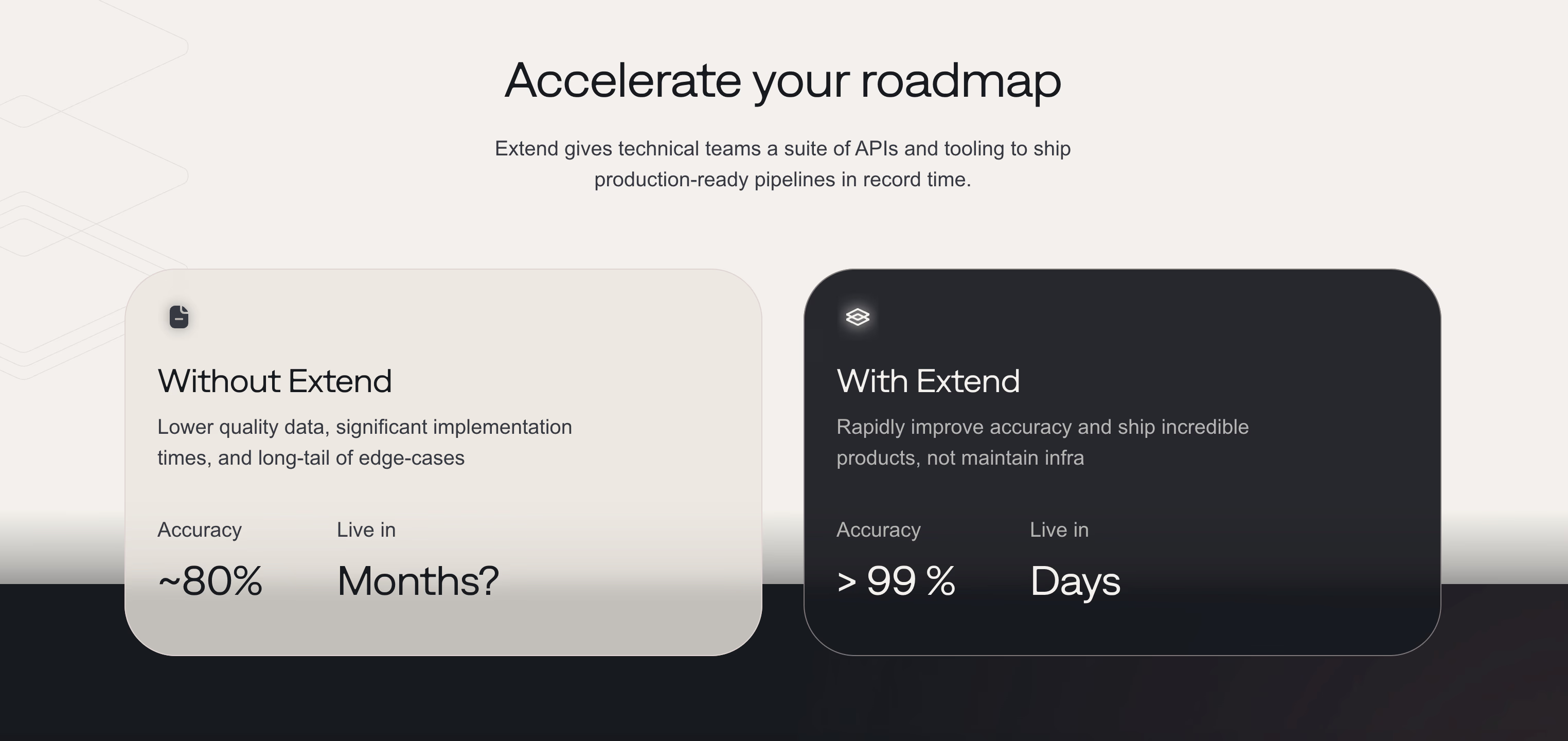
Traditional IDP implementations often stall in the 80% accuracy range, often requiring months of additional tuning to reach production readiness. Extend typically reaches near-99% accuracy at launch and improves through feedback over time.
Pre-built processors eliminate the development overhead that makes other solutions cost-prohibitive. Instead of building extraction logic from scratch, teams configure workflows and iterate on results.
Continuous Improvement Architecture
Static models become liabilities as document formats evolve and edge cases appear. Extend's feedback loops turn every human correction into training data, automatically adapting to your specific document variations.
This learning ability builds over time. Extend's memory system learns from the visual layout of past documents to improve accuracy on similar files over time, turning every processed document into training data that improves future performance. This continuous learning means accuracy improves automatically as you process more documents.While competitors require manual retraining or expensive professional services to handle new document types, Extend evolves with your business requirements.
For teams handling mission-critical document workflows where accuracy cannot be compromised, Extend delivers the reliability and customization that generic OCR APIs simply cannot match.
FAQs
What accuracy should I expect from modern IDP solutions?
Most traditional OCR tools achieve 70-85% accuracy on complex documents, while LLM-powered solutions like Extend consistently deliver over 99% extraction accuracy even on degraded scans and handwritten content.
How long does it typically take to deploy an IDP solution?
Deployment time varies dramatically by solution. Legacy tools often require weeks to months of configuration and training, while modern platforms like Extend can deliver working prototypes in hours and production deployment within days.
What's the difference between basic OCR and intelligent document processing?
Basic OCR simply extracts text from documents, while IDP provides end-to-end workflows including classification, extraction, validation, and human review features, with the ability to handle complex layouts and continuously improve accuracy.
Final thoughts on choosing the right intelligent document processing solution
Modern LLM-powered platforms show that 99%+ accuracy on complex documents is achievable from day one. Unlike legacy OCR systems that demand months of setup and endless fine-tuning, Extend delivers production-ready results within days, adapting to the unpredictability of real business workflows. The difference in accuracy, deployment speed, and ongoing maintenance costs will compound quickly once you're processing real volumes.