A cracked laminate, a driver's license photographed at an angle, an ID card where the MRZ zone clips the frame: these are the moments where most tools quietly hand a document to manual review and slow down onboarding. Picking the right id document verification API means looking past the demo and asking what happens once the input isn't clean: does structured extraction hold, does the deployment model fit your data residency rules, and does the vendor return enough signal for your KYC pipeline to act on. This breakdown covers exactly where each option fits, and where it runs out of road.
TLDR:
- Template-based extractors reset on layout deviation; VLM-based pipelines maintain document-scoped context so field extraction holds on degraded captures.
- Most ID verification APIs return a pass/fail signal; structured field extraction into validated JSON is what downstream KYC pipelines and underwriting engines actually consume.
- Jumio, Onfido, Veriff, and Persona cover biometric matching and compliance decisioning; none return per-field confidence scores for downstream extraction workflows.
- Extend is the only vendor in this comparison that returns per-field confidence scores, routes low-certainty fields to human review before they reach decisioning systems, and supports on-premises deployment for data residency requirements.
What Are ID Document Verification APIs?
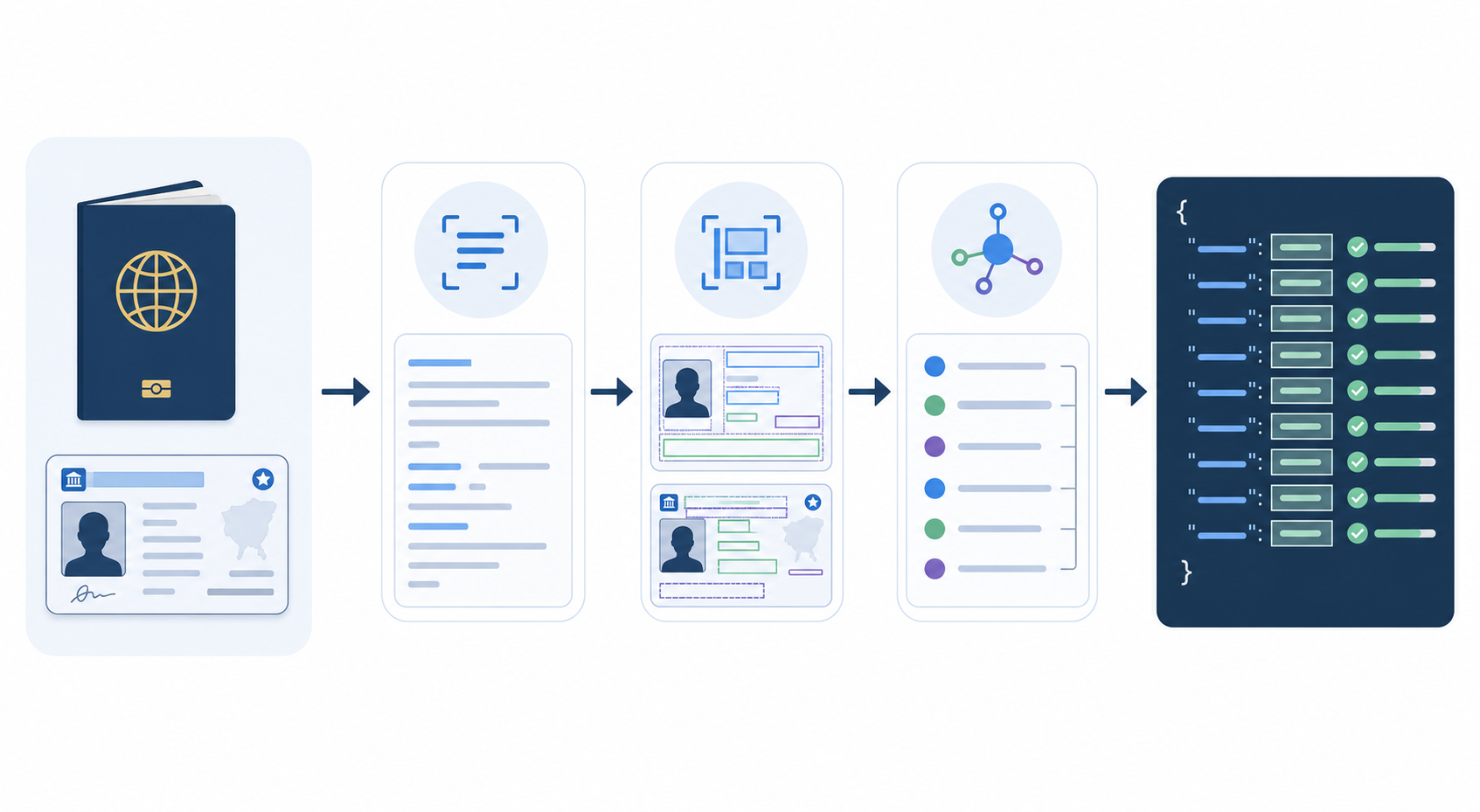
ID document verification APIs are software interfaces that extract, parse, and validate identity information from government-issued documents: passports, driver's licenses, national ID cards, and residence permits. At their core, these APIs combine OCR for text layer extraction, specialized computer vision models for layout and document type classification, and VLMs for semantic field resolution across variable document formats.
The verification layer goes beyond extraction. These APIs cross-reference extracted fields against issuing authority patterns, check document security feature signatures, flag tampered or expired credentials, and return structured confidence scores per field. That structured output feeds downstream KYC workflows, onboarding systems, and compliance validators directly.
Teams integrating these APIs typically get a REST endpoint that accepts a document image or PDF, returns a normalized JSON payload with extracted fields, document type classification, and per-field confidence scores, and routes low-confidence results to human review queues automatically.
How We Ranked ID Document Verification APIs
Rankings here draw from publicly available product information across seven criteria that reflect production engineering priorities, not marketing surface area.
- Extraction accuracy: field-level precision on passports, driver's licenses, national ID cards, and residence permits across variable layouts and issuing jurisdictions
- Document type coverage: breadth of supported document types and countries, including state-specific formats and international edge cases
- Latency: synchronous response characteristics for real-time onboarding flows versus async batch processing requirements
- Fraud and tampering detection: detection of altered, forged, or expired credentials before data reaches downstream systems
- Deployment flexibility: cloud, self-hosted, and on-premises options for teams with data residency or sovereignty requirements
- Developer experience: REST API design, SDK availability across languages, CLI tooling, and documentation depth
- Compliance posture: SOC2, HIPAA, and GDPR certifications relevant to handling identity data at scale
Best Overall ID Document Verification API: Extend
Extend is the complete document processing toolkit comprised of the most accurate parsing, extraction, and splitting APIs to ship your hardest use cases in minutes, not months. For ID document verification, that means OCR, specialized computer vision models, VLMs, confidence scoring, and human-in-the-loop review working together in a single pipeline, not stitched across vendors.
Most verification pipelines break at the edges: a passport with a cracked laminate, a driver's license photographed at an angle, an ID card where the MRZ zone clips the frame. Template-based extractors reset on the first layout deviation. Extend's VLMs maintain document-scoped context, so field extraction holds even when document condition or capture quality degrades.
What Extend Ships for ID Verification
Extraction APIs pull structured fields from government-issued IDs, passports, visas, and residence permits. Confidence scoring flags low-certainty fields for human-in-the-loop review before they propagate downstream. Ingestion pipelines handle scanned images, mobile captures, and multi-page bundles without preprocessing. The output is validated JSON that feeds directly into identity decisioning systems, KYC workflows, and onboarding pipelines.
Parse 2.0 leads on layout accuracy, scoring an Adjusted F1 of 0.847 across 1,500 real-world samples. It also reaches 95.7% document Q&A accuracy across 1,359 prompts and 581 documents, as validated by the RealDoc-Bench benchmark. Teams shipping ID verification at scale get extraction infrastructure that handles document variability in production, beyond what demos show.
Jumio
Jumio combines AI-powered government ID document checks with biometric facial recognition, liveness detection, and AML screening into a single KYC compliance suite covering 5,000+ document types across global jurisdictions. Risk signals, AML watchlist checks, and case management tooling make it a reasonable fit for large financial institutions with mature enterprise procurement processes and dedicated compliance teams.
Tradeoffs show up in two places: custom enterprise contracts make per-verification costs hard to model when verification volumes fluctuate, and teams without dedicated compliance or technical resources will spend meaningful time on configuration before the first document clears. Teams that need precise structured data extraction, flexible self-hosted deployment, or faster integration timelines will find Jumio's compliance-first architecture limits the document processing layer in ways that compound at production scale.
Onfido
Onfido focuses on biometric identity verification, using facial recognition and liveness detection to match selfies against government-issued ID documents. The core workflow runs a document authenticity check alongside a biometric comparison, fitting onboarding flows where proving that the person holding the document is its legitimate owner matters as much as confirming the document itself is genuine. Teams in compliance-sensitive industries such as financial services or gig economy onboarding find the compliance coverage useful, and the liveness check reduces the risk of spoofing attacks using printed photos or video replays.
The architectural tradeoff is scope: Onfido covers document authenticity plus biometric match, not downstream extraction. Teams that need structured data from those same documents, such as pulling mailing fields into a CRM or parsing expiry dates into an eligibility engine, need a separate extraction layer, since the signals Onfido produces do not automatically become structured, LLM-ready JSON. Teams running broader document processing pipelines will need to pair Onfido with a dedicated extraction API to cover the full workflow.
Veriff
Veriff runs automated identity verification across 230+ countries with a library of 12,000+ document specimens, targeting consumer-facing apps in finance, gaming, and mobility where verification speed at global scale is the primary requirement. Behavioral signal analysis and AML screening function as modular add-ons alongside the core document check.
Teams that need custom extraction logic, jurisdiction-specific field handling, or high accuracy on complex document structures will find Veriff's configurability limited. The verification signal it returns is a pass/fail decision, not extraction-ready structured data that downstream systems consume directly. Reported false positive rates compound this for engineering teams where decision accuracy directly affects user trust.
Persona
Persona provides a configurable verification workflow engine that lets engineering and compliance teams assemble custom KYC, AML, and KYB programs from modular components: document verification with selfie matching across 200+ countries, database checks against email, phone, and SSN records, and fraud investigation tooling for manual review queues. Teams that need risk-tiered verification logic with precise control over decision rules and data collection find the configurability genuinely useful.
That flexibility requires meaningful engineering investment to deploy and maintain, and pricing that scales with per-service fees can compound at volume. Teams needing high-accuracy structured data extraction from complex ID formats, or self-hosted deployment for data residency requirements, will find Persona's architecture doesn't cover that scope.
Stripe Identity
Stripe Identity is a narrowly scoped ID verification product built on top of Stripe's existing payments infrastructure. It handles government-issued ID checks, selfie matching, and sanctions screening, fitting SaaS companies that already run billing through Stripe and want to add identity verification without standing up a separate vendor relationship. The flow is straightforward: users submit a photo ID, Stripe extracts the document fields, a liveness check confirms the match, and teams get a risk score and structured result object back via webhook or API pull.
Where Stripe Identity runs into architectural limits is outside that core flow. Document type support is narrower than dedicated identity verification providers, and the product targets consumer onboarding, not workflows requiring cross-document verification, business entity checks, or high-volume re-verification at scale. For teams already inside the Stripe ecosystem processing straightforward consumer checks, it works well; teams running complex verification workflows across multiple document types or jurisdictions will hit the product's ceiling quickly and need a purpose-built verification API for full coverage.
Feature Comparison Table of ID Document Verification APIs
The table below maps each vendor against the capabilities that matter most in production ID document workflows. Biometric checks and AML coverage cover compliance requirements; structured extraction, confidence scoring, and deployment flexibility determine what teams build downstream.
| Feature | Extend | Jumio | Onfido | Veriff | Persona | Stripe Identity |
|---|---|---|---|---|---|---|
| Structured Field Extraction from ID Documents | Yes | Partial | Partial | Partial | Partial | No |
| Confidence Scoring per Extracted Field | Yes | No | No | No | No | No |
| Document Fraud and Tampering Detection | Yes | Yes | Yes | Yes | Yes | No |
| Support for 25+ File Types | Yes | No | No | No | No | No |
| Classical ML Vision for Document Validation | Yes | No | No | No | No | No |
| Real-Time Synchronous Validation | Yes | Yes | Yes | Yes | Yes | Yes |
| AML Screening Included | No | Yes | Partial | Partial | Partial | No |
| Liveness / Biometric Check | No | Yes | Yes | Yes | Yes | Yes |
| SOC2 / HIPAA / GDPR Compliance | Yes | Yes | Yes | Yes | Yes | Partial |
Why Extend Is the Best ID Document Verification API
Extend's architecture separates it from every other vendor in this list. Other tools submit a document, match a face, and return a pass/fail signal. Extend handles what comes after that signal: structured data delivered as validated JSON to underwriting engines, KYC pipelines, onboarding systems, and compliance validators. For teams running document processing for financial services, ID verification becomes foundational infrastructure, not a terminal step.
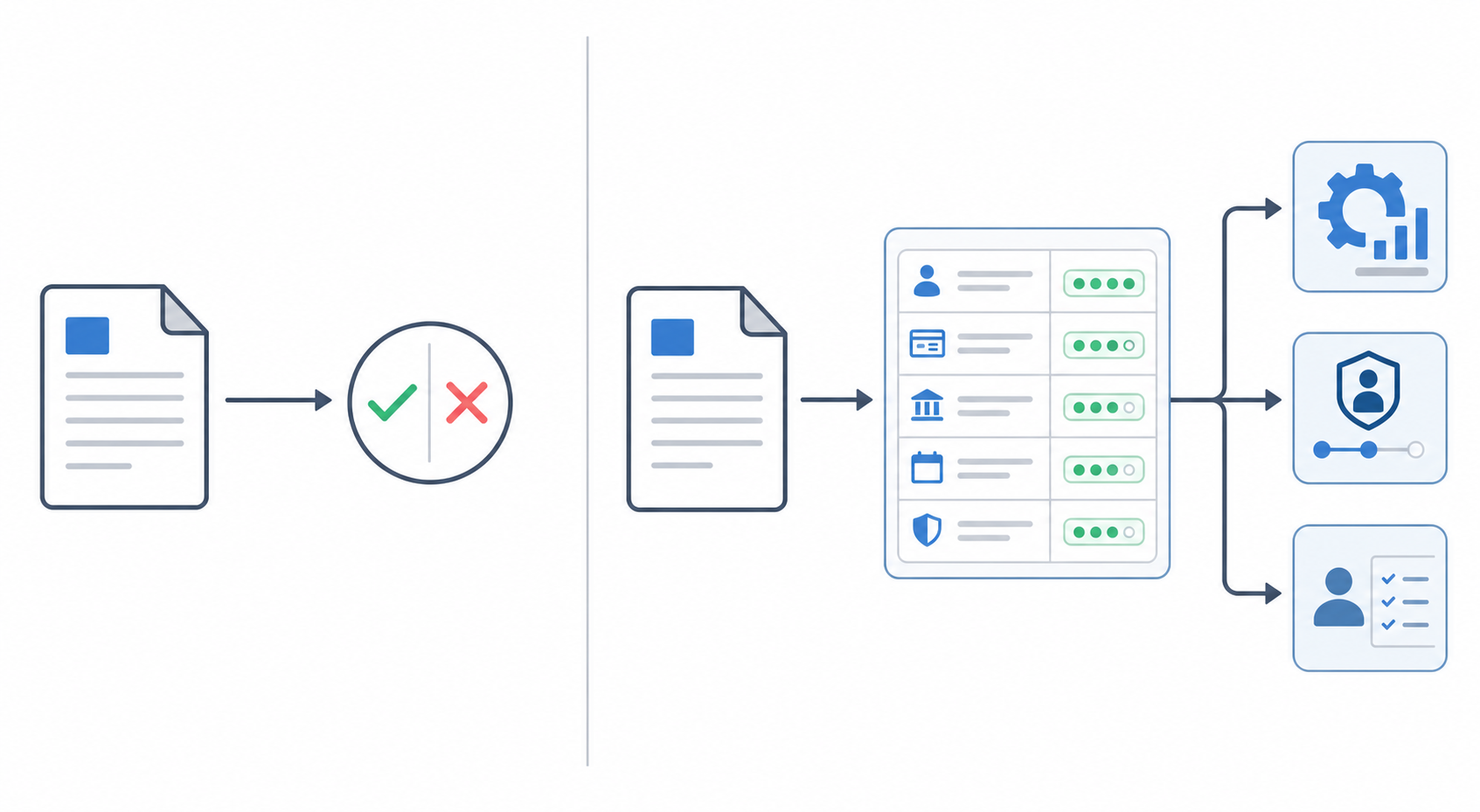
Brex, Chime, Mercury, and Checkr run Extend on mission-critical ID document workflows because extraction errors carry real downstream consequences. Confidence scoring flags uncertain fields before they propagate into downstream systems. On-premises deployment keeps sensitive identity data within customer infrastructure. When the pipeline needs to be right every time, Extend is the extraction layer teams build on.
Final Thoughts on ID Document Verification APIs and What They Actually Deliver
Verification is only one part of the workflow. The structured data that comes out of it determines what your onboarding systems, compliance validators, and KYC pipelines can actually do with it. Teams that treat the document extraction AI layer as an afterthought tend to rebuild it once production volume reveals the gaps. Extend ships the extraction infrastructure that makes the rest of the pipeline reliable from the start.
FAQ
How do I choose between Extend, Jumio, Onfido, Veriff, Persona, and Stripe Identity for my ID verification workflow?
The decision splits on what your pipeline needs after the verification signal. Jumio, Onfido, Veriff, and Persona return pass/fail decisions with biometric matching; Extend returns structured, validated JSON that feeds directly into downstream systems like underwriting engines, KYC pipelines, and onboarding validators. If your workflow ends at identity confirmation, any of the biometric-focused tools cover that scope. If extracted document fields flow into downstream systems, Extend is the extraction layer those systems depend on.
When should teams weight structured field extraction over biometric liveness detection in an ID document verification API?
Teams building KYC onboarding flows that feed extracted data into eligibility engines, CRMs, or compliance validators need structured extraction as the primary capability. Biometric liveness detection confirms the person matches the document; it does not produce the name and residency fields, expiry dates, or ID numbers that downstream systems consume. Workflows that require both signals need either two separate vendors or an extraction-first platform like Extend paired with a dedicated biometric layer.
How does Extend handle ID documents with degraded image quality or non-standard capture conditions?
Extend's VLMs maintain document-scoped context across variable layouts and degraded capture conditions, including passports with cracked laminates, driver's licenses photographed at an angle, and ID cards where the MRZ zone clips the frame. Template-based extractors reset on the first layout deviation; Extend's hybrid OCR plus computer vision plus VLM pipeline holds field extraction even when document condition or image quality degrades from ideal capture.
Which ID document verification APIs include confidence scoring per extracted field?
Extend is the only vendor in this list that returns per-field confidence scores alongside extracted values. Jumio, Onfido, Veriff, Persona, and Stripe Identity return pass/fail verification signals without field-level confidence data. Per-field scoring matters in production because it flags uncertain extractions before they propagate into downstream decisioning systems, routing low-confidence results to human review automatically; extraction errors never reach underwriting engines or compliance validators.