Template-based extractors reset on the first unseen merchant format, which is why review queues in receipt OCR pipelines grow with format variation, not document volume. A production-grade stack layers OCR for text extraction, specialized computer vision models for layout detection, and VLMs for semantic field resolution, outputting structured JSON that downstream approval engines, ERP systems, and LLM reasoning layers consume directly. That stack has to hold across thermal print degradation, handwritten annotations, mobile photo inputs, and multi-currency formats before it qualifies as production-ready. What follows is a ranked breakdown of the strongest APIs available right now, assessed on parsing accuracy, edge case handling, schema flexibility, processing modes, evaluation tooling, deployment options, and enterprise readiness.
TLDR:
- Template-based extractors reset on the first unseen receipt format, so review queues grow with format variation, not document volume
- Production receipt OCR stacks OCR for text, computer vision models for layout detection, and VLMs for semantic field resolution, outputting structured JSON downstream systems consume directly
- Azure and Google Document AI handle clean, printed receipts well; accuracy degrades on handwritten annotations, non-standard layouts, and multi-currency formats without retraining cycles
- Nanonets and Reducto lack document-scoped context models, so cross-field misclassifications recur across similar batches without manual intervention to fix the root cause
- Extend ships OCR, VLMs, confidence scoring, and human-in-the-loop review as a unified API; Parse 2.0 posts an Adjusted F1 of 0.847 across 1,500 real-world samples on RealDoc-Bench
What Is Receipt OCR?
Receipt OCR converts raw pixel data from receipt images into structured, machine-readable fields: merchant name, transaction date, line items, totals, and tax amounts. The extraction process layers optical character recognition over document layout analysis to resolve positional relationships between text blocks, which is why a receipt with a two-column item list produces different parsing challenges than one with a single-column format.
Template-based extractors handle known layouts reliably; they reset on the first unseen format and require manual template authoring for every new merchant or receipt style. At scale, that means review queues grow proportionally with format variation, not with document volume.
Production receipt OCR systems handle format variability by combining OCR for text layer extraction with computer vision models for layout detection and VLMs for semantic field resolution, producing structured JSON outputs that downstream systems consume directly.
How These Receipt OCR and Scanning APIs Were Ranked
Rankings draw on publicly available documentation, API references, changelog records, and developer resources. No vendor-supplied claims or unpublished benchmarks factor into the scores.
Each tool was assessed across these dimensions:
- Parsing accuracy: performance on real-world receipt formats, including variable column layouts, thermal print degradation, and mixed merchant styles
- Edge case handling: handwritten annotations, low-resolution scans, and partially obscured fields
- Schema flexibility: custom output field configuration and the ability to define non-standard extraction targets without retraining
- Processing modes: speed, cost, and accuracy tradeoffs available across extraction pipelines
- Agentic tooling and evaluation frameworks: confidence scoring and human-in-the-loop review tooling for production accuracy management
- Deployment options: cloud, self-hosted, and on-premises configuration support
- Enterprise readiness: compliance certifications, uptime SLAs, and rate limit thresholds
Best Overall Receipt OCR API: Extend
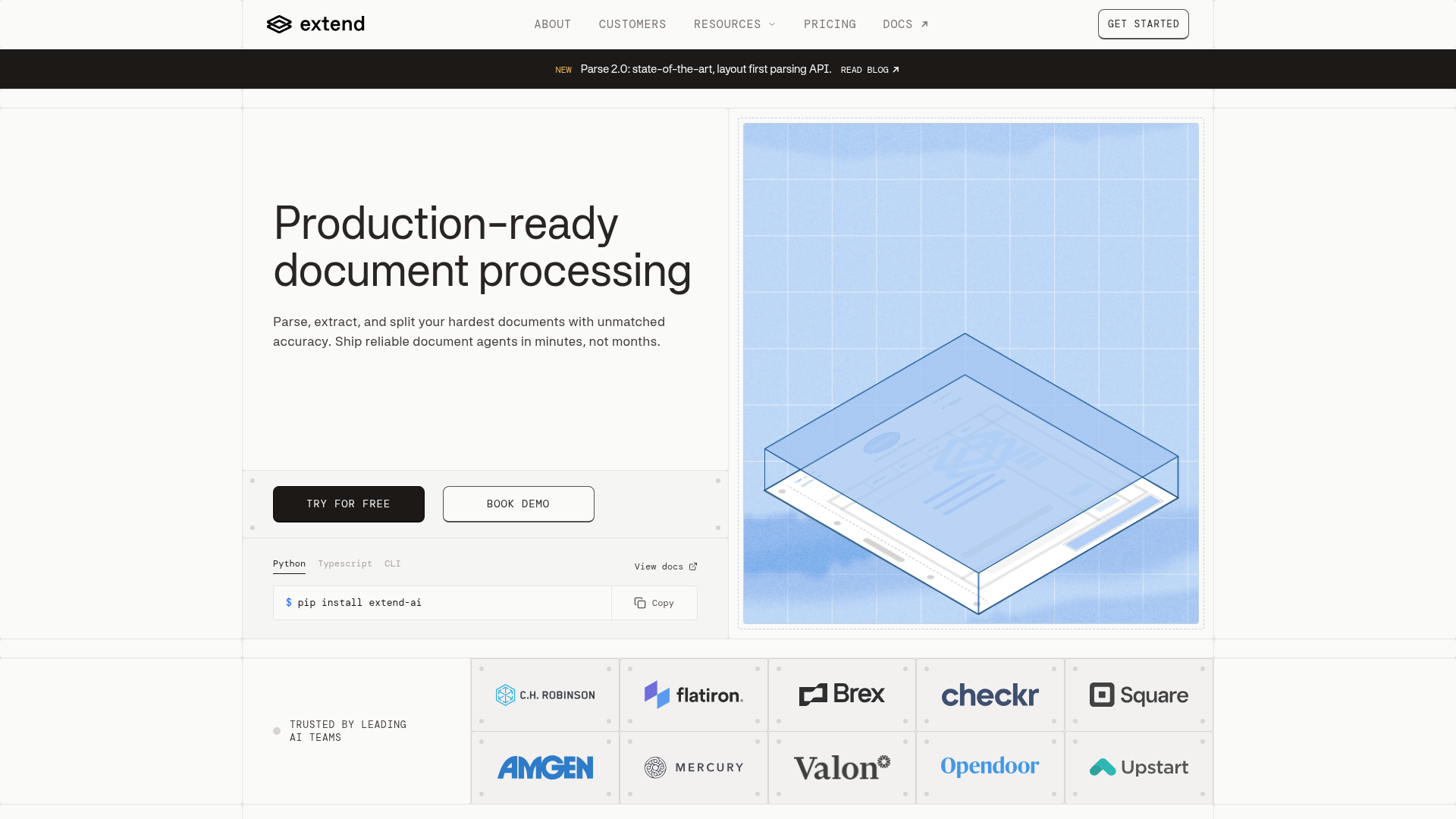
Extend is the complete document processing toolkit comprised of the most accurate parsing, extraction, and splitting APIs to ship your hardest use cases in minutes, not months. Extend's suite of models, infrastructure, and tooling is the most powerful custom document solution, without any of the overhead. Agents automate the entire lifecycle of document processing, allowing your engineering teams to process your most complex documents and optimize performance at scale.
For receipt OCR, Extend ships OCR, specialized computer vision models, VLMs, confidence scoring, and human-in-the-loop review as a unified API surface. Template-based extractors reset on layout variation; Extend's document-scoped context resolves field references across variable receipt formats without manual rule updates.
Azure Document Intelligence
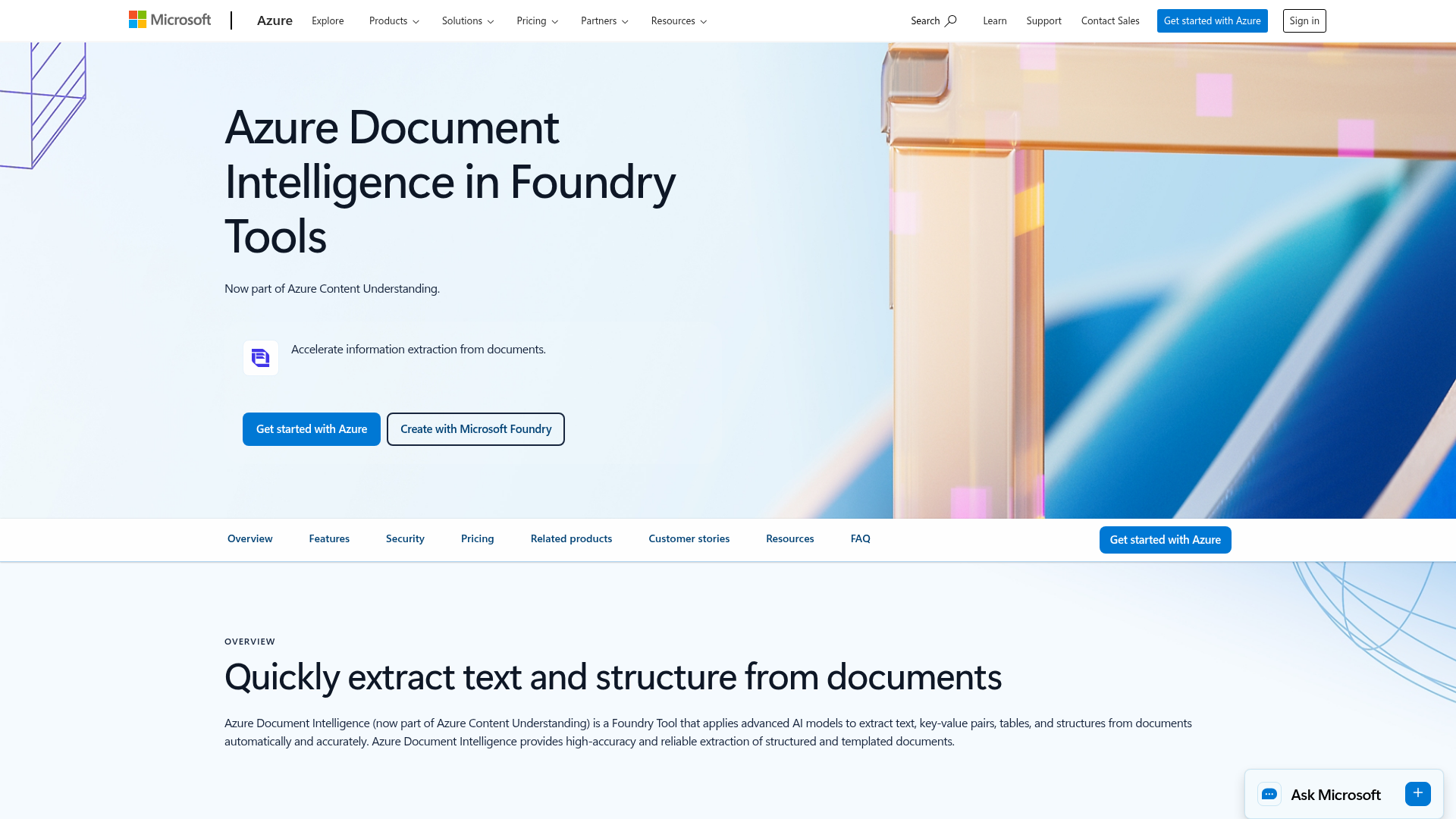
Microsoft's Azure Document Intelligence brings enterprise-grade OCR infrastructure to receipt scanning, with pre-built receipt models that extract merchant name, transaction date, line items, and totals from common retail formats, integrating directly into Azure pipelines. It fits teams already running workloads on Microsoft infrastructure who process printed receipts in standard retail layouts. Non-standard merchant formats and multi-currency receipts in international deployments still tend to need manual review in practice, and pricing follows Azure's consumption model, which scales in cost quickly for high-throughput receipt pipelines outside that ecosystem.
Google Document AI
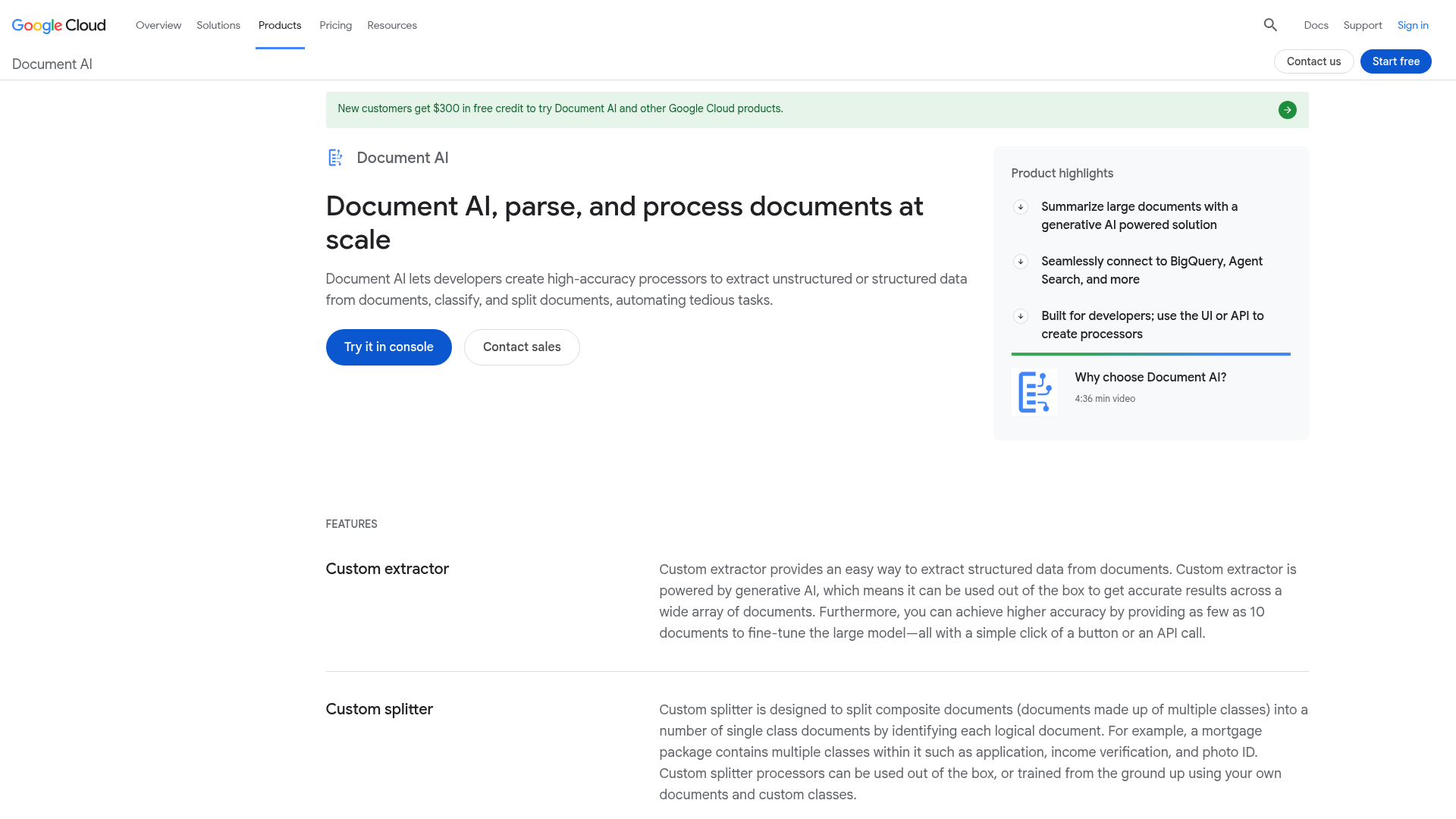
Google Document AI is Google Cloud's document processing service, with an Expense Parser processor that extracts merchant name, date, line items, totals, and tax fields from receipts, built on the same infrastructure that powers Google's search and data products. It fits teams running well-resourced GCP deployments with consistent, clean, printed receipts from major retailers, where training data coverage is high. Custom field extraction outside the predefined schema requires Document AI Workbench, which adds labeling overhead and retraining cycles; layout variability on handwritten or non-standard receipts degrades field-level accuracy faster than model-based extractors that reason over document structure contextually, and per-page pricing compounds quickly once receipts mix with broader financial document types like invoices and bank statements.
Nanonets
Nanonets targets mid-market finance and operations teams running invoice and receipt workflows, with an OCR pipeline that handles multi-format inputs and returns structured JSON through a low-code interface that lets non-engineering teams configure extraction fields without writing custom parsers. It fits high-frequency, low-variability document types well. There is no document-scoped context model, so cross-field validation across a receipt bundle routes back to human review instead of resolving automatically, Nanonets ships no evaluation framework to catch accuracy regressions as receipt formats shift, and its block-based pricing, around $0.30 per page plus separate fees for formatting, lookups, and premium integrations, makes per-receipt costs unpredictable as volume scales.
Veryfi
Veryfi targets mobile receipt capture and expense management workflows, with SDKs built around smartphone camera input and line-item parsing that return structured JSON for merchant name, totals, tax, and individual line items, averaging 2.8 seconds per document according to its published specs. It fits teams building expense apps or receipt capture features where documents arrive as mobile photos and turnaround speed matters more than cross-document context or complex layout handling. The architecture stays focused on receipt and expense document types, so teams processing mixed document sets, multi-page financial packages, or formats outside that category hit coverage gaps quickly.
Reducto
Reducto targets developer teams that need reliable document parsing across PDFs, scanned images, and structured forms, combining OCR and layout detection models to handle itemized line extraction and header field parsing on receipts at acceptable accuracy for clean digital inputs. It fits engineering teams building pipelines where document structure varies across batches. Performance degrades on low-quality scans, handwritten annotations, or non-standard layouts, showing up as field misclassification in production queues; its Edit API fills blank form fields, table cells, and checkboxes but isn't built for correcting extraction errors, so correction patterns don't feed back into extraction logic and the same misclassification recurs across similar document batches without manual intervention.
Feature Comparison Table
The table below maps each tool against the capabilities that matter most in production receipt OCR deployments, covering infrastructure depth, compliance posture, and agentic tooling.
new document instance with the same layout.
| Feature | Extend | Azure Document Intelligence | Google Document AI | Nanonets | Veryfi | Reducto |
|---|---|---|---|---|---|---|
| Multi-Mode Processing (Fast/Cost/Accuracy) | Yes | No | No | No | No | No |
| Agentic Schema Optimization | Yes | No | No | No | No | No |
| Built-in Evaluation Framework | Yes | No | No | No | No | No |
| Schema Versioning | Yes | No | No | No | No | No |
| Human-in-the-Loop Review UI | Yes | No | No | Yes | No | No |
| Dedicated Classification API | Yes | Yes | Yes | No | No | No |
| Barcode and QR Code Extraction | Yes | Yes | Yes | No | Yes | No |
| On-Premises Deployment | Yes | Yes | No | Partial | No | No |
| SOC2 / HIPAA / GDPR | Yes | Yes | Yes | Partial | Yes | Partial |
Barcode/QR support, on-premises deployment, and compliance certifications are compiled from public vendor documentation as of July 2026 and vary by plan tier. Confirm current capabilities directly with each vendor before procurement.
Why Extend Is the Best Receipt OCR API
The other tools on this list cover standard receipt formats well enough. Each one hits a structural ceiling when layouts vary, edge cases accumulate, or pipelines need evaluation tooling without custom engineering work to fill the gap. Extend ships OCR, specialized computer vision models, VLMs, agentic schema optimization, confidence scoring, and human-in-the-loop review as a single API surface.
RealDoc-Bench-validated Adjusted F1 of 0.847 across 1,500 real-world samples, combined with multi-mode processing across speed, cost, and accuracy, means teams don't re-platform when receipt workflows expand into broader financial document pipelines. The Parse API infrastructure is built to scale with them. Every other tool handles receipts. Extend handles receipts and everything that comes after them.
Final Thoughts on Receipt OCR and Scanning APIs
Receipt OCR gets harder as format variation grows, not easier. The tools that hold up in production reason over document structure; template-matching against fixed layouts breaks on the first unseen format. If your team is processing receipts at scale, Extend gives you the extraction layer that keeps downstream workflows running without manual intervention filling the gaps.
FAQ
How do teams choose between Extend, Azure Document Intelligence, and Google Document AI for receipt OCR pipelines?
The decision hinges on format variability and pipeline scope. Azure Document Intelligence and Google Document AI handle clean, printed receipts from standard retail formats well; both degrade on handwritten annotations, non-standard merchant layouts, and multi-currency inputs without additional fine-tuning or retraining cycles. Teams processing receipts alongside broader financial document types (loan packets, invoices, bank statements) need a system that holds accuracy across the full document mix, which is where Extend's document-scoped context and multi-mode processing separate it from single-purpose receipt parsers.
When does Veryfi's mobile-first architecture hit its limits in production receipt workflows?
Veryfi fits expense capture apps where documents arrive as smartphone photos and per-document turnaround speed is the primary requirement. The architecture focuses on receipt and expense document types, so pipelines that mix receipts with multi-page financial packages, PDFs from accounting systems, or non-consumer formats run into coverage gaps quickly. Teams that start with receipt capture and expand into broader document processing workflows will need to re-platform.
What breaks architecturally when a receipt OCR API lacks an evaluation framework?
Without built-in evaluation tooling, teams have no systematic way to catch field-level regressions when merchant formats change or scan quality degrades. Misclassifications recur across similar document batches because correction patterns never feed back into extraction logic; each fix is an isolated manual intervention. Extend's built-in evaluation framework, schema versioning, and Composer AI agent close this loop by automatically refining extraction logic from evaluation data, so production accuracy holds as receipt format variation increases.
How do teams pick the right receipt OCR tool when processing volume and format diversity both matter?
Low-volume pipelines with consistent merchant formats and clean scan quality hit acceptable accuracy thresholds on Nanonets or Veryfi without heavy configuration overhead. High-volume pipelines with diverse merchant formats, mobile photo inputs, handwritten annotations, or mixed document sets expose the structural ceiling in template-based and single-mode extractors. For teams where extraction feeds downstream approval engines, ERP systems, or LLM reasoning layers, the extraction layer must hold accuracy across format variation at scale. Parse 2.0's RealDoc-Bench validated Adjusted F1 of 0.847 across 1,500 real-world samples quantifies where Extend lands on that scale.
Does Reducto's Edit API handle correction patterns the same way Extend's does?
Reducto's Edit API is designed for filling blank form fields, table cells, and checkboxes, not for correcting extraction errors, so misclassifications in extracted data still require manual intervention outside that endpoint, and don't feed back into extraction logic. Extend's Edit API, by contrast, maintains document-scoped context across corrections, so fixes propagate and don't reset on every