Arabic purchase orders return reversed word sequences. Chinese bills of lading produce empty extraction fields. Devanagari records drop entire syllables when bounding-box segmentation misses stacked vowel diacritics. The root cause is the same: OCR engines trained on 26-letter Latin alphabets apply uniform left-to-right segmentation logic that breaks on bidirectional text flow, logographic character sets, and conjunct consonant clusters. Multilingual document parsing at production scale requires script-aware OCR where right-to-left handling, CJK tokenization, and Indic character stacking operate as first-class model layers. Extend's Parse 2.0 handles all three through a single API, processing documents across 100+ languages and outputting structured JSON that LLMs and downstream automation consume directly.
TLDR:
- Standard OCR breaks on Arabic RTL, CJK, and Devanagari, producing output downstream systems cannot recover from.
- VLMs handle script, layout, and field extraction in one pass. Parse 2.0 hits 0.847 Adjusted F1 and 95.7% Q&A accuracy on RealDoc-Bench across 100+ languages.
- Aggregate accuracy hides script-level failures. A 97% Latin score can drop to 85-90% on Arabic or Hebrew.
- Per-region script detection (not document-level language flags) prevents field boundary bleed in mixed-script documents.
- Parse 2.0 handles Arabic, CJK, and Devanagari through one API with no per-language model selection or separate queue setup.
The Script Complexity Problem: From Latin to Logographic Systems
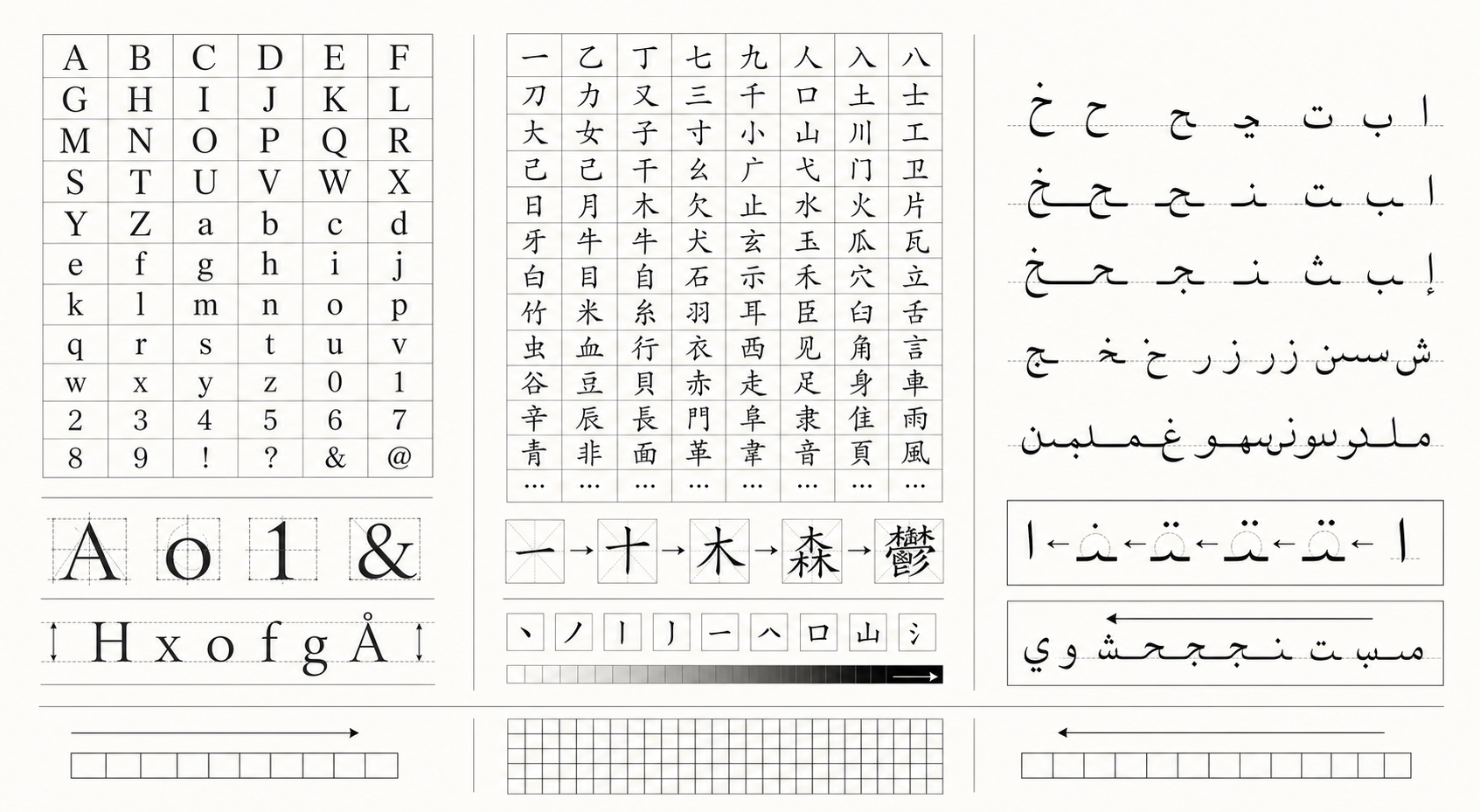
Latin script dominates most enterprise OCR tooling by design. Template-based extractors built around ASCII character sets fail structurally when they encounter Arabic's right-to-left bidirectional text, Chinese character sets with 20,000+ standard CJK Unified Ideographs (50,000+ in traditional Chinese), or Devanagari's stacked consonant clusters and vowel diacritics that sit above, below, and beside base characters simultaneously.
Three script families drive most of the architectural complexity in multilingual document parsing:
- Logographic systems (Chinese, Japanese, Korean): glyph vocabularies measured in the tens of thousands, with no whitespace separators between tokens.
- Bidirectional scripts (Arabic, Hebrew): text direction resolves per run, not per document, requiring direction inference when numerals or Latin strings interrupt the RTL flow.
- Abugida scripts (Devanagari, Tamil, Ethiopic): vowel markers attach to base consonants in ways that change character identity depending on position and combination.
| Script Family | Character Recognition Challenge | Production Failure Mode |
|---|---|---|
| Latin (English, French, Spanish) | 26-letter discrete alphabets with horizontal left-to-right flow and whitespace token boundaries | Template-based extractors work on fixed layouts but reset on first structural variation in multi-page documents |
| Arabic/Hebrew (RTL Scripts) | Contextual letter shaping where character form changes by position, plus bidirectional text requiring per-run direction resolution | Standard OCR reverses word sequences, misorders characters within words, and collapses mixed Latin-Arabic content in invoices |
| CJK (Chinese, Japanese, Korean) | 20,000+ logographic glyphs (50,000+ in traditional Chinese) with no whitespace separators requiring different tokenization logic per language | Regex extractors misclassify kanji vendor names as invalid data; word segmentation errors misalign every field after the first error |
| Devanagari/Indic Scripts | Stacked consonant clusters with vowel diacritics above, below, and beside base characters that alter character identity | Bounding-box extractors miss or misread entire syllables when vowel markers stack; field extraction skips conjunct clusters |
A 100 language OCR API that handles all three families treats script detection as a prerequisite inference step, not a configuration option teams set manually per document type.
Right-to-Left Languages and Bidirectional Text Handling
Arabic, Hebrew, Urdu, and Farsi introduce a compound text flow problem beyond simple direction. A standard OCR engine optimized for left-to-right reading misorders characters within words, reverses word sequences across lines, and collapses bidirectional mixed content where numerals or Latin strings appear inside RTL text blocks. The result is structurally broken output that downstream field extractors cannot recover from.
Production RTL handling requires three distinct layers: Unicode bidirectional algorithm compliance for correct character ordering, script-aware segmentation that treats connected Arabic glyphs as single tokens instead of isolated code points, and line-level direction inference that holds when numerals interrupt the RTL flow. Without all three layers, mixed-content documents like Arabic invoices with embedded Latin product codes produce misaligned field boundaries and dropped values at extraction time.
Teams processing Arabic contracts, Hebrew financial statements, or Urdu medical records need a multilingual document parsing pipeline where RTL logic is built into the OCR layer itself, not patched on top as a post-processing step.
Vision Language Models: The Shift From Character Recognition to Document Understanding
Traditional OCR reads pixels and outputs characters; VLMs read pixels and output meaning. That architectural difference determines whether a multilingual document processing pipeline survives contact with real production documents.
Character-level recognition treats a Japanese invoice and an Arabic shipping manifest as sequences of glyphs to be decoded. Field boundaries, table structures, reading direction, and semantic relationships between values all require separate post-processing logic layered on top. Each language adds another rule set. Each rule set adds another failure mode.
VLMs ingest the full document image and reason over layout, typography, and content simultaneously. A form field in Hebrew and the same field in Thai resolve to the same structured output without separate extraction templates per language. Reading direction, right-to-left or top-to-bottom, gets handled at the model layer. With traditional OCR stacks, accuracy degrades as language count grows and maintenance cost scales with every new locale added; VLM-based architectures invert that relationship. Extend's Parse 2.0, validated on RealDoc-Bench across 1,500 samples and 581 documents, achieves 0.847 Adjusted F1 on layout accuracy and 95.7% document Q&A accuracy across logistics, healthcare, financial services, and real estate. The structured JSON output feeds directly into LLM reasoning layers and downstream automation without intermediate cleaning or schema normalization per language variant.
Language Detection and Automatic Script Identification
Before extraction begins, a multilingual document processing pipeline must resolve two upstream problems: which language is present, and which script encodes it. Script identification handles the segmentation problem: Devanagari blocks route differently than Arabic right-to-left runs, which route differently than CJK character clusters. Getting this wrong upstream means field extractors receive mismatched encoding contexts and structured output breaks before any LLM sees the document. Detection runs per text region, so mixed-script documents resolve correctly without manual pre-labeling.
Two detection behaviors matter in practice:
- Per-region script segmentation: a Southeast Asian logistics manifest with Thai headers, English part numbers, and Chinese supplier names in the same table gets three separate script classifications, one per text region. Each extraction layer receives correctly segmented input, so the Thai header value, the English SKU, and the Chinese vendor name land in the right fields instead of bleeding across boundaries when detection runs on the full page as a single unit.
- Confidence-scored language identification: on a mixed Arabic/Latin invoice where a vendor abbreviation is ambiguous between Arabic and Roman script, the detection layer scores that region low-confidence and routes it to human review. The misclassification never propagates silently into the ERP ingestion layer, and the correction is recorded against the specific region that failed, not the document as a whole.
Teams running high-volume pipelines across 100+ languages see the downstream payoff here: accurate script identification at the region level means the extraction layer receives clean, correctly segmented input, which is what makes structured JSON output reliable enough to feed directly into approval engines or ERP ingestion pipelines without an intermediate cleaning pass.
Performance Degradation on Non-Latin Scripts: The Benchmark Reality
Most OCR systems report aggregate accuracy figures that obscure how performance varies by script. A pipeline achieving 97% accuracy on Latin-script documents frequently drops to 85-90% on Arabic or Hebrew, where right-to-left text flow and contextual letter shaping require fundamentally different segmentation logic. For Indic scripts like Devanagari or Tamil, character stacking and vowel diacritics cause bounding-box-based extractors to misread or skip entire syllables. CJK documents add another failure class: no whitespace between tokens means word segmentation errors compound downstream, misaligning every field that follows a single error. Teams processing cross-border logistics documents, international KYC packets, or multilingual insurance filings hit these failure modes on the first batch of non-English documents. Teams need accuracy figures broken down by script family, not rolled up into a single aggregate that masks where their specific document corpus will fail.
Production Scale Throughput and API Architecture
At production scale, document throughput requirements outpace what synchronous extraction pipelines can deliver. Extend's Parse API handles batch ingestion across document types and languages without separate pipeline configurations per language family. A single API call accepts PDFs, scanned images, and mixed-format bundles regardless of source language, returning structured JSON that downstream LLMs and orchestration agents consume directly.
Language-specific processing introduces latency variance that single-language pipelines never encounter. RTL scripts, CJK character sets, and Indic scripts with conjunct consonants each carry different OCR compute profiles. Async job submission with webhook callbacks lets teams handle high-volume batches without holding open HTTP connections, and per-document confidence scores surface at the field level so routing logic sends low-confidence extractions to human review automatically.
Multilingual content appears most frequently in production across logistics, healthcare, financial services, and real estate, the same verticals covered in the RealDoc-Bench benchmark. Extend AI's funding supports continued advancement of these multilingual parsing capabilities.
100+ Language Support at Production Scale With Extend
Extend's Parse 2.0 handles multilingual document parsing across 100+ languages without requiring separate models or language-specific template configurations per locale. OCR, specialized computer vision models, and VLMs process Arabic right-to-left layouts, CJK character sets, Devanagari scripts, and Latin-based European languages through the same API surface, outputting structured JSON that downstream LLMs and automation agents consume directly.
Teams processing cross-border logistics documents, international loan packages, or multilingual insurance claims route all document types through a single ingestion pipeline. There is no per-language model selection, no locale-specific preprocessing step, and no separate queue for non-Latin scripts.
Parse 2.0 leads on layout accuracy with an Adjusted F1 of 0.847 across 1,500 samples on the RealDoc-Bench benchmark, measured across logistics, healthcare, financial services, and real estate documents. Document Q&A output accuracy reaches 95.7% across 1,359 prompts and 581 documents.
Final Thoughts on Deploying Document Extraction Across Language Boundaries
Production document processing pipelines hit real constraints the moment non-Latin scripts enter the queue. Right-to-left text direction, character stacking, and logographic segmentation require different extraction models entirely. Parse 2.0 processes Arabic contracts, Japanese invoices, and Devanagari records through the same API surface that handles English documents. Test it on your actual corpus to validate extraction accuracy before committing infrastructure.
FAQ
Can I build multilingual document processing without separate OCR models per language?
Yes. Extend's Parse 2.0 processes Arabic right-to-left layouts, CJK character sets, Devanagari scripts, and Latin-based European languages through a single API that outputs structured JSON regardless of source language. Teams route all document types through one ingestion pipeline without per-language model selection or locale-specific preprocessing steps.
How do vision language models handle script detection differently than traditional OCR?
VLMs resolve script identification at the character-block level instead of treating the entire document as a single language unit, which means mixed-script documents with Thai headers, English part numbers, and Chinese supplier names in the same table extract correctly without manual pre-labeling. Traditional OCR engines fail on these documents because they apply detection once per document and misorder fields when multiple scripts appear within a single page.
What breaks when OCR systems process right-to-left languages like Arabic or Hebrew?
Standard OCR engines optimized for left-to-right reading misorder characters within words, reverse word sequences across lines, and collapse bidirectional mixed content where numerals or Latin strings appear inside RTL text blocks. Production RTL handling requires Unicode bidirectional algorithm compliance, script-aware segmentation that treats connected Arabic glyphs as single tokens, and line-level direction inference that holds when numerals interrupt the RTL flow. Without all three, downstream field extractors receive structurally broken output they cannot recover from.
Multilingual OCR API performance: how does accuracy vary by script family?
OCR systems reporting 97% accuracy on Latin-script documents frequently drop to 85-90% on Arabic or Hebrew where right-to-left text flow and contextual letter shaping require different text segmentation logic, while Indic scripts like Devanagari cause character stacking errors that make bounding-box-based extractors misread or skip entire syllables. Parse 2.0 validated on RealDoc-Bench achieves 0.847 Adjusted F1 across 1,500 samples spanning logistics, healthcare, financial services, and real estate documents with multilingual content.