Healthcare providers face mounting pressure from prior authorization workflows that consume 13 hours of staff time weekly per physician while delaying patient care. Manual paper-based processes can't meet CMS's January 2026 mandate requiring payers to respond within 7 calendar days, forcing practices to adopt electronic prior authorization systems. Automated solutions handle form processing challenges that defeat traditional OCR (checkboxes, handwritten physician notes, and state-specific Medicaid templates) through vision models and direct payer API connections.
This guide covers how prior auth automation works, the regulatory changes driving adoption in 2026, and practical vendor selection criteria for practices comparing clearinghouses, specialized platforms, and document processing tools. Organizations implementing these systems reduce claim denials, shrink administrative teams, and redirect staff hours from paperwork to patient care while maintaining compliance with shortened approval windows.
TLDR:
- Cut your prior auth processing from days to hours with automated systems that extract EHR data, validate payer requirements, and transmit requests through APIs instead of manual faxing.
- Meet CMS's January 2026 mandate requiring 7-day payer responses (down from 14 days) by replacing paper workflows that consume 13 hours of staff time weekly per physician handling 39 requests.
- Choose vendors based on your form complexity: clearinghouses like Waystar and Availity for broad payer connectivity, specialized platforms like Myndshft for complex workflows, or document processing tools like Extend for state-specific Medicaid templates with checkboxes and handwriting.
- Reduce claim denials from expired authorizations and shrink administrative teams by automating validation checks that catch missing documentation before submission.
- Request demos from vendors showing how their systems handle your specific payer mix, form types, and EHR integration requirements before committing.
What Is Prior Auth Automation
Prior auth automation uses software and AI to handle insurance approvals that providers need before delivering treatments, medications, or procedures. Automated systems submit requests electronically and track approval status without staff manually completing forms, making calls, or sending faxes.
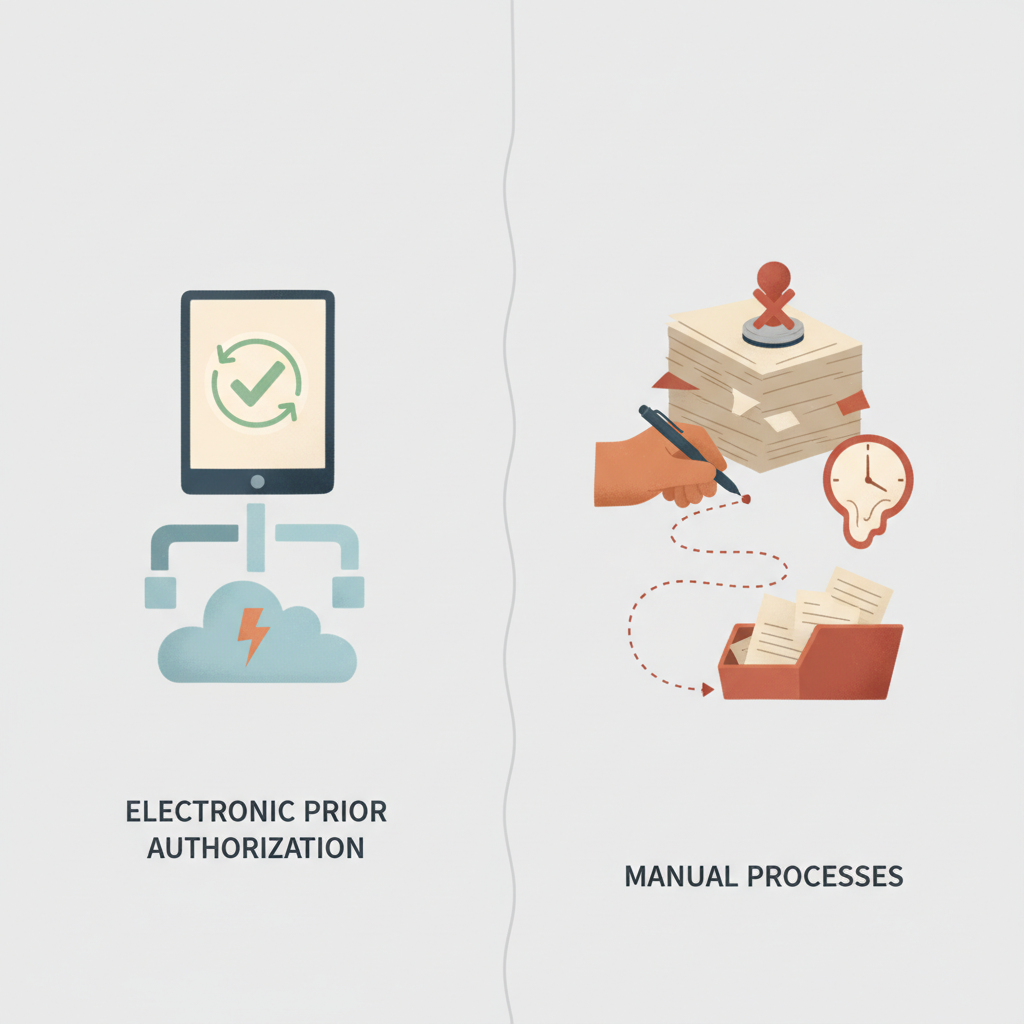
Electronic prior authorization creates direct digital connections between provider systems, pharmacies, and payers through standardized data formats. This eliminates paper workflows entirely, unlike manual processes that require pulling charts, completing payer forms, faxing requests, and waiting days for responses.
These solutions connect EHRs to payer portals, validate requests against payer requirements before submission, and flag incomplete information early.
The Administrative Burden on Healthcare Providers
Medical practices handle 39 prior authorization requests per physician each week. Each request requires gathering clinical documentation, contacting payer portals, completing forms, and tracking responses across multiple systems.
The aggregate impact is staggering. Physicians and their staff spend an average of 13 hours completing those requests each week. This represents thousands of hours that could otherwise go toward direct patient care.
Staff members work across different payer portals, each with unique login credentials, requirements, and interfaces. Many practices assign dedicated personnel just to manage the prior auth queue.
Impact on Patient Care and Clinical Outcomes
Prior authorization delays directly harm patient outcomes. 93% of physicians report these delays impact patient care, while 89% link the process to physician burnout. Patients wait days or weeks for medications and procedures, creating treatment gaps.
Extended approval timelines lead to treatment abandonment. Patients skip medications, postpone surgeries, or forgo imaging studies when authorizations drag on. Time-sensitive conditions suffer the most, with delayed treatment worsening outcomes.
Automation cuts processing time from days to hours. Faster approvals mean earlier treatment starts, better medication adherence, and fewer health complications during authorization waits.
Electronic Prior Authorization vs Manual Processes
Electronic prior authorization systems transmit structured EHR data directly to payers via protocols like FHIR, eliminating the need for staff to track down records, complete payer PDFs, and follow up by phone. Clinical documentation auto-populates requests, cutting submission time below two minutes. Decisions return in hours instead of the 2-5 business days typical for faxed forms. Validation checks catch missing fields before submission, reducing the transcription errors and incomplete data that trigger manual rejections.
Common Prior Authorization Challenges
Each payer operates with different requirements, forms, and submission portals. A request approved by one insurer gets rejected by another for the same procedure because documentation standards vary across health plans.
Determining requirements before submission creates guesswork. Medical necessity criteria change without notice. Staff find out about missing information only after rejection, restarting the entire cycle.
Manual data entry introduces errors in patient IDs, procedure codes, and dates. Pulling clinical notes, test results, and diagnosis codes from patient charts takes time, and missing attachments force resubmission.
How Prior Auth Automation Works
Automated prior auth systems connect to EHRs and extract patient data and clinical documentation when providers order services requiring approval. The software validates payer-specific criteria to identify which services need authorization and determines required supporting materials.
After retrieval, the system formats clinical data into standardized outputs and transmits requests through APIs or clearinghouses linked to payer systems. Real-time tracking monitors each submission, notifying staff when additional information is requested or decisions are issued. Approvals return to the EHR automatically, updating patient records without manual intervention.
Benefits of Implementing Prior Auth Automation
Automated systems reduce prior auth processing from days to hours. Faster approvals improve revenue cycles, cut claim denials from expired authorizations, and allow earlier treatment starts. Staff process higher volumes without additional headcount while administrative costs fall through reduced workflow automation.
Organizations shrink FTE requirements for prior auth teams, reallocating staff to clinical work. Pre-submission validation catches missing documentation and incorrect codes before submission, reducing rejections and rework. Clean requests receive faster payer responses and fewer denials.
SamaCare, which operates the largest provider network in the U.S. for prior authorization, built their clinical document autofill feature in just 3 weeks using document processing APIs. The platform now processes over 500,000 pages per month at 98% accuracy, handling handwriting, signatures, and checkboxes that traditional systems miss. Providers drag and drop clinical documents and insurance cards to auto-generate prior authorization drafts, cutting manual data entry entirely.
Staff satisfaction rises as automation eliminates repetitive tasks. Clinicians redirect time from paperwork to patient care. Lower administrative burden reduces burnout and improves retention.
Regulatory Changes Driving Adoption in 2026
CMS mandates insurers respond to prior authorization requests within 7 calendar days starting January 2026, cutting the previous 14-day window in half. By 2027, at least 80% of electronic prior authorization approvals must receive real-time decisions.
These rules force payers to build faster decision systems, but providers bear the burden if their submission workflows remain manual. Paper-based processes can't meet seven-day turnarounds consistently when staff manually gather documentation and fax requests. The shortened timelines make prior auth automation necessary for practices to meet deadlines without risking delayed care and revenue cycle disruptions.
Key Vendors and Solutions in the Prior Auth Space
Compare vendors based on your current authorization volume, form complexity, and existing EHR infrastructure. Practices handling high volumes of state-specific Medicaid forms benefit most from document processing specialists, while those focused on broad connectivity should consider clearinghouses with proven payer networks.
| Solution Type | Key Vendors | Best For | Key Strengths |
|---|---|---|---|
| Document Processing Tools | Extend | Automating prior auth at scale by processing messy handwritten forms, state-specific templates, character-per-box fields | Vision models for checkboxes and handwriting, handles form variations, high accuracy on complex layouts |
| Clearinghouses | Waystar, Availity, Surescripts | Practices needing broad payer connectivity alongside claims processing | Existing integrations, bundled revenue cycle management, proven payer networks |
| Specialized Platforms | Myndshft, CoverMyMeds, Tandem AI | Complex authorization scenarios requiring deep functionality | Dedicated auth workflows, advanced tracking, appeals management, real-time status updates |
| Payer Portals | OptumRx, UHC Optum | Providers working primarily with specific payers | Direct payer integration, proprietary workflows, no third-party needed |
Form Processing Challenges in Prior Authorization
Prior auth forms contain checkboxes, handwritten physician notes, and character-per-box fields that defeat traditional OCR. Basic text recognition misses checked boxes, misreads cursive signatures, and loses table structure across page breaks - challenges that extend to other PDF extraction scenarios involving complex forms.
State-specific variations multiply complexity. Medicaid forms differ by state, pharmacy benefit managers use proprietary templates, and payers modify layouts without notice. A system trained on one insurer's form fails when that payer updates their PDF.
Accurate processing requires vision models that detect form elements, understand spatial relationships between fields and labels, and handle partial completions where some boxes remain blank.
The Role of Document Processing Technology
Intelligent document processing solves the structural challenges that make prior auth forms resistant to basic digitization. Vision models trained on form layouts detect spatial relationships between checkboxes, labels, and signature fields that traditional text extraction misses - capabilities found in modern IDP tools built for healthcare workflows.
Modern systems use hybrid approaches combining computer vision for element detection with vision-language models for context-aware extraction. A checkbox marked in a multi-page Medicaid form gets correctly associated with its corresponding question three pages earlier through layout understanding instead of proximity alone.
Character-per-box fields (common in government forms for SSNs, dates, and ID numbers) require specialized recognition. Each box contains a single character, and standard OCR treats these as disconnected symbols instead of unified values. Vision models reconstruct these sequences by understanding form structure.
Handwritten physician notes present variable legibility across cursive styles, abbreviations, and medical shorthand. Training data from clinical documentation improves recognition accuracy for common patterns like dosage instructions and diagnosis codes. Handwriting OCR tools trained on business documents handle cursive signatures, margin notes, and partially completed fields that appear on authorization forms.
Confidence scoring flags uncertain extractions for human review before submission. A 92% confidence score on a handwritten date triggers review, while a 99% score on a printed procedure code passes through automatically. This selective escalation maintains accuracy without reviewing every field.
State-specific form variations require systems that generalize across layouts. A solution trained on California Medicaid forms should handle Texas templates without retraining. Transfer learning from large document corpora supports this adaptability, where models learn form conventions instead of memorizing specific templates.
Tools like Extend process complex prior auth forms by routing different regions through specialized models (checkboxes to detection models, handwriting to vision-language models, tables to layout-aware extractors). This agentic approach, powered by Extend's document processing APIs, handles the mixed content that appears on real-world authorization requests.
Real-world implementations demonstrate this capability at scale. SamaCare processes nearly 99% of their document volume through automated document processing, handling over 500,000 pages monthly across varying payer formats, letterheads, and requirements. Their platform uses classification APIs for real-time user feedback and extraction APIs to auto-populate prior authorization drafts from clinical documents, closing the loop on the entire PA workflow.
Final Thoughts on Prior Authorization Software
Prior authorization automation has become necessary infrastructure for healthcare providers facing CMS's 2026 compliance deadlines and rising authorization volumes. The shift from manual fax-based workflows to automated prior authorization software solves both regulatory pressure and workflow bottlenecks, making vendor selection a strategic decision instead of a technology upgrade. Practices should assess solutions based on payer connectivity breadth, form processing capabilities for complex state-specific templates, and integration depth with existing EHR systems to handle the 39 weekly authorization requests per physician without expanding administrative staff.
Extend was built to handle the exact form processing challenges that make prior authorization so painful. As the complete document processing toolkit comprised of the most accurate parsing, extraction, and splitting APIs, Extend helps healthcare organizations ship their hardest prior auth use cases in minutes, not months.
Book a call to see how our document processing APIs work with your authorization workflows.
FAQ
How do electronic prior authorization systems reduce processing time from days to hours?
Electronic systems extract structured data directly from EHRs and transmit requests through APIs to payer systems, eliminating manual chart review, form completion, and fax workflows. Pre-submission validation catches missing fields before requests leave the practice, preventing rejection cycles that add days to manual processes.
What prior authorization tasks consume the most staff time in manual workflows?
Staff spend time working across separate payer portals with unique login credentials, pulling clinical documentation from patient charts, manually completing payer-specific forms, and tracking submission status through phone calls.
When should practices consider switching from manual to automated prior authorization?
Practices handling 39+ prior authorization requests per physician weekly or experiencing frequent claim denials from expired authorizations should consider automation. The CMS 7-day response mandate starting January 2026 makes automation necessary for practices that can't meet shortened turnaround times with paper-based workflows.
Why do basic OCR systems fail on prior authorization forms?
Prior authorization forms contain checkboxes, handwritten physician notes, character-per-box fields, and multi-page tables that traditional OCR cannot parse accurately. State-specific Medicaid forms and payer-specific templates vary in layout, requiring vision models that detect spatial relationships between form elements instead of simple text recognition.
Can AI document processing handle payer-specific form variations without retraining?
Vision models detect form elements and extract data from checkboxes, signatures, and dense tables regardless of layout changes. Confidence scoring flags uncertain extractions for human review before submission, preventing rejection cycles when payers modify forms or introduce state-specific variations.