When a scanned invoice arrives with corrupted OCR output or a contract splits fields across page breaks, the failure happens before any reasoning logic runs. Preprocessing documents for LLM agents converts raw inputs (scanned PDFs, handwritten forms, image-based contracts) into structured, LLM-ready representations by handling format normalization, text extraction, layout detection, and semantic chunking before agents see the content. Skip that step and agents work on noise: misread table boundaries, hallucinated field values, and silent failures that compound across every downstream decision.
TLDR:
- Raw documents break agent pipelines before extraction logic runs; preprocessing converts scanned PDFs, handwritten forms, and multi-page bundles into structured, LLM-ready representations so agents receive organized content instead of noise.
- Production pipelines run four stages: ingestion normalizes formats, parsing extracts text and layout geometry, chunking preserves semantic boundaries within context windows, and enrichment attaches metadata for routing decisions.
- OCR degrades on skewed scans and multi-column layouts; layout detection prevents field mismatches by passing structural metadata alongside text so agents receive both content and organizational context.
- Semantic chunking splits at natural boundaries instead of fixed token counts, which prevents mid-sentence cuts that force agents to reason over incomplete units and hallucinate missing context.
- Extend's Parse 2.0 achieves 0.847 Adjusted F1 on layout accuracy and 95.7% on document Q&A across 581 documents in the RealDoc-Bench benchmark, handling tables, handwriting, and variable-format documents that break template-based preprocessors.
Why Document Preprocessing Matters for AI Agents
Raw documents break agent pipelines before extraction logic runs. A scanned PDF with no text layer, a 200-page loan package, or a handwritten form gives an LLM agent nothing structured to reason over. Preprocessing converts those inputs into structured representations. Without it, agents misread table boundaries and hallucinate field values that were never cleanly extracted.
The Document Preprocessing Pipeline for Agentic Workflows
A production-ready pipeline runs through four sequential stages:
- Ingestion: Normalizes formats across PDFs, scanned TIFFs, Word documents, and email attachments into a consistent representation the rest of the pipeline can process without format-specific branching logic.
- Parsing: Converts raw document bytes into structured, LLM-ready output, extracting text layers, table structures, and layout geometry so agents receive organized content instead of raw character streams.
- Chunking: Splits parsed output into context-window-sized segments while preserving semantic boundaries, keeping related fields together instead of splitting mid-clause or mid-table row.
- Enrichment: Attaches metadata like page numbers, confidence scores, and document type classifications so downstream agents route, filter, or escalate based on document properties instead of re-inferring them at query time.
Text Extraction and OCR: From Pixels to Structured Content
Scanned PDFs and image-based forms arrive as pixel data. OCR converts that into a text layer the agent can consume.
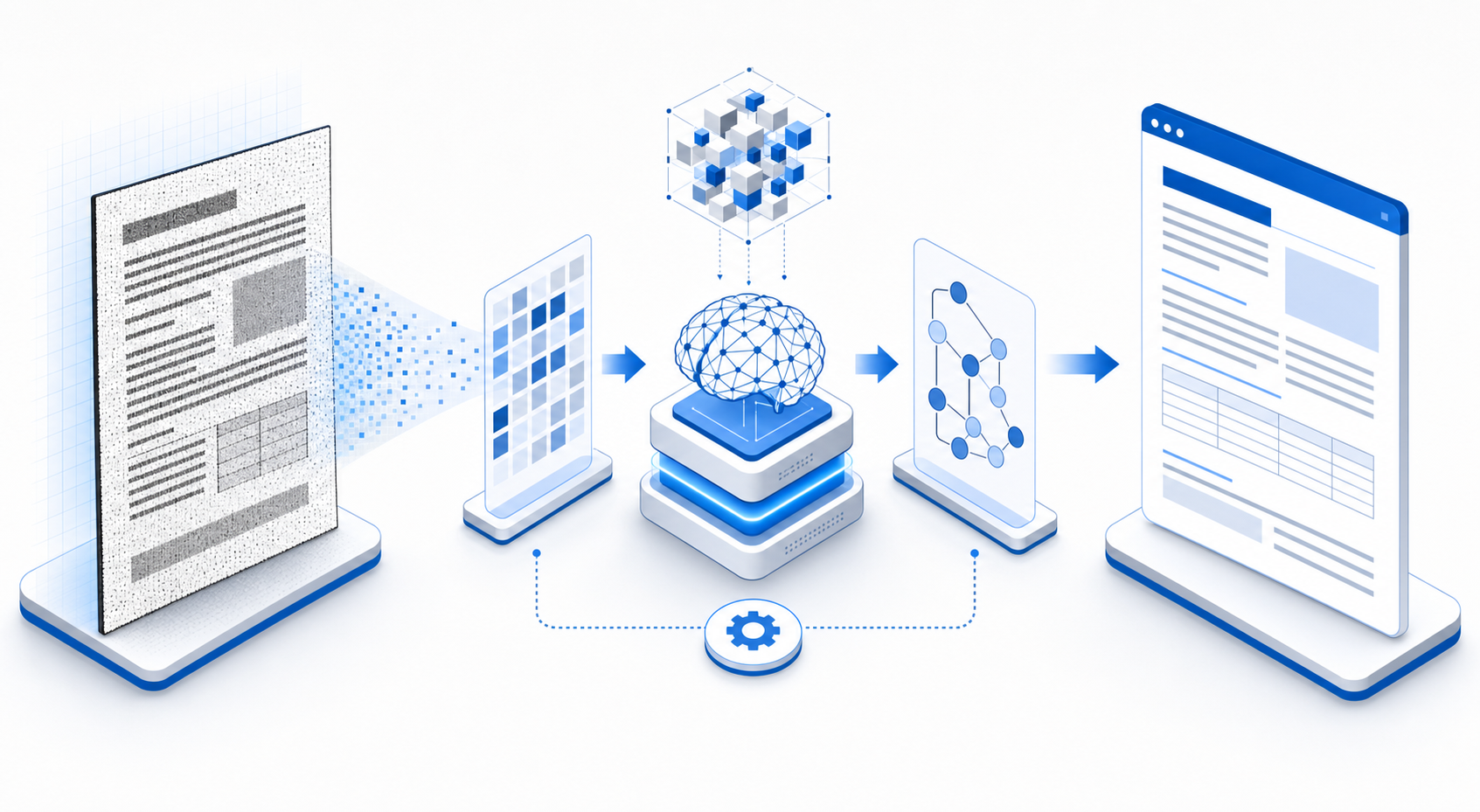
OCR quality directly determines downstream extraction accuracy. Standard OCR performs reliably on clean PDFs but degrades on:
- Skewed or low-resolution scans: Character boundaries blur and recognition confidence drops below usable thresholds, degrading output quality before extraction runs.
- Multi-column layouts and tables: Reading-order reconstruction fails and cells merge incorrectly into the extracted text stream.
- Handwritten fields: Model confidence is structurally lower when handwriting mixes with printed text, making field-level validation necessary.
- Embedded image text: OCR pipelines miss text inside embedded images entirely if the image layer is not detected and processed separately.
Layout Detection and Structural Understanding
Effective layout detection identifies headers, tables, form fields, and reading-order sequences, outputting a structured JSON or Markdown representation before the agent sees it. Teams working with complex document types benefit most from models trained on layout variability instead of fixed templates. Without this, LLMs fill structural gaps with inference, producing field-value mismatches and lost relational data.
Chunking Strategies for Long Documents and Context Windows
LLM context windows have hard token limits. Sending an entire 200-page document in one prompt produces degraded reasoning and missed fields.
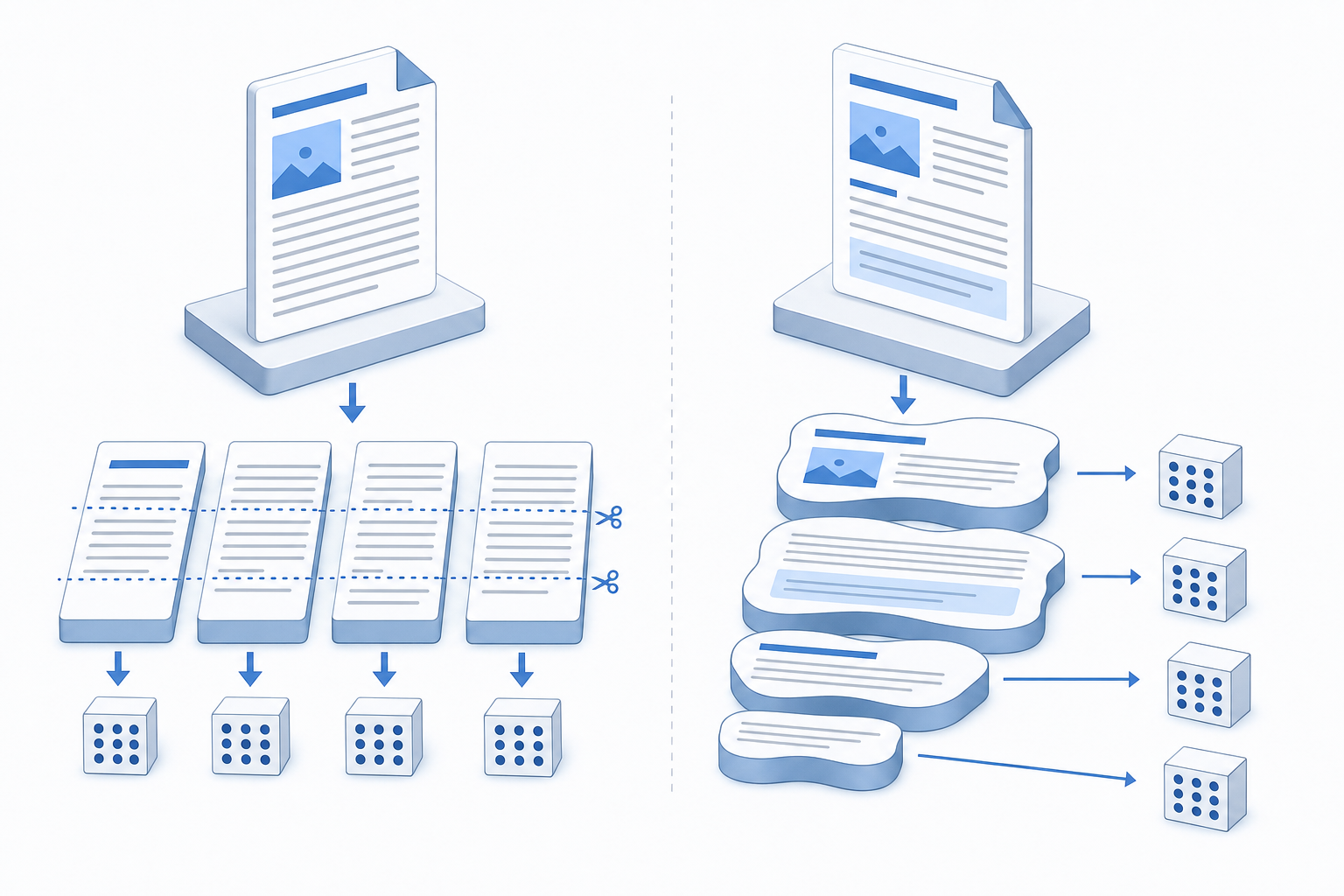
Chunking strategy selection determines whether agents receive coherent units or fragmented text. Two primary approaches:
- Fixed-size chunking: Splits at a set token count regardless of content boundaries. Fast and simple to implement, but routinely cuts sentences, table rows, or clause structures mid-thought, forcing the agent to reason over incomplete units.
- Semantic chunking: Splits at natural boundaries (paragraph breaks, section headers, or detected topic transitions). The resulting chunks are coherent units the agent reads the way a human analyst would, producing more consistent field extraction and fewer hallucinated completions.
| Dimension | Fixed-size chunking | Semantic chunking |
|---|---|---|
| Split logic | Cuts at a set token count regardless of content boundaries | Cuts at natural boundaries: paragraph breaks, section headers, detected topic transitions |
| Boundary handling | Routinely severs sentences, table rows, and clause structures mid-thought | Keeps related fields and clauses together as coherent units |
| Implementation effort | Fast and simple to set up | Higher, since it depends on structure detection |
| Agent reasoning impact | Forces agents to reason over incomplete units | Produces more consistent extraction and fewer hallucinated completions |
| Best fit | Uniform, low-stakes text where speed matters most | Structured or high-stakes documents where field accuracy matters |
For entities spanning boundaries, a small token overlap between adjacent chunks preserves cross-boundary context; teams tune the overlap to document density and entity length. Teams route summary chunks to classification, detail chunks to extraction, and ambiguous chunks to human review.
Document Quality Filtering and Validation
A quality filtering layer intercepts corrupted files, low-resolution scans, and password-protected PDFs before they consume agent resources. A validation step checks file integrity, resolution, and completeness.
Confidence scoring after extraction provides a second gate. Fields below threshold route to human review instead of automated decisioning. A 2026 benchmark across 37 LLMs found hallucination rates ranging between 15% and 52% on structured analysis tasks, showing how much output quality depends on the quality of inputs fed to the model.
Handling Edge Cases: Handwriting, Signatures, Tables, and Messy Scans
Handwritten fields get skipped by OCR layers trained on printed text. Dedicated handwriting recognition models recover those fields; signature detection runs as a separate binary classifier. Tables with merged cells must be reconstructed into logical structure before the agent sees them. Skewed or artifact-heavy scans require deskewing and noise filtering before OCR runs.
Deduplication and Document Splitting
Duplicate pages compound extraction errors. Deduplication runs at both page and document level before extraction. Splitting handles multi-document bundles: a 200-page loan package containing a W-2, bank statements, and title commitment needs separate extraction passes per document type to avoid field collisions.
Multimodal Preprocessing: Combining Text, Images, and Metadata
Effective multimodal preprocessing routes each content type through the appropriate model: OCR for scanned text, computer vision for layout and table detection, VLMs for mixed-format regions. The output is a unified, structured representation the agent reasons over directly. Skipping this separation produces hallucinated field values and confidence scores that don't reflect actual extraction accuracy.
Preprocessing Documents for Production AI Agents With Extend
Extend is the complete document processing toolkit made up of the most accurate parsing, extraction, and splitting APIs, built to ship the hardest document use cases in minutes, not months. Agents automate the entire lifecycle of document processing, allowing engineering teams to process their most complex documents and optimize performance at scale.
Parse 2.0 is the core parsing engine that powers this pipeline. It routes every page through specialized models for tables, forms, handwriting, signatures, and checkboxes. A single REST API call handles 35+ file types and 100+ languages, outputting structured, LLM-ready markdown that agents consume directly, with no intermediate cleaning, schema normalization, or field mapping required before agent handoff.
The preprocessing pipeline covers every stage that breaks raw document inputs:
- OCR and vision parsing: A hybrid computer vision and VLM pipeline handles skewed scans, low-resolution images, and handwritten fields that standard OCR misses. The layout model detects tables, checkboxes, signatures, and structural elements on every page before extraction runs.
- Semantic chunking: Four chunking strategies split documents at natural boundaries (paragraph breaks, section headers, detected topic transitions), preserving coherent units and preventing mid-clause cuts that force agents to reason over incomplete content.
- Confidence scoring and quality gates: A multi-pass Review Agent checks every extraction output, flags low-confidence fields with cited explanations, and routes documents below threshold to human review before they reach downstream decisioning systems.
- Performance modes: Teams toggle between speed, cost, and accuracy modes per document, routing simple files through a cost-optimized model and complex layouts through the performance model, without separate processors or workflows.
Parse 2.0 was validated through the RealDoc-Bench benchmark across 581 real-world documents spanning financial services, logistics, healthcare, and real estate. It leads at 0.847 Adjusted F1 on layout accuracy across 1,500 samples and 95.7% on document Q&A across 1,359 prompts, on variable-format documents that break template-based preprocessors.
Teams integrate via REST API and receive LLM-ready markdown output agents consume directly. No custom OCR stack, no template configuration, no separate infrastructure for tables, handwriting, or multi-page bundles.
Final Thoughts on Agent-Ready Document Processing
Preprocessing documents for LLM agents is the layer every downstream result traces back to: extraction accuracy and routing logic depend on whether OCR, layout detection, and chunking were handled correctly. Parse 2.0 delivers LLM-ready outputs across complex document types that template-based systems cannot parse reliably.
FAQ
Can I build document preprocessing pipelines without a custom OCR stack?
Yes. Extend's Parse 2.0 handles the complete OCR and vision pipeline through a single API, routing pages through specialized models for tables, forms, handwriting, signatures, and checkboxes without requiring you to build or maintain separate OCR infrastructure. Teams integrate via REST API and receive LLM-ready markdown output that agents consume directly.
What's the fastest way to validate preprocessing quality before production deployment?
Run extraction benchmarks on a representative sample of actual documents from your workflow, including layout variations, multi-page bundles, and handwritten or scanned inputs. Synthetic test sets miss the failure modes that show up in production. Track field extraction accuracy (target 99%+ for high-stakes documents), chunk coherence rate (how often retrieved chunks contain complete information), and human review escalation rate (the share of documents routed to manual review after preprocessing).
Preprocessing documents for llm agents with template-based systems vs vision models?
Template-based systems match fixed layouts and break on the first format variation, requiring new templates for each document type. Vision models parse structure directly from pixel data, handling layout variations without template configuration. Parse 2.0 routes pages through specialized vision models that resolve tables, handwriting, and signatures across 35+ file types and 100+ languages, achieving 0.847 Adjusted F1 on layout accuracy and 95.7% on document Q&A output across the RealDoc-Bench benchmark.
How do I handle documents that exceed LLM context windows?
Semantic chunking splits documents at natural boundaries (paragraph breaks, section headers, topic transitions) instead of fixed token counts, producing coherent units the agent reads without cutting mid-sentence or mid-table. For entities that span boundaries (locations wrapping across page breaks, clauses referencing earlier sections), apply a sliding window with a small token overlap between adjacent chunks, tuned to entity length and document density, to preserve cross-boundary context.