Few-shot document classification helps teams add new document categories when labeled data is limited. It does not guarantee accurate classification from a fixed number of examples. The result depends on the quality and coverage of the examples, the visual and semantic differences between classes, and evaluation on documents the model has not seen.
For document workflows, the practical value is faster onboarding. A team receiving a new payer's EOB format, a new carrier's bill of lading, or a county-specific deed can start with a small labeled support set, test the classifier, and expand the set when errors reveal gaps.
TLDR:
- Few-shot classification transfers knowledge from pretrained representations to new document categories with a small labeled support set.
- Five to twenty examples can be a starting point, not a production guarantee. The right sample size depends on class variation and the required error rate.
- Prototype-based, retrieval-based, and fine-tuned methods have different retraining and operational requirements.
- Text captures document vocabulary; page images capture layout, tables, headers, and other visual signals.
- Production evaluation requires held-out documents, per-class metrics, confusion analysis, and a review path for uncertain predictions.
What Is Few-Shot Document Classification?
Few-shot document classification assigns a document to a category using a small number of labeled examples for each class. Instead of collecting a large training set for every new category, the system uses a pretrained representation to compare a new document with its support examples.
The approach is useful when document taxonomies change faster than teams can label data. It is not a shortcut around evaluation. A support set must represent the documents that will arrive in production, and the classifier still needs a confidence threshold and an exception path.
The phrase “few-shot” describes the amount of labeled data available for adaptation. It does not describe one specific algorithm. Prototype networks, nearest-neighbor retrieval, lightweight fine-tuning, and prompting can all use few-shot examples, but they make different tradeoffs.
How the Classification Workflow Works
A practical few-shot workflow has four parts:
- Define the classes. Decide whether the system needs to distinguish invoices from purchase orders, or whether it also needs to distinguish carrier, jurisdiction, or document variant.
- Curate a support set. Select labeled examples that cover the layouts, issuers, and quality levels that occur in production.
- Classify new documents. Encode the support examples and the incoming document into a comparable representation, then score the candidate classes.
- Evaluate and review. Test on held-out documents, inspect errors by class, and send uncertain predictions to review instead of forcing a label.
A support set of five examples may work for two visually distinct classes. It may fail for a class that includes many issuers, layouts, scan qualities, or document subtypes. The correct sample size is the smallest set that meets the workflow's measured error tolerance.
Prototype and Retrieval-Based Classification
Prototype-based methods represent each class with one or more vectors derived from its labeled examples. A new document is assigned to the nearest class representation in the embedding space. The original Prototypical Networks paper describes this approach for few-shot classification.
A prototype can be easy to update: add labeled examples, recompute the class representation, and evaluate again. That does not mean the method works without limits. A single average vector can hide important variation inside a class, such as EOBs from many payers. Multiple prototypes or nearest-neighbor comparisons may represent that variation better.
Retrieval-based classification takes a related approach. It stores labeled examples in an index and retrieves the most similar examples for a new document. Retrieval can provide useful evidence for a reviewer, but similarity is not the same as a correct class. The system still needs a decision rule, a confidence threshold, and an evaluation set.
Fine-Tuning and Other Few-Shot Methods
Some few-shot methods update model parameters or a classifier head. SetFit, for example, uses contrastive learning with a small labeled dataset and then trains a classification head. This can be efficient, but it is different from a prototype lookup: adding a new class may require another training step.
Meta-learning methods such as MAML optimize a model to adapt quickly across many training tasks. They can be useful when rapid adaptation is a primary requirement, but they also require a suitable meta-training distribution. A method that adapts quickly on benchmark tasks may not transfer to a company's document formats without testing.
The implementation determines the operational behavior:
- Prototype or nearest-neighbor methods can often add a class by updating examples or vectors.
- Fine-tuned classifiers may require retraining a head or adapter.
- Prompt-based systems may require examples in the prompt and careful control of context size.
- Retrieval systems need index updates, similarity thresholds, and safeguards against near-duplicate errors.
Few-shot classification is therefore a data regime, not a promise that every method adds classes with no retraining.
Why Document Classification Often Needs Vision and Text
Document classes can share vocabulary while differing in layout. A purchase order and a packing list may contain similar terms but place them in different tables, headers, and sections. A text-only representation can lose those signals.
A multimodal classifier combines:
- Text features, which capture words, field labels, and document content.
- Visual features, which capture page layout, table boundaries, logos, stamps, signatures, and field placement.
Document-aware models such as LayoutLM show why text, layout, and visual information can be useful together. The right input depends on the classification task. If document classes are defined by content alone, text may be sufficient. If classes differ by form layout or issuer template, page images can add important evidence.
How to Build a Reliable Support Set
The support set is part of the classifier. Treat it like production configuration.
- Pull examples from real intake traffic, not only clean vendor samples.
- Include layout, issuer, scan-quality, and language variation that the workflow will encounter.
- Label examples independently when the class boundary is easy to misunderstand.
- Resolve disagreements before adding examples to the support set.
- Keep a held-out evaluation set that is not used to select or tune support examples.
- Track per-class precision, recall, and confusion instead of relying on one aggregate accuracy number.
- Re-evaluate after changing the support set, class definitions, or preprocessing.
A mislabeled support example can distort a prototype or retrieve the wrong neighbors. A missing variant can make a classifier look accurate in testing while failing on a common production format. Small-data methods reduce labeling work; they do not remove data-quality work.
Few-Shot Classification with Extend
Extend's Document Classification API identifies document types and variants. The relevant production question is not whether a fixed number of examples guarantees a result; it is whether the classifier can be evaluated and updated as the document distribution changes.
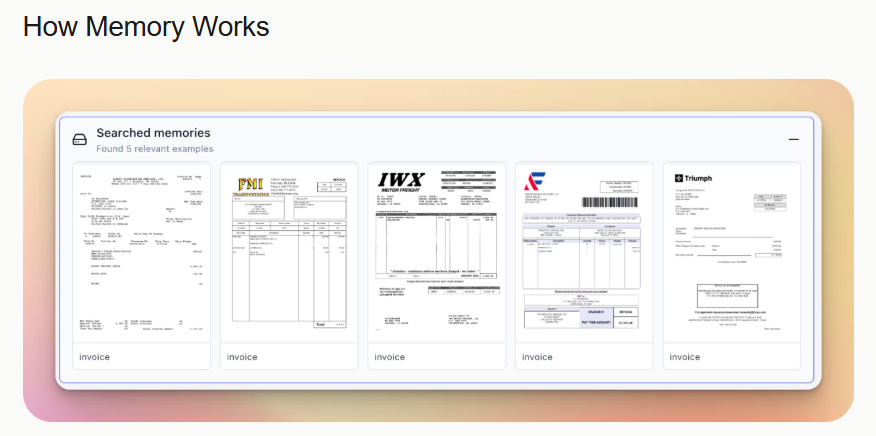
Extend Memory provides a retrieval-based way to use validated examples and visual patterns in document workflows. That is related to few-shot classification, but it should not be described as identical to prototypical networks, SetFit, or meta-learning. Teams still need to define the classes, curate representative examples, evaluate held-out documents, and route uncertain predictions to review.
In a workflow, classification should happen before document-specific extraction. A low-confidence prediction can route to a broader classifier, a review queue, or a fallback workflow instead of sending the document through the wrong extraction schema.
Final Thoughts on Teaching Systems New Document Types
Few-shot document classification reduces the labeled-data burden for new document categories. It does not make accuracy independent of data quality, class variation, or evaluation.
Start with representative production examples. Choose a method that matches the workflow's update and latency requirements. Use text, visual signals, or both based on the class boundary. Measure per-class performance on held-out documents, and route uncertain predictions to review before they select a downstream extraction path.
That is the production value of few-shot classification: faster adaptation with explicit checks on where the approach works and where it needs more data.
Test Extend's classification and retrieval APIs on your own document variants and measure the results against a held-out evaluation set.