Coordinate-dependent extraction fails before most teams notice the pattern: a vendor invoice arrives with column positions shifted two pixels from the expected bounding box, and the field drops silently before reaching the approval engine. The open source doc parsing vs. production APIs decision starts here. Open source document parsing pipelines handle clean, text-layer PDFs with predictable layouts well; accuracy degrades on scanned documents, multi-column layouts, and tables that span page boundaries because the extraction model assumes fixed spatial structure. Infrastructure costs run $15,000 to $40,000 annually at modest scale, but the harder number is the 20 to 30 percent of engineer time per quarter that goes into dependency management, version conflicts, and custom preprocessors the base library was never trained to handle. Whether open source fits a given pipeline or a production API fits better depends on three factors: data residency requirements, document volume, and how much layout variability the team expects before the first quarter ends.
TLDR:
- Open source parsers break on layout variability; coordinate-dependent extraction drops fields two pixels outside expected bounding boxes, which is why vendor invoices and loan packages fail before reaching downstream systems
- Self-hosting open source parsing runs $15,000-$40,000 annually in infrastructure costs, plus 20-30% of engineer time per quarter on dependency management and accuracy regression handling
- Open source fits three specific contexts: strict data residency requirements (HIPAA, localization mandates), low-volume pipelines with consistent layouts, and deep customization needs at the library level
- Table extraction is the highest-failure surface; merged cells, cross-page headers, and variable column spacing cause Camelot and pdfplumber to misalign or silently drop fields
- Extend's Parse 2.0 delivers a 0.847 Adjusted F1 on layout accuracy and 95.7% document Q&A output across 1,500 real-world samples on the RealDoc-Bench benchmark, outputting structured JSON that feeds approval engines and ERP pipelines directly
The Most Widely Used Open Source Document Parsing Libraries
These five libraries are among the most widely used open source tools for document parsing and extraction, forming the backbone of many document processing pipelines.
- PyMuPDF (fitz) extracts text, images, and metadata from PDFs with low latency and minimal dependencies. It performs well on clean, digitally native PDFs but, like most PDF parsers, cannot extract text from scanned documents unless paired with an OCR engine.
- Tesseract OCR remains the default open source OCR engine, covering 100+ languages and integrating into most Python pipelines. Accuracy drops on low-resolution scans, irregular fonts, and handwritten content without dedicated preprocessing.
- Apache Tika supports a wide variety of document formats through integrated parsers, making it a common choice in enterprise pipelines that ingest mixed document types. The JVM dependency adds infrastructure overhead.
- pdfplumber builds on pdfminer to expose table and layout extraction through a readable Python API. It works well on structured PDFs but has no built-in OCR support, so scanned documents typically produce little or no text unless OCR is run first.
- Camelot extracts tables from PDFs using two parsing modes: lattice for tables with visible ruling lines and stream for whitespace-delimited tables. While it can automatically detect tables, complex or changing layouts often require manually specifying table areas or tuning extraction parameters. Even small layout changes can reduce extraction accuracy without producing obvious errors.
Each of these tools solves a narrow, well-defined problem. Where they begin to struggle is at the intersection of format variability, processing volume, and field-level accuracy requirements that production document workflows actually impose.
Table Extraction: Where Open Source Parsers Struggle Most
The underlying failure is coordinate-dependency: layout models classify text regions by spatial position, so a field two pixels outside the expected bounding box gets misclassified or dropped before table reconstruction runs. Nested headers, multi-column layouts, and tables that span pages break open source parsers in predictable ways. A table with merged cells confuses row-boundary detection; extractors either duplicate values across merged cells or drop them entirely. When column headers appear only on the first page and data continues across subsequent pages, most open source multi-page table extraction tools lose the header-to-column mapping and return orphaned rows with no field attribution.
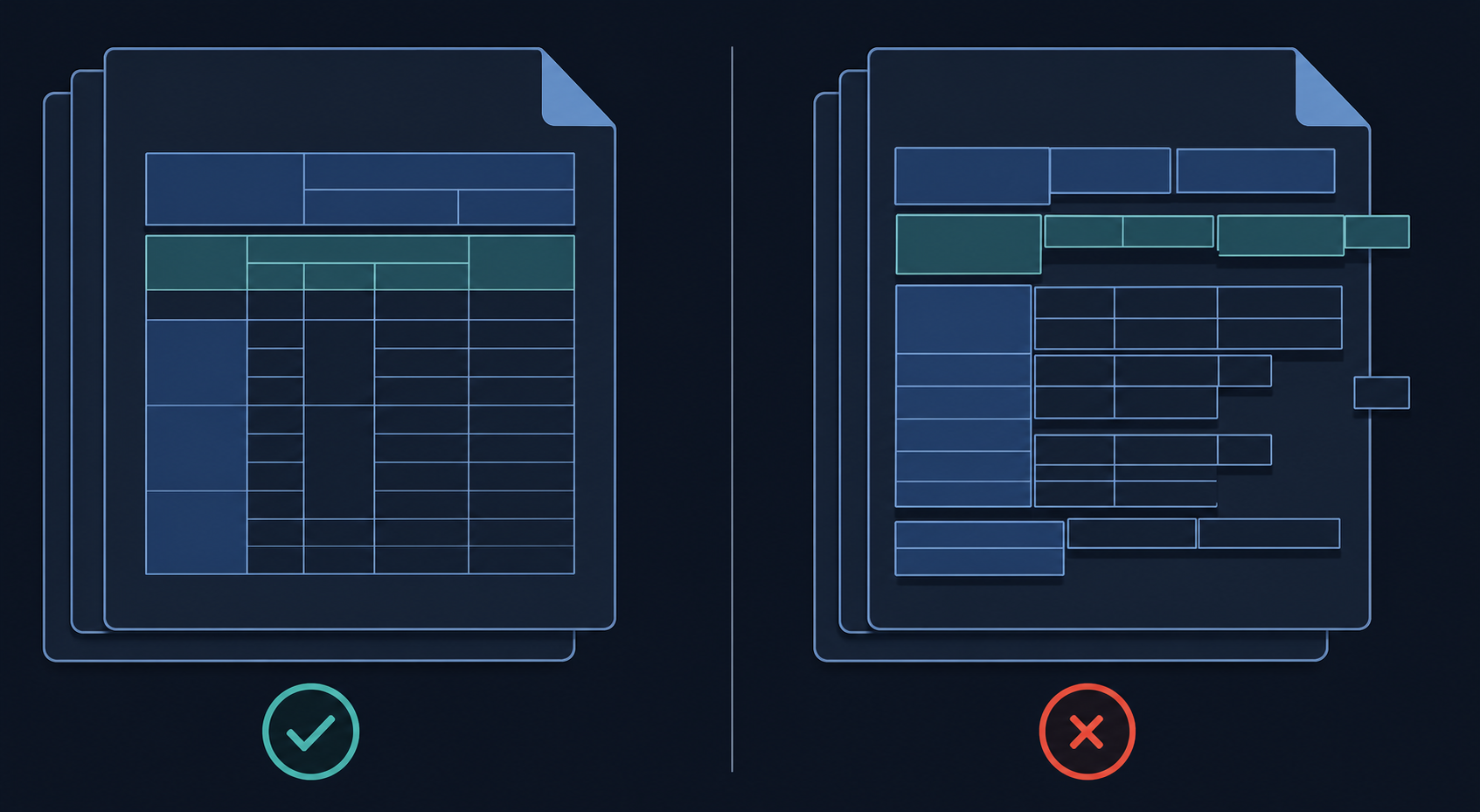
PDFPlumber handles simple grid tables reasonably well, but irregular column spacing causes it to misalign cells. Camelot requires explicit region coordinates, which means teams must hardcode bounding boxes per template, and any layout variation breaks extraction silently.
Production table failures tend to cluster around a few patterns: totals rows that span full width get parsed as separate single-cell tables, sub-headers embedded mid-table get treated as data rows, and right-aligned numeric columns shift position when font output varies across PDF generators.
Where Open Source Parser Accuracy Breaks Down
Open source parsers tell a different story at that same complexity level. A PDF parsing tool accuracy study across six document categories found accuracy varies widely by document type and layout complexity. Tools like PyMuPDF and pdfminer perform well on text-layer PDFs with predictable structure; accuracy drops on scanned documents, multi-column layouts, and tables that span page boundaries. That degradation is architectural: these libraries extract what the PDF spec exposes directly, so anything requiring layout inference or cross-page context resolution falls outside their design scope.
The practical gap shows up in error class, beyond error rate alone. Open source parsers tend to misorder columns in complex tables, drop footnotes that anchor critical fields, and lose context at page breaks. Each error class maps to a downstream failure in a real workflow.
The Hidden Costs of Self-Hosting Open Source Parsers
Teams running open source parsers in production encounter the real cost structure well after the initial commit. The license is free; the infrastructure is not. Compute, storage, and egress charges for self-hosted parsing workloads typically run $15,000 to $40,000 annually at modest scale. Engineering time tells the harder story: maintaining parser dependencies, handling library version conflicts, and writing custom logic for edge cases consumes 20 to 30 percent of an engineer's working hours each quarter. That overhead compounds in three consistent areas. OCR libraries, layout detection models, and format handlers each follow independent release cycles that break compatibility on upgrades. These tools ship no production monitoring or confidence scoring, so accuracy regressions surface only when downstream failures accumulate. Scanned PDFs, handwritten fields, and multi-column layouts each require custom preprocessors the base library was never trained to handle. Independent PDF parser accuracy benchmarks across 800+ documents show parser accuracy varies by more than 55 points across document domains, which directly determines how much manual correction overhead lands on the engineering team.

These costs scale with document volume. A pipeline processing 50,000 pages monthly needs meaningfully more infrastructure than one handling 5,000, but the engineering overhead to keep it accurate scales at roughly the same rate as the compute bill.
Production APIs absorb that maintenance surface entirely, which is why teams at high document volume tend to hit a crossover point where the build cost exceeds the subscription cost before the end of the first year.
When Open Source Is the Right Choice
Open source document parsing fits specific architectural contexts well. The decision comes down to data residency, budget constraints, and how much customization a team needs at the library level.
Teams with strict data governance requirements (healthcare organizations under HIPAA or financial institutions with data localization mandates) sometimes need on-premises processing where no document leaves the local environment. Open source libraries like pdfplumber, Tesseract, or Camelot run entirely within a team's own infrastructure, which satisfies those constraints without negotiating vendor data processing agreements.
Budget is the other driver. For teams building internal tooling on modest document volumes with relatively consistent layouts, the licensing cost of a production API adds up against limited return. Open source works here when the documents are structured enough that regex and rule-based extraction hold up, and when layout variation is low enough that template drift stays manageable.
The third context is deep customization. Teams building specialized pipelines (custom OCR fine-tuning, domain-specific table extraction logic, or proprietary preprocessing steps) sometimes need library-level access that managed APIs abstract away. Open source gives full control over the extraction stack, which matters when the use case sits far enough outside standard document types that off-the-shelf accuracy benchmarks stop being relevant.
Production APIs vs. Open Source: What Changes at Scale
At low volume, open source parsers hold up. Tesseract extracts text from clean scans, PDFMiner walks a PDF's object tree, and Camelot pulls structured tables with reasonable fidelity. The failure mode shows up when document variety increases: a new vendor invoice layout breaks the regex, a handwritten field slips past the OCR confidence threshold, and the review queue grows faster than the team patching templates.
Top PDF parsing APIs for complex documents are built around that reality. They ship versioned endpoints, SLA-backed uptime, and model updates that don't require teams to retrain or redeploy anything.
| Dimension | Open Source | Production API |
|---|---|---|
| Layout variability | Breaks on unseen formats | Handles variability by design |
| Maintenance burden | Teams own every fix | Vendor owns model updates |
| Accuracy on complex docs | Degrades without retraining | Consistent across document types |
| Scale | Manual intervention increases with volume | Throughput scales with demand |
| Time to production | High, requires integration work | Low, REST API with prebuilt connectors |
The architectural difference is who absorbs the document variability problem. Open source pushes it onto the engineering team. Production APIs absorb it at the model layer, so teams spend time on the workflows downstream, not on the parser itself.
How to Pick the Right Parser for Your Stack
Four questions separate a workable choice from a painful rewrite six months later.
- Layout variability: Document formats that change quarterly or arrive from multiple vendors with inconsistent layouts break open source template matchers; a production API with model-based extraction handles layout variation without re-engineering.
- Document volume: Pipelines processing more than a few thousand pages per month require weighing the engineering hours to operate, monitor, and scale open source infrastructure against the per-page cost of a managed API.
- Compliance requirements: Use cases touching sensitive data need audit trails, confidence scoring, and human-in-the-loop review alongside raw extraction speed.
- Time to production: Tight timelines favor managed APIs; open source document parsing software for developers typically requires weeks of integration and tuning before it ships.
The decision is rarely permanent. Teams often prototype with open source, hit layout variability or volume constraints before the first quarter ends, and migrate to a production API when manual correction queues start consuming engineering time.
How Extend Approaches the Production Parsing Problem
Extend is the complete document processing toolkit comprised of the most accurate parsing, extraction, and splitting APIs to ship your hardest use cases in minutes, not months. Extend's suite of models, infrastructure, and tooling is the most powerful custom document solution, without any of the overhead. Agents automate the entire lifecycle of document processing, allowing your engineering teams to process your most complex documents and optimize performance at scale. Where open source libraries hand off raw text and leave teams to build schema normalization, confidence routing, and human review queues from scratch, Extend ships that entire stack as production-ready infrastructure.
Parse 2.0, Extend's core parsing engine, leads on layout accuracy with an 0.847 Adjusted F1 across 1,500 samples and 95.7% document Q&A output accuracy across 1,359 prompts and 581 documents on the RealDoc-Bench benchmark, which measures performance on complex real-world documents across logistics, healthcare, financial services, and real estate.
What Extend Delivers Beyond Raw Extraction
Extend's suite of OCR, specialized computer vision models, and VLMs converts scanned PDFs and multi-page bundles into structured, LLM-ready JSON that downstream approval engines, ERP pipelines, and orchestration agents consume directly. No intermediate cleaning or field mapping required before agent handoff.
The extraction layer includes:
- Confidence scoring: Applied to every extracted field, with configurable thresholds that route low-confidence results to human-in-the-loop review before they reach downstream systems.
- Ingestion pipelines: Handle variable layouts, multi-page documents, and mixed-format bundles without template resets or per-page context loss.
- Document splitting tools: Segment multi-document packets by type before extraction runs, so a 200-page loan package routes its W-2s, pay stubs, and bank statements to the correct extraction model automatically.
This is the infrastructure layer that powers AI document agents and makes automated decisioning possible. Without accurate, structured output at ingestion, nothing downstream runs reliably.
Final Thoughts on Open Source Parsers and Production Document Workflows
Open source tools earn their place in specific setups: strict data residency, low volume, well-formatted documents. Outside those conditions, the maintenance surface grows fast and the accuracy gap widens on complex layouts. Most teams hit the crossover point sooner than expected. Get started with Extend to skip the infrastructure build and move straight to reliable extraction.
FAQ
What's the real cost difference between open source document parsing and a production API?
Open source licenses are free; the infrastructure running them is not. Self-hosted parsing workloads typically run $15,000 to $40,000 annually at modest scale, and maintaining dependencies, handling version conflicts, and writing custom edge case logic consumes 20 to 30 percent of an engineer's working hours each quarter. Most teams hit the crossover point where the production API subscription costs less than the engineering overhead before the end of the first year.
When does open source document parsing break down in production?
Open source parsers hold up on clean, text-layer PDFs with predictable layouts; accuracy degrades on scanned documents, multi-column layouts, and tables that span page boundaries because the extraction model assumes fixed spatial structure. The failure mode shows up in specific error classes: misaligned columns in complex tables, dropped footnotes that anchor critical fields, and lost context at page breaks. Each of those error classes maps to a downstream failure in a real workflow, which is why manual review queues grow faster than the team patching templates.
Should my team self-host an open source parser or use a managed API?
Teams with strict data residency requirements, including healthcare organizations under HIPAA or financial institutions with localization mandates, have legitimate architectural reasons to run open source libraries entirely within their own infrastructure. For teams processing more than a few thousand pages monthly with variable layouts from multiple vendors, a managed API absorbs the document variability problem at the model layer; open source pushes that problem onto the engineering team permanently.
How does Extend's Parse 2.0 perform against open source parsers on complex documents?
Parse 2.0 scored an Adjusted F1 of 0.847 on layout accuracy across 1,500 samples and 95.7% document Q&A output accuracy across 1,359 prompts on the RealDoc-Bench benchmark, which tests on complex production documents across logistics, healthcare, financial services, and real estate, not clean academic datasets. Open source tools like PyMuPDF and pdfminer perform well on structured text-layer PDFs; accuracy drops on the same complex document types because those tools extract what the PDF spec exposes directly, leaving layout inference and cross-page context resolution outside their design scope.
How do I handle multi-page table extraction without losing header-to-column mapping?
Open source tools like Camelot require hardcoded bounding box coordinates per template, and any layout variation breaks extraction silently; when column headers appear only on the first page, most open source extractors return orphaned rows with no field attribution on subsequent pages. Extend's extraction layer maintains document-scoped context across page boundaries, so column headers map correctly to rows across the full table span, and the Extract Agent performance mode achieves 99.2% accuracy on long array extraction benchmarks targeting these multi-page table use cases (per Extend's internal RealDoc-Bench evaluations).