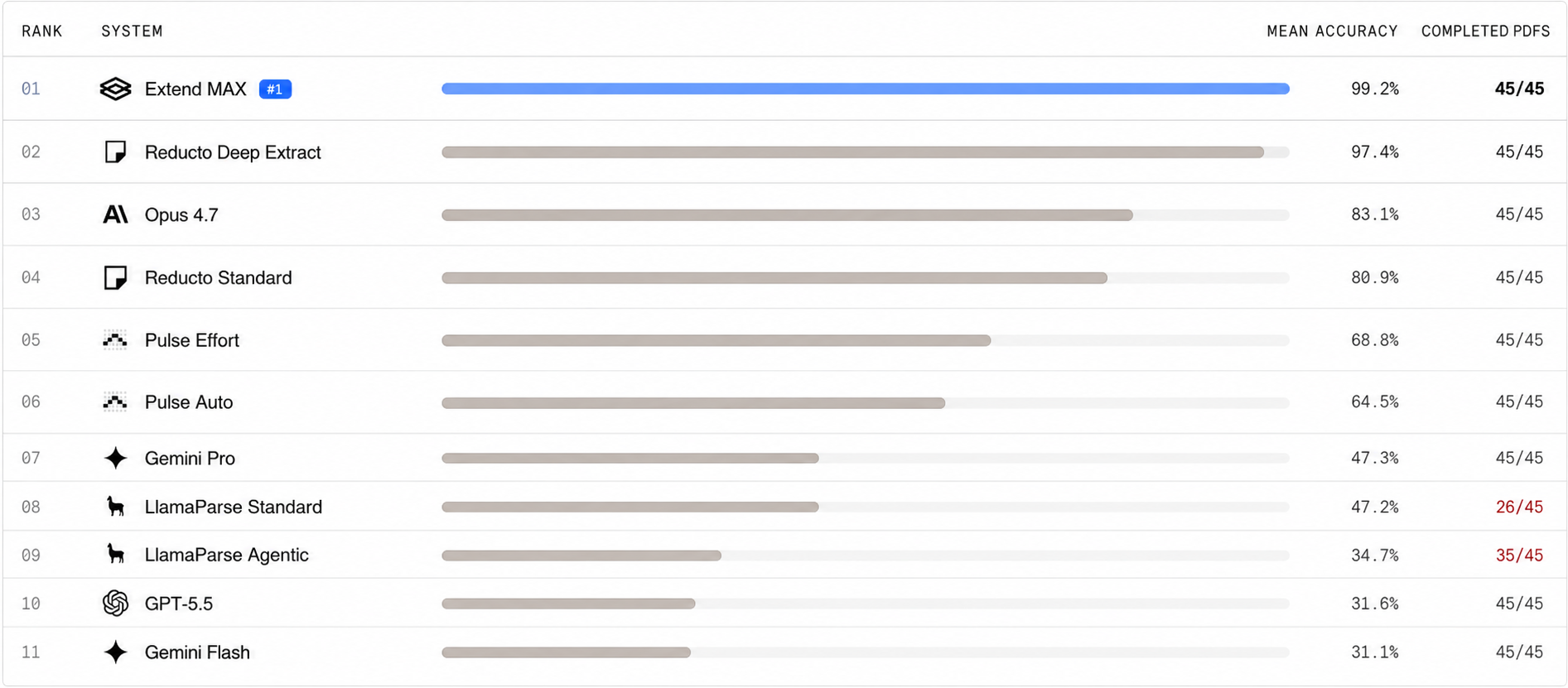
Most document extraction APIs perform about the same until they hit messy documents and edge cases, which show up constantly in production. Tables with thousands of rows, dense forms, and handwritten fields are where these APIs break, and most drop rows silently. That breakage is what renders most PDF extraction APIs unusable in production. This is an objective review of seven APIs against public benchmarks, documented capabilities, and verifiable product data, with an eye toward the breakage points typical of production document pipelines. Extraction accuracy is the primary filter: an extractor that drops a row or misreads a field corrupts everything downstream. On the LongArray-Extract benchmark, LlamaParse Standard scored 47.2%, Pulse Effort scored 68.8%, and Extend MAX hit 99.2% with 100% run completion.
TLDR:
- Extraction pulls the exact fields you define via a schema and returns them as structured JSON, with confidence scores and citations back to the source.
- Extraction accuracy on clean test documents does not predict accuracy on long arrays, dense forms, or handwritten fields.
- On LongArray-Extract, LlamaParse Standard scored 47.2% and Pulse Effort scored 68.8%, showing real production gaps.
- Extend scored 99.2% mean extraction accuracy on LongArray-Extract with 100% run completion, ahead of every provider tested.
- Only Extend ships schema versioning and a built-in evaluation framework out of the box.
What Is a Document Extraction API?
Extraction pulls the exact fields you need out of a document and returns them as structured JSON. You define a schema describing the fields you want, and the API returns each value with confidence scores and citations back to the source document. Use it to turn receipts, invoices, statements, contracts, and forms into reliable, machine-readable data.
Engineers reach for them because agents and downstream pipelines can't act on data trapped in unstructured documents.
Accuracy decides whether an API is usable in production. A parser that drops a row, misreads a checkbox, or ties a value to the wrong label poisons everything downstream. That's why we rank by accuracy first.
How We Ranked These Document Extraction APIs
We ranked each API against six dimensions that separate production-grade tools from basic OCR, using public benchmarks, documented capabilities, and verifiable product information over vendor claims.
- Extraction accuracy: performance on complex, real-world documents including dense forms, handwriting, nested tables, and long repeating arrays.
- Structured JSON output: per-field confidence scores and precise citations back to the source.
- Document type breadth: support for varied layouts and document types across industries.
- Built-in tooling: evaluation sets and schema versioning.
- Enterprise readiness: SOC 2, HIPAA, and GDPR compliance, deployment flexibility, and zero data retention (ZDR) availability.
- Latency and cost control: tunable processing across different workload profiles.
Best Overall Document Extraction API: Extend
Engineers are building agents that can take on increasingly complex work, but those agents can't act on critical data trapped in messy, unstructured documents. Extend delivers a production-ready document ingestion layer that turns those documents into structured output that agents can reliably use, freeing up engineers to focus on building their core product. It provides APIs that cover parsing, extraction, splitting, classification, and form filling, while giving you a complete toolkit to support deployment and controls over accuracy, latency, and cost.
Here is where Extend pulls ahead:
Extraction accuracy: on LongArray-Extract, Extend MAX scored 99.2% mean extraction accuracy across 45 PDFs with arrays up to 2,205 rows, running nearly 3x faster than Reducto with better accuracy.
Run completion: on LongArray-Extract, Extend completed 100% of runs (45 of 45 PDFs) while other systems failed or timed out on the longest arrays, a drop that counts as zero because failed runs are penalized.
Complete pipeline: parsing, extraction, classification, splitting, form filling, versioned workflows, evaluation sets, a Review Agent, and the Composer optimization agent.
Enterprise controls: SOC 2, HIPAA, GDPR, zero data retention for paid customers on request, cloud deployment on every tier, Enterprise self-hosted/BYOC deployment, and audit logs with version history.
Light and Performance Parse: Light Parse reaches 90.5% field-level accuracy on RealDoc-Bench at $0.00625 per page for straightforward, high-volume documents. Performance Parse (Parse 2.0) is the right engine for dense forms, handwriting, and large tables.
Extend is the only option pairing benchmark-leading accuracy with a complete pipeline and enterprise controls out of the box.
Reducto
Reducto began as a parsing product for RAG ingestion and has expanded into a general-purpose document processing platform with Parse, Extract, Split, Classify, Edit, and Pipelines. That broader API surface does not close the measured performance gap: Reducto trails Extend on open-source parsing and extraction benchmarks and spreads accuracy, latency, and cost tradeoffs across multiple modes, with per-product list pricing since September 2026 and Standard and Agentic parsing still billed by complexity and mode.
What They Offer
- Standard and Agentic Parse: standard parsing plus a higher-cost agentic mode for harder documents.
- Deep Extract mode: complex extraction handling for difficult documents, launched April 2026.
- Classify endpoint: routes documents to the right workflow, also launched April 2026.
- Batch queue processing: high-volume async workloads at discounted credit rates.
- Pipeline endpoint: reusable, single-call workflows for Parse, Split, Extract, and Edit; Classify can run before the pipeline to route documents.
Good for: lower-stakes ingestion and RAG workloads where the measured accuracy gap and variable latency are acceptable, or enterprise teams that specifically require air-gapped deployment and can operate Kubernetes and PostgreSQL themselves.
Limitation: Reducto offers Standard and Agentic parsing, r-1 parsing in preview, and Deep Extract and Deep Split modes with endpoint-specific controls; the benchmark results cited here were measured on the Standard and Agentic modes. There is no native schema versioning, so teams push changes straight to production with no way to draft, test, or roll back. Studio evaluations are gated behind custom-priced Growth plans, there is no packaged review-and-correction UI, and ZDR and no-training commitments require a Growth or Enterprise plan plus a platform fee.
Bottom line: Reducto is best for lower-stakes RAG ingestion where accuracy and latency variation are tolerable. For complex documents and costly errors, Extend leads Reducto on open-source parsing and extraction benchmarks, provides tighter control over the accuracy-cost-latency frontier, and ships the evaluation, versioning, and review controls required to operate the pipeline safely. See the full Extend vs. Reducto comparison.
LlamaParse
LlamaParse is the document parsing product from LlamaIndex. It converts unstructured documents into markdown or structured output for LLM consumption, retrieval, and indexing. Its product suite includes Parse, Extract, Classify, Split, Sheets, and Index.
What They Offer
- Schema-defined extraction: Pydantic and Zod schema support with per-field confidence scores and bounding box citations.
- Four parsing tiers: Fast, Cost Effective, Agentic, and Agentic Plus trade speed and price against harder-document performance.
- Document classification and splitting: both available through the LlamaCloud API.
- LlamaCloud Index: native path into chunking, embedding, and hosted vector indexes for RAG pipelines.
- 50+ file types supported: broad format coverage beyond standard PDF and image inputs.
Good for: teams building LlamaIndex-native RAG pipelines or retrieval stacks who need a parsing front-end and a native path into LlamaCloud's indexing layer.
Limitation: on LongArray-Extract, LlamaParse Standard scored 47.2% mean accuracy (completing only 26 of 45 documents) and LlamaParse Agentic scored 34.7% (completing 35 of 45). Failed and incomplete runs score zero, so the numbers reflect real production risk on long-array documents. There is no native schema versioning, no built-in evaluation framework, and no packaged human review UI at any tier.
Bottom line: LlamaParse is a decent parsing option for LlamaIndex-native retrieval stacks. For accuracy-critical extraction workflows with long repeating arrays, or for teams that need evaluation, review, and schema versioning without building those layers themselves, Extend is the right choice. See the full Extend vs. LlamaParse breakdown for a detailed comparison.
Pulse
Pulse is a document extraction service that converts PDFs, images, and office files into markdown, HTML, or structured JSON. It offers sync and async extraction with job polling, schema-defined JSON output, bounding box coordinates per field, and enterprise deployment options including VPC, on-premises, and air-gapped environments.
What They Offer
- Schema-defined extraction: define a JSON schema and get structured output with bounding box coordinates per field.
- Sync and async modes: the current
/extractendpoint supports synchronous calls or asynchronous jobs withasync: true; the older/extract_asyncendpoint is deprecated. - Current models: the API exposes
defaultandpulse-ultra-2models; Effort and Auto below are the configurations tested in the published LongArray-Extract benchmark. - Zero data retention: available alongside enterprise deployment options including VPC, on-premises, and air-gapped environments.
- Multilingual OCR: broad document format support with multilingual extraction.
Good for: developer teams that want a clean schema-defined extraction API with bounding boxes and can build their own evaluation, review, and workflow orchestration around it.
Limitation: on LongArray-Extract, the tested Pulse Effort configuration scored 68.8% and Pulse Auto scored 64.5% mean accuracy across 45 PDFs, behind Extend (99.2%), Reducto Deep Extract (97.4%), and Reducto Standard (80.9%). There is no native schema versioning, no built-in evaluation framework, and no packaged human review UI. Pulse now delivers asynchronous job events through signed Svix webhooks.
Bottom line: Pulse is a capable extraction API for teams comfortable building pipeline infrastructure around it. For production workflows that need evaluation-driven quality, schema versioning, human review loops, and workflow orchestration, see the full Extend vs. Pulse comparison.
AWS Textract
AWS Textract is a managed AWS ML service that extracts text, key-value pairs, tables, layout elements, queries, and signatures from documents. Its core output is a graph of Block objects your application must map to its own data model.
What They Offer
- Text, form, and table extraction: pulls structured data from JPEG, PNG, PDF, and TIFF files.
- Pre-built APIs: purpose-built endpoints for expenses, IDs, and lending documents.
- Amazon A2I integration for existing customers: A2I can route low-confidence fields to reviewers, but it is closed to new customers and AWS plans no new features.
- Native AWS integration: connects directly to IAM, S3, Lambda, and CloudTrail.
Good for: AWS-native teams processing standard documents like invoices, receipts, or IDs who can own schema mapping, orchestration, and evaluation.
Limitation: Textract returns a graph of Block objects, not schema-defined JSON, so you build the mapping and cardinality checks that Extend handles for you. It has no published LongArray-Extract score for long repeating arrays. It is read-only, supports only English for handwriting and Queries, and needs Lambda, Step Functions, and EventBridge stitched together. A2I no longer accepts new customers and AWS plans no new features for it, leaving Textract without a replacement packaged review UI.
Bottom line: The block-primitive output, the missing schema-defined extraction, and the pipeline burden make Extend the clear choice for production extraction agents.
Google Document AI
Google Document AI is a cloud-based document processing API on Google Cloud, built on Vertex AI. Developers create processors that digitize, classify, split, and extract data.
What They Offer
- Pre-trained processors: purpose-built for invoices, receipts, bank statements, pay slips, and identity documents
- Gemini-powered Layout Parser: handles table recognition and reading order, with image and table annotations reaching GA in May 2026.
- Custom Extractor: uses generative AI for schema-defined field extraction on your own document types.
- Native GCP integration: connects directly to BigQuery, Vertex AI, and Cloud Storage.
Good for: teams already on Google Cloud processing standardized documents with engineers to wire GCP services into a pipeline.
Limitation: Form Parser, Custom Extractor, and Layout Parser accept 15 pages online, or up to 30 pages when imageless mode is enabled; longer documents require batch processing. Generative Custom Extractor can start with few or no labeled examples, but reliable quality on variable layouts still requires a representative evaluation set and more labeled documents as variation grows.
Bottom line: the online page limit, training requirements, and GCP dependency make Extend the more flexible, accurate choice for compliance-heavy industries with variable layouts. See the full Extend vs. Google Cloud Document AI breakdown for a detailed comparison.
Unstructured
Unstructured is an open-source ETL library and hosted API that turns unstructured documents into LLM-ready output. It primarily prepares documents for downstream RAG pipelines and vector databases; its separate Structured Data Extractor is documented but not yet listed as generally available.
What They Offer
- Partitioning: 50+ document and image formats, including PDFs, Word, Excel, HTML, images, and email.
- Processing strategies: choose from auto, fast, hi-res, and OCR-only modes depending on your quality and speed needs.
- Contextual chunking: title-based and overlap controls tuned for RAG retrieval.
- Pre-built connectors: 40+ connectors, including 20+ sources and 20+ destinations.
Good for: data engineering teams building RAG ingestion pipelines who need broad format support and flexible chunking.
Limitation: Unstructured sits primarily at the preprocessing layer. Its Structured Data Extractor (LLM- and regex-based schema extraction with up to 10 levels of nesting) is documented, but Unstructured's own pricing page currently labels it "Coming Soon." As a result, schema-defined output isn't yet confirmed as generally available. It offers no per-field confidence scores, typed document splitting, form filling, or packaged human review.
Bottom line: Unstructured fits RAG preprocessing, but teams needing schema-faithful extraction, accuracy measurement, and workflow control can see the full Extend vs. Unstructured comparison.
Feature Comparison Table of Document Extraction APIs
Here is how the seven ranked APIs stack up across the capabilities that matter most for production extraction.
| Feature | Extend | Reducto | LlamaParse | Pulse | AWS Textract | Google Document AI | Unstructured |
|---|---|---|---|---|---|---|---|
| Extraction accuracy (LongArray-Extract) | 99.2% mean (100% run completion) | 97.4% (Deep Extract) / 80.9% (Standard) | 47.2% Standard (26/45 docs) / 34.7% Agentic (35/45 docs) | 68.8% (Effort) / 64.5% (Auto) (45/45 docs) | Not benchmarked | Not benchmarked | Not benchmarked |
| Schema-defined JSON extraction | Yes | Yes | Yes (Pydantic/Zod) | Yes | No (Block graph output) | Yes (Custom Extractor) | Documented, not GA ("Coming Soon") |
| Per-field confidence scores and citations | Yes | No | Yes | Yes (bounding box coordinates) | No | Partial | No |
| Multiple processing modes (latency/cost) | Yes | Yes (standard/agentic) | Yes (Fast/Cost Effective/Agentic/Agentic Plus) | Yes (default/pulse-ultra-2; benchmark tested Effort/Auto) | No | Partial | Yes (fast/hi-res) |
| Built-in evaluation framework | Yes | Partial (Growth tier only) | No | No | No | No | No |
| Native schema versioning | Yes | No | No | No | No | No | No |
| Human-in-the-loop review UI | Yes | No | No | No | No for new customers (A2I is maintenance-only) | No | No |
| Native workflow orchestration | Yes | Pipelines for Parse, Split, Extract, and Edit | No | No | No (requires AWS services) | No | No |
| Document classification API | Yes | Yes (Classify endpoint) | Yes | No | No | Yes | No |
| Document splitting API | Yes | Yes | Yes | No | No | Yes | No |
| Form filling / document editing | Yes | Partial | No | No | No | No | No |
| SOC 2, HIPAA, GDPR | Yes | SOC 2, HIPAA only | Yes | Partial | Yes (AWS-managed) | Yes | Partial |
| Self-hosted / on-premises deployment | Enterprise (self-hosted/BYOC) | Enterprise air-gapped deployment | Yes (Enterprise VPC/hybrid) | Yes (VPC/on-prem/air-gapped) | No (AWS-managed only) | No (GCP-managed only) | Yes (open source) |
| Zero data retention | Yes (paid plans, on request) | Yes (Growth/Enterprise with platform fee) | No | Yes | No | No | No |
Why Extend Is the Best Document Extraction API
Extend leads on every dimension that matters for production: accuracy, pipeline completeness, and enterprise controls. No other API on this list ships all three out of the box.
Extraction accuracy on real documents. On LongArray-Extract, Extend MAX scored 99.2% mean extraction accuracy across 45 financial, clinical, and legal PDFs with arrays up to 2,205 rows and completed 100% of runs. The closest peer, Reducto Deep Extract at 97.4%, finished 2.8x slower and still trailed on accuracy. LlamaParse Standard scored 47.2% and completed only 26 of 45 documents, the kind of silent row-dropping that corrupts downstream agents.
A complete processing pipeline. Extend covers every primitive an agent pipeline needs: parse, extract, classify, split, edit, and workflow orchestration. It also ships schema versioning, a built-in evaluation framework, a Review Agent, and the Composer optimization agent. Every other API on this list requires you to build at least some of those layers yourself.
Enterprise controls included. SOC 2, HIPAA, and GDPR compliance and cloud deployment are available on every tier. Zero data retention is available to paid customers on request; self-hosted/BYOC deployment is available to Enterprise customers. Reducto restricts ZDR and no-training commitments to custom-priced Growth or Enterprise plans with a platform fee. AWS Textract and Google Document AI offer no self-hosted path.
Proven in production. Brex runs document workflows across 30,000 customers on Extend, beating every other vendor, open-source option, and foundation model in a head-to-head evaluation. Mercury evaluated AWS, foundation models, and newer vendors on latency, accuracy, and developer experience; Extend was the only one that hit their performance bar. HomeLight achieved 99% accuracy and removed manual human review from its pipeline entirely.
Final Thoughts on the Top Document Extraction APIs and How They Stack Up
Accuracy on clean test documents does not predict accuracy on dense healthcare forms, long repeating arrays, or handwritten fields. The tool you pick determines how much pipeline infrastructure your team owns. Extend covers parsing through human review in one place, which means less stitching and more time building what actually matters.
FAQ
How do I choose between Extend, Reducto, LlamaParse, and the other document extraction APIs on this list?
Start with your accuracy floor and your build budget. If you need benchmark-verified accuracy on complex documents and want evaluation, schema versioning, and human review built in, Extend is the right choice. Reducto is a fit for lower-stakes ingestion and RAG workloads where its measured accuracy gap and variable latency are acceptable, or for enterprises that require an air-gapped deployment and can operate the runtime infrastructure.
Is LlamaParse accurate enough for production extraction workflows with long repeating arrays?
No. On the LongArray-Extract benchmark, LlamaParse Standard scored 47.2% mean accuracy and completed only 26 of 45 documents, while LlamaParse Agentic scored 34.7%. For any workflow where dropping rows is a real risk, those numbers represent a production liability.
When should I choose AWS Textract or Google Document AI over a purpose-built extraction API like Extend?
Choose Textract or Google Document AI when you're already deep in AWS or GCP, processing standard document types like invoices or IDs, and your team can own schema mapping and pipeline orchestration. For long repeating arrays, neither publishes a LongArray-Extract score, while Extend scored 99.2% with 100% run completion. Google Document AI's Form Parser, Custom Extractor, and Layout Parser accept 15 pages online, or up to 30 pages with imageless mode enabled.
What should I look for beyond raw accuracy when picking a document extraction API for a production agent pipeline?
Look for per-field confidence scores with source citations, a built-in evaluation framework, native schema versioning, and a human review UI. Of the seven APIs ranked here, only Extend ships all four out of the box. The others require you to build those layers yourself, which shifts engineering time away from your core product.
Which document extraction APIs on this list support enterprise security requirements like HIPAA, zero data retention, and self-hosted deployment?
Extend covers SOC 2, HIPAA, GDPR, and cloud deployment on every tier; zero data retention is available to paid customers on request, while self-hosted/BYOC deployment is an Enterprise option. Reducto covers SOC 2 Type II and HIPAA, but its public BAA, zero-data-retention, no-training, and regional-processing terms require a custom-priced Growth or Enterprise plan and platform fee. Pulse offers zero data retention and deployment options that include air-gapped environments. AWS Textract and Google Document AI are fully managed with no self-hosted path.