Picking the wrong form filling approach creates pain that compounds quietly. Templates misfire when a layout changes, with no validation layer to catch the error. AI-driven filling racks up per-document inference cost that looks fine at low volume but becomes a real budget line at scale. The choice between static form APIs and runtime field mapping carries downstream consequences for maintenance overhead, integration complexity, and cost structure that most teams underestimate at build time. The decision comes down to form stability, volume patterns, and where the complexity should live in the pipeline.
TLDR:
- Template-based filling wins for high-volume stable forms with fixed layouts and strict compliance needs
- AI-driven filling handles variable external forms without template maintenance overhead
- Hybrid workflows route stable forms to templates while using AI for unpredictable layouts
- Setup costs favor templates at scale; runtime costs favor templates for stable forms and AI-driven for variables
- Extend's Edit API supports both template-based and AI-driven filling through a single integration point
Understanding Template-Based and AI-Driven Form Filling
Automated form filling splits into two distinct approaches, and choosing the wrong one creates real friction downstream.
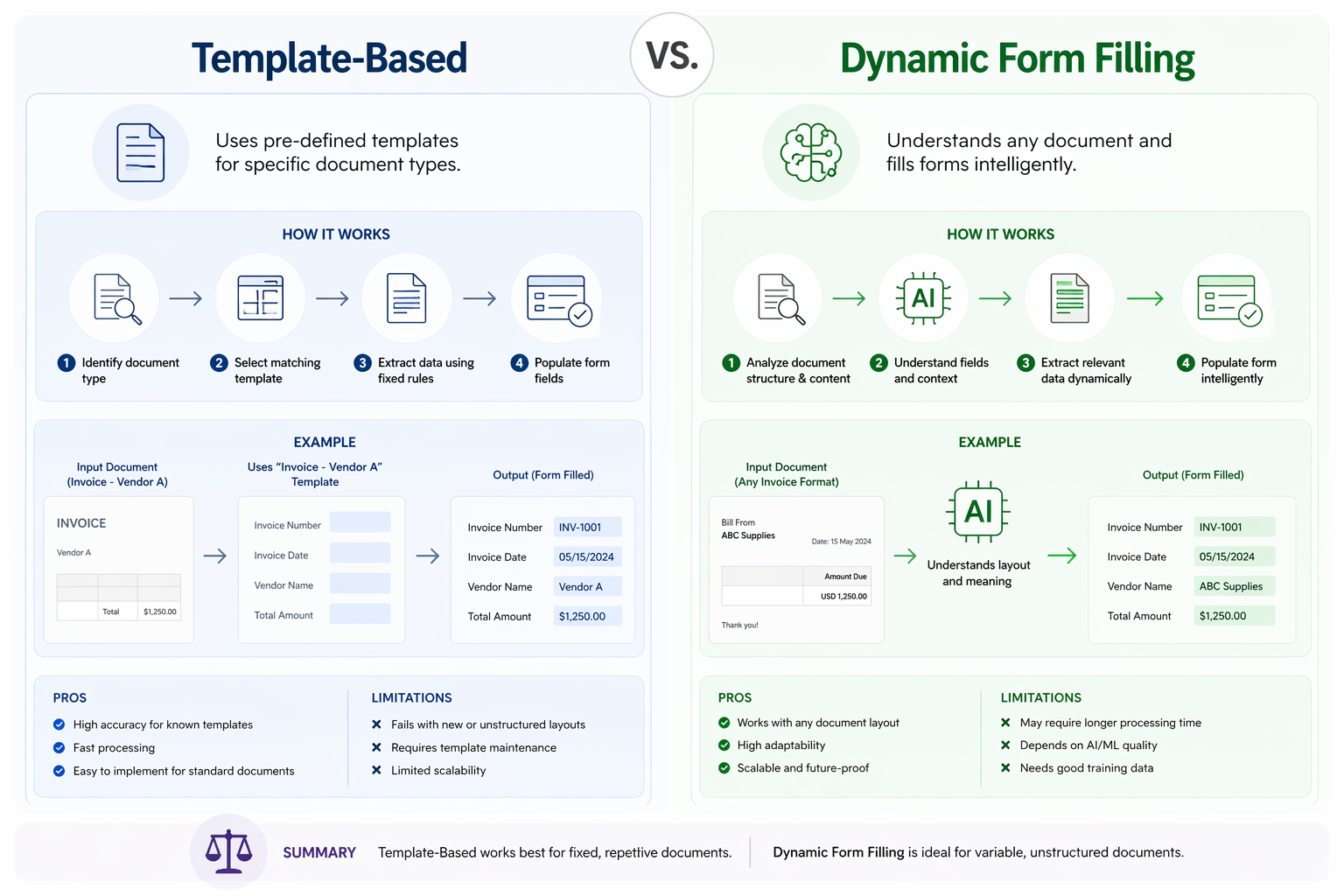
Template-based filling works by detecting field positions once, storing those coordinates, then filling deterministically every time. The form does not change, so the template does not need to either. It is fast, predictable, and consistent at scale.
AI-driven form filling takes a different path. Instead of pre-configured field maps, it analyzes each form at runtime and maps incoming data to the right fields based on contextual instructions. No template required.
| Template-Based | AI-Driven | |
|---|---|---|
| Cost Structure | High setup per form type; very low runtime cost at volume | Lower setup via prompt configuration; higher per-document inference cost at scale |
| Form Stability | Deterministic on fixed layouts; silently misfires when layout changes | Adapts to variable and externally sourced layouts without reconfiguration |
| Maintenance | Reconfiguration required on every form version change | Layout changes absorbed at runtime; maintenance moves to prompt refinement and evaluation coverage |
Both approaches have a place. The sections below map out which one belongs in which scenario.
When Template-Based Form Filling Makes Sense
Template-based filling earns its place in a narrow but high-value category: standardized, high-volume, repeat-form workflows.
Think W-2s, insurance claim forms, mortgage applications, or government-issued tax documents. These forms share one trait: the field layout does not change between submissions. When that condition holds, detecting field positions once and filling deterministically at scale is the right call. Document automation saves up to 82% of time spent generating contracts and legal documents, and template-based filling is largely responsible for those gains in structured workflows.
Here is where template-based filling consistently wins:
- Processing thousands of identical forms per day where runtime parsing overhead adds up fast
- Compliance-sensitive workflows where deterministic output is auditable and reproducible
- Forms with strict character-per-box inputs like SSNs or tax IDs, where layout precision matters
- Internal ops workflows where the form version is controlled and changes rarely
The per-document cost drops once the template is configured. Companies adopting IDP solutions report 60-70% reductions in document processing time, and much of that comes from eliminating redundant field detection on every run. Pay the setup cost once, then fill at scale with consistent speed.
The Case for AI-Driven Form Filling
When form layouts are unpredictable, sourced externally, or change faster than any template library can realistically track, template-based approaches break down.
Vendor invoices are a clear example. Every supplier ships a different format, and maintaining a per-vendor template at scale compounds into a serious maintenance burden. The same holds for multi-jurisdiction legal forms, third-party intake documents, and any workflow where form versions shift frequently.
AI-driven filling tends to outperform templates in these scenarios:
- Forms sourced from many external parties, each with unique layouts that cannot be pre-mapped
- Agent-driven workflows where the system must map data to fields using contextual reasoning instead of pre-configured coordinates
- Rapid prototyping or low-volume use cases where template setup cost outweighs the benefit
- Workflows where field labels exist but positions shift across document versions or variants
The core mechanism is instruction-based field mapping at runtime. Instead of coordinates, the system receives data alongside field instructions and resolves placement on the fly. Extend's Edit API fits this model directly, supporting agent-driven form filling by mapping incoming data to fields using natural language instructions, with no template required.
The tradeoff is real. AI-driven filling introduces per-run inference cost and more edge case surface area. But for workflows built around variable or externally sourced forms, that cost is lower than the engineering overhead of maintaining templates at scale.
Performance and Accuracy Considerations
Each approach fails in a distinct way. Template-based filling fails silently when a field coordinate moves: the fill completes, the output looks valid, and the error only surfaces downstream. Catching that requires a diff layer comparing output against a known-good schema on every run. AI-driven filling fails differently: field mapping errors appear as low-confidence scores on instrumented pipelines, or as plausible-looking fills that land data in the wrong field. IDP reduces error rates over 52%, but realizing those gains requires confidence scoring and a human-in-the-loop review layer.
- Template accuracy requires a validation layer that diffs output against a fixed schema on every run
- AI-driven accuracy requires confidence thresholds and a review queue for low-certainty fills
- Both failure modes are silent by default and must be instrumented explicitly
Implementation Complexity and Time to Value
Template-based systems front-load complexity in field detection, coordinate mapping, and validation logic before a single form gets filled. That cost pays off quickly for a small stable set but stretches longer than most teams expect across dozens of variants. AI-driven filling moves that complexity to prompt engineering and confidence threshold tuning. New form types require no new configuration, but each novel layout introduces edge cases that need evaluation coverage.
A rough decision heuristic:
- Under 10 stable form types with high volume: template-based setup cost is worth it
- Over 20 external or variable form layouts: AI-driven filling avoids compounding configuration debt
- Mixed workflows: start with runtime filling to validate form coverage, then layer in templates for your highest-volume stable forms
Cost Structure Analysis: Setup vs. Runtime
Form filling cost structure rarely breaks down the way teams expect.
Template-based filling carries a higher setup cost: field detection, coordinate mapping, and QA testing per form type. But runtime cost per document is low. Once configured, volume scales cheaply. The numbers back this up: organizations processing over 100,000 documents monthly report per-document costs dropping below $0.10 versus $1.00 with manual workflows, according to document automation cost benchmarks. The financial trap is maintenance. Every form version change reintroduces configuration cost, and those updates compound quietly over time.
AI-driven filling inverts this. Setup is lighter, but per-document inference cost adds up at scale. For low-to-mid volume workflows with variable forms, that tradeoff holds. At high volume with stable forms, it gets expensive fast.
There are several hidden costs worth tracking carefully:
- Template maintenance labor accumulates whenever form versions shift, and teams often underestimate how frequently that happens across vendors or regulatory updates.
- Validation and review time for low-confidence AI-driven fills can quietly consume engineering bandwidth that never gets attributed to the pipeline's true cost.
- Engineering hours spent QA-ing template regressions after upstream form changes are easy to miss in initial build estimates.
- Inference overhead on high-volume AI-driven pipelines can make per-document costs non-trivial at scale.
Neither approach is cheaper in absolute terms. The cheaper one depends on form volume, stability, and how much engineering time gets absorbed by ongoing maintenance.
Maintenance and Adaptability Over Time
Templates hold up until a form changes. A new field or shifted layout requires reconfiguration before the next run. For external forms tied to vendor or regulatory cycles, that cadence is unpredictable. AI-driven filling absorbs layout changes at runtime, shifting maintenance to prompt refinement instead. Neither approach eliminates ongoing work; both just move where that work lands.
- Who controls the form version schedule, and do they notify before rolling changes?
- How fast can the team detect a template regression before a bad fill reaches production?
- Is the form set growing? Growing sets favor AI-driven filling; fixed sets favor templates once the layout stabilizes.
For organizations processing forms from many external parties, AI-based filling tends to age better. For internally controlled, high-volume form types, templates remain worth the upkeep.
Building a Hybrid Approach
Most mature document workflows run both approaches in parallel, routing each form type to the method that fits it best.
A practical pattern: use template-based filling for highest-volume stable forms, then fall back to AI-driven filling for anything outside that set. New vendors, irregular form types, and edge cases get handled without blocking the pipeline. Over time, high-frequency forms that stabilize can graduate to templates once the layout proves consistent.
The routing logic is usually straightforward:
- Known form type with controlled versioning: use a template
- External or variable layout: use AI-driven filling
- Unknown form type on first encounter: AI-driven, with follow-up evaluation to decide if a template is worth building
How Extend Supports Both Approaches Through the Edit API
Extend is the complete document processing toolkit comprised of the most accurate parsing, extraction, and splitting APIs to ship the hardest use cases in minutes, not months. Extend's suite of models, infrastructure, and tooling is the most powerful custom document solution, without any of the overhead. Agents automate the entire lifecycle of document processing, allowing engineering teams to process the most complex documents and optimize performance at scale.
The Edit API supports both filling paths through a single integration point. For stable, high-volume forms, teams configure field positions once and fill deterministically at scale. For variable or externally sourced layouts, the same endpoint accepts natural language instructions to map data to fields at runtime, with no template required. There is no separate vendor or split pipeline for each mode.
Before any fill step runs, Extend's Parse layer converts the incoming file into clean structured output using house-built parsing models, regardless of format or input quality. The fill step then receives consistent, well-formed document representations whether the source is a scanned government form, a vendor-supplied PDF, or a programmatically generated file. Both template-based and AI-driven fills benefit from this normalization without any extra configuration.
The routing logic from a hybrid workflow maps directly to a single integration point, with no split pipelines or separate vendors.
Final Thoughts on Template-Based vs. AI-Driven Form Filling
The choice between template and AI-driven form filling comes down to form behavior over time. Templates work when layouts stay consistent and volume scales, while AI-driven filling handles variable formats without the configuration debt that builds up quietly. Most workflows will need both, routing stable forms to templates and everything else to runtime mapping. Start with Extend to run both methods through one API that adapts to your form types instead of locking into a single approach.
FAQ
Can I build a form filling pipeline without configuring templates?
Yes. AI-driven form filling maps data to fields at runtime using natural language instructions, requiring no template setup. This works well for variable layouts or external forms, though it introduces per-run inference cost that can add up at high volume.
Template-based vs AI-driven form filling: which one scales better?
Template-based filling scales more cheaply once configured, making it the right choice for high-volume stable forms like W-2s or tax documents. AI-driven filling scales better across form variety: it handles hundreds of external layouts without compounding configuration debt.
How often do templates break when forms change?
Any layout shift breaks a template until it gets reconfigured. For externally sourced forms tied to vendor or regulatory updates, that cadence is unpredictable and creates recurring maintenance work. Internal forms under version control stay stable longer.
What is the fastest way to add form filling to an agent workflow?
AI-driven form filling integrates faster for agent-driven workflows since it accepts instructions to map data to fields without pre-configured coordinates. Extend's Edit API supports this through the same endpoint that handles template-based filling, so teams can route both approaches through a single integration.
When does it make sense to run both template and AI-driven form filling?
Use templates for the highest-volume stable forms where deterministic output matters, then route everything else to runtime filling. New vendors, irregular layouts, and edge cases get handled without blocking the pipeline, and high-frequency forms can graduate to templates once the layout proves consistent.