Document volume scales faster than manual review queues can handle, but traditional template-based extractors fail just as quickly on the first layout variation. Older systems misread handwritten dates and break on multi-column tables because they map fixed pixels to character strings without comprehending the underlying content. Vision-Language Models (VLMs) solve this architectural flaw by interpreting documents the way trained reviewers do, reading layout and semantics at the exact same time. This modern approach to OCR and AI maintains context across page boundaries, deciding whether downstream systems run reliably or route everything right back to manual data entry.
TLDR:
- Template-based OCR extractors break on layout variation; teams hit template drift before the first quarter ends, accumulating hundreds of brittle template files that require manual updates when vendor formats change.
- VLMs process handwritten annotations, multi-column tables, and cross-page entity references by maintaining document-scoped context; template-based extractors reset context per page and misclassify fields when layouts shift.
- Production evaluation requires per-field confidence scoring and structured JSON output; systems without these force teams to review everything or nothing.
- Extend combines OCR, specialized computer vision models, and VLMs into a unified stack that ships structured JSON to downstream systems; Parse 2.0 leads on layout accuracy (0.847 Adjusted F1) across 1,500 production samples.
What Traditional OCR Is and How It Works
Traditional OCR converts scanned images into text through a deterministic pipeline of preprocessing, layout analysis, and pattern matching against stored character templates. This pipeline works reliably on clean, printed text in predictable layouts like standard forms or simple receipts. However, the assumptions baked into that architecture, like fixed structure, uniform fonts, and clean scans, are exactly what define its ceiling in production environments.
The Limitations That Make Traditional OCR Fail on Real Documents
Traditional OCR maps pixel patterns to strings without semantic understanding. When layouts shift, template-based extractors fail silently by misclassifying fields based on fixed coordinates.
Fixed coordinate mapping creates immediate failure points in production pipelines. Handwritten annotations break character recognition models, requiring teams to consult notes scrawled across a typed form, producing garbled output that downstream systems cannot parse.
- Reading-order errors: Multi-column layouts cause text from adjacent columns to get concatenated, turning a structured table into a single incoherent string.
- Degraded accuracy: Scanned documents with skew, low contrast, or mixed resolution degrade character-level accuracy, and template matchers have no recovery path when confidence drops.
- Isolated page processing: Cross-page field references fail entirely because traditional OCR processes pages in isolation, resetting context at each page boundary and losing relationships between fields that span a multi-page loan package or insurance submission.
Teams running high-volume pipelines quickly reach a breaking point with template maintenance. Adding new templates for each layout variant scales the maintenance burden linearly with document variety, forcing teams into a continuous cycle of manual configuration whenever source formats change.
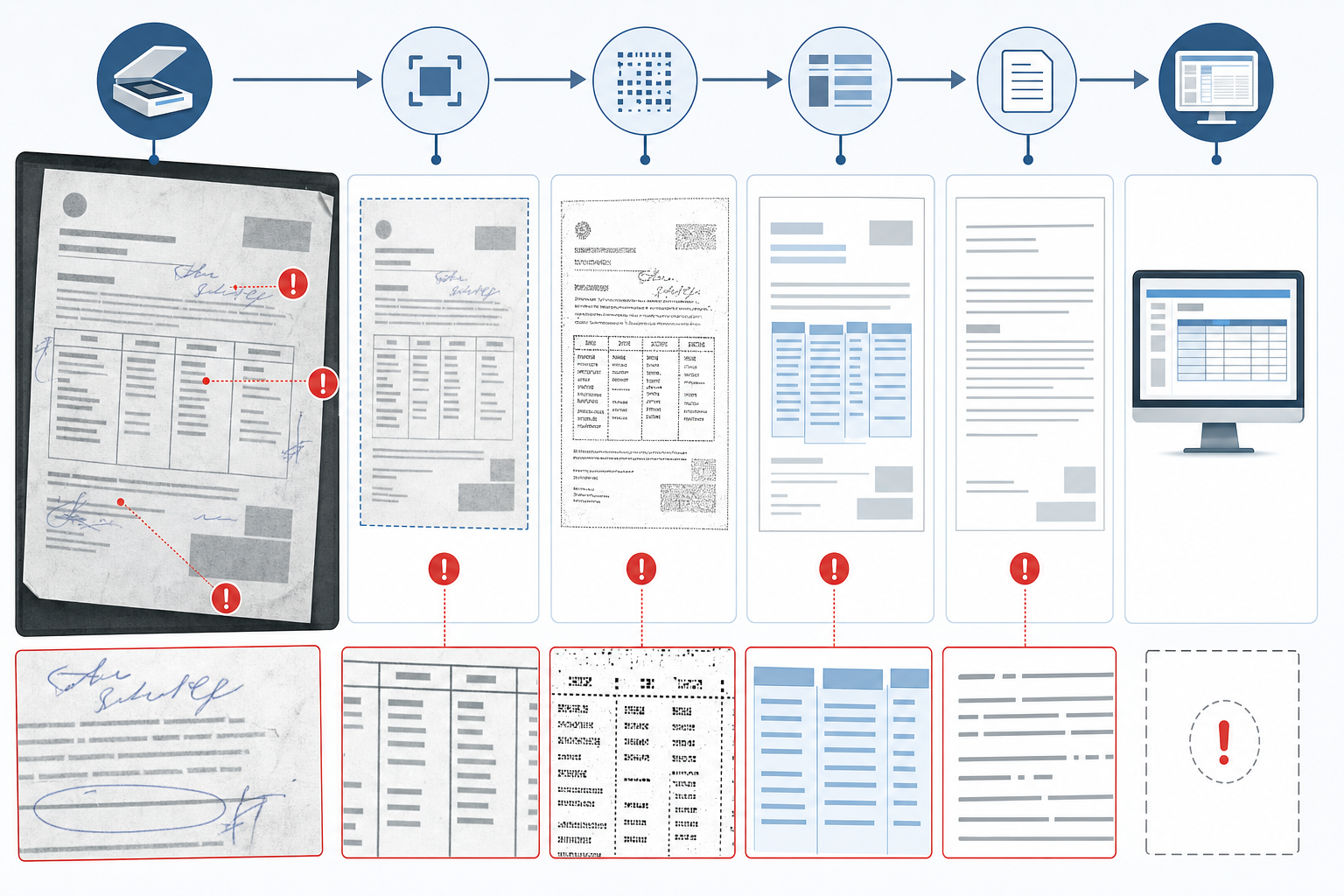
How Vision-Language Models Process Documents Differently
Where traditional OCR pipelines separate layout detection, text extraction, and field parsing into discrete steps, VLMs receive the raw image and extract structure, semantics, and field identity in a single forward pass.
The architectural difference matters most at the failure points OCR hits repeatedly: handwritten annotations overlapping printed fields, multi-column tables where row context spans visual regions, and forms where field labels appear spatially adjacent instead of semantically linked. A VLM reading a mortgage application sees the spatial relationship between "Borrower Income" and the value two cells to its right; a regex extractor looking at the same document sees a character sequence with no geometric awareness. Purpose-built VLMs like Parse 2.0 handle this by processing layout and semantics simultaneously.

Why AI OCR Achieves Higher Accuracy on Complex Documents
Traditional systems fail structurally on complex layouts, with traditional OCR accuracy on complex real-world documents hovering around 60-75%, compared to AI-powered OCR systems that now exceed 98.5% accuracy on complex character sets including handwritten and cursive text. Vision AI document processing tools handle these deviations by reasoning over layout and semantics simultaneously:
- Spatial table recognition: Reads table structure as a spatial object and identifies cell boundaries correctly across column spans.
- Cross-page entity matching: Maintains document-scoped context across the full file to connect entity references that span page boundaries.
| Document Processing Challenge | Traditional OCR Behavior | AI OCR (VLM) Behavior |
|---|---|---|
| Handwritten annotations overlapping typed fields | Character recognition models trained on printed fonts produce garbled output that downstream systems cannot parse | Treats handwritten text as semantically distinct from printed content based on visual and positional context without separate preprocessing |
| Multi-column layouts with merged cells | Regex field extractors expecting linear text order concatenate adjacent columns into incoherent strings | Reads table structure as a spatial object and identifies cell boundaries correctly across column spans |
| Vendor format changes to invoice layouts | Template matchers fail silently when fields move position and route documents to manual review queues that compound at volume | Generalizes across layout variations without retraining by reasoning over semantic relationships between fields |
| Degraded scans with low contrast or skew | Character substitution errors require preprocessing correction steps before extraction runs | Handles quality degradation without preprocessing because training covers diverse document condition distributions |
| Cross-page entity references in multi-page documents | Processes pages in isolation and resets context at each boundary, causing field mismatches across sections | Maintains document-scoped context across the full file to connect entity references that span page boundaries |
Real-World Applications Where AI OCR Replaces Manual Processing
Invoice line items, shipping manifests, insurance claim forms, and loan packages all share one structural property: they arrive in formats that no template covers completely. When OCR was the only option, teams built extraction rules around expected layouts. Any deviation required manual correction.
AI OCR handles this differently. VLMs read document context the way a trained reviewer does, which is why document extraction AI holds even when a vendor moves their location block or a handwritten note appears mid-form.
Where the Replacement Is Already Happening
- Accounts payable: Teams processing hundreds of invoices daily no longer route mismatched formats to manual review queues. Financial services companies like Brex integrate extraction APIs to achieve 99%+ accuracy on invoices from any vendor, extracting line items and totals regardless of format variation. This eliminates the manual effort previously spent correcting template drift each week.
- Mortgage lending: Lenders route extracted fields directly to underwriting systems. Teams process complete loan application checklists rapidly, building loan officer trust in AI-calculated income figures and eliminating the need to manually scan 800-page packages for co-borrower addenda. What used to require days of manual entity matching across disjointed documents now happens instantly.
- Healthcare processing: Providers parse dense layouts like CMS-1500s and EOBs with nested tables and hundreds of rows. The structured data feeds downstream compliance validators and automated payment posting pipelines without intermediate cleaning or manual field remapping, preventing costly downstream claim rejections caused by legacy OCR misreads.
- Logistics operations: Operators extracting shipper details, consignee information, and cargo descriptions from bills of lading across ocean, air, and LTL carriers no longer hit extraction failures when location blocks span two lines or complex fuel statements contain thousands of rows. Freight bill processing runs immediately upon receipt, accelerating time-to-revenue by days.
In each case, the failure mode was the same: regex extractors or template matchers tied to a fixed layout, breaking on the first format variation and resetting manual workload from scratch.
What to Look for When Assessing OCR and AI Solutions
Accuracy on variable-layout documents is the baseline requirement, not a differentiator for intelligent document processing systems. Template-based extractors fail when a vendor changes their invoice format or a lender submits a non-standard loan package; the extraction breaks and the review queue grows. Teams assessing IDP tools should test against their actual production documents before committing to any system.
Structured Output Format
Raw text extraction is insufficient for downstream automation. The system must deliver structured JSON or normalized field schemas that feed directly into approval engines, ERP pipelines, or LLM reasoning layers without intermediate cleaning.
Confidence Scoring and Human-in-the-Loop Routing
Production pipelines need confidence scores per extracted field, beyond aggregate accuracy claims. Low-confidence fields should route automatically to human review; high-confidence fields should pass through without touching a queue.
Multi-Page and Cross-Document Context
Template-based extractors reset context per page, which causes field mismatches in multi-page invoices, loan packages, and medical charts. The extraction system must maintain document-scoped context across page boundaries to match entity references correctly.
Ingestion Flexibility
Teams processing documents at scale receive files across email, API push, and manual upload. Systems with limited ingestion options introduce preprocessing overhead before document processing even starts.
Benchmark Transparency
Vendors citing accuracy figures should disclose the benchmark dataset, document types tested, and sample size. Aggregate accuracy on clean PDFs does not predict performance on scanned, handwritten, or variable-layout documents in production.
How Extend Combines Vision-Language Models With Production Infrastructure
Extend is the complete document processing toolkit comprised of the most accurate parsing, extraction, and splitting APIs to ship your hardest use cases in minutes, not months. Extend's suite of models, infrastructure, and tooling is the most powerful custom document solution, without any of the overhead. Agents automate the entire lifecycle of document processing, allowing your engineering teams to process your most complex documents and optimize performance at scale.
The platform relies on Parse 2.0, a parsing engine validated through the RealDoc-Bench benchmark. Parse 2.0 leads on layout accuracy (0.847 Adjusted F1 across 1,500 samples) and document Q&A output accuracy (95.7% across 1,359 prompts and 581 documents). Instead of returning raw text, the architecture processes incoming documents through specialized computer vision models and VLMs to output normalized, structured JSON.
This unified stack applies per-field confidence scoring at the moment of extraction. High-confidence data flows straight to downstream systems like ERPs or loan origination software without manual intervention. Conversely, low-confidence fields trigger automated human-in-the-loop routing, keeping review queues strictly focused on edge cases instead of entire document batches.
Final Thoughts on AI OCR Versus Template-Based Extraction
Understanding the fundamental difference between OCR and AI comes down to handling variability. Legacy optical character recognition software relies on regex extractors and template matchers, which compound review queues at scale because they reset on layout variation, degrade on handwritten annotations, and lose context across page boundaries. VLMs process those same documents by reasoning over spatial layout and semantic relationships simultaneously, eliminating the manual review cycles that traditional systems require. Run your production documents through Extend to compare extraction output against what template-based systems deliver.
FAQ
What is OCR in computer, and how is it different from AI-based document processing?
OCR is a template-based pipeline that converts scanned images into machine-readable text by matching pixel patterns to character strings without understanding what those strings mean or how they relate. AI-based document processing uses vision-language models that process documents as unified visual objects, determining structure, semantics, and field identity in a single forward pass while maintaining context across pages.
Can I use optical character recognition software free for production document workflows?
Free OCR software typically relies on template matching that breaks when vendors change invoice formats or forms shift layout, requiring manual template updates for each variation. Production workflows processing variable-layout documents at scale hit template drift failures within the first quarter, making free OCR unsuitable for high-volume pipelines without constant maintenance.
Traditional OCR vs AI OCR: which one handles handwritten forms better?
Traditional OCR fails on handwritten annotations because character recognition models are trained on printed fonts, producing garbled output that downstream systems cannot parse. AI OCR using vision-language models treats handwritten text as semantically distinct from printed content based on visual and positional context, reading handwriting without requiring separate preprocessing steps.
What's the difference between OCR and AI when processing multi-page loan packages?
OCR processes pages in isolation and resets context at each page boundary, causing field mismatches when borrower names or property locations reference across sections in multi-page documents. AI maintains document-scoped context across the full file, connecting cross-page entity references that template matchers structurally cannot hold.
How accurate is Google OCR compared to vision-language model extraction on real documents?
Parse 2.0, Extend's vision-language model parsing engine validated through the RealDoc-Bench benchmark, reaches 95.7% document Q&A output accuracy across 1,359 prompts and 581 real-world documents spanning logistics, healthcare, financial services, and real estate with variable layouts and handwritten annotations, alongside a 0.847 Adjusted F1 score on layout accuracy. Traditional OCR systems including Google's approach fail on these documents because template matchers assume fixed geometry and cannot recover when layouts change.