Looking at Kofax alternatives usually means you've encountered one of three friction points: configuration overhead that delays deployment, pricing models that don't scale with your business, or accuracy problems that require constant manual intervention. The core difference between Kofax and modern extraction platforms comes down to infrastructure. Legacy tools were built for template-based processing where IT teams configure rules for known document types. Current solutions handle document variety with agentic systems that optimize extraction automatically, version schemas safely, and route uncertain extractions through review workflows without custom code.
TLDR:
- Kofax works for large enterprises but creates friction with high costs and complex setup
- Users report ongoing template maintenance and technical issues like disappearing variables
- Extend ships production-ready document processing with built-in evaluation and agentic optimization
- Competitors lack evaluation frameworks, schema versioning, and automated accuracy improvement
- Extend processes complex documents with 99%+ accuracy using LLMs and vision AI for financial services, healthcare, real estate, and supply chain
What is Kofax and How Does it Work?
Tungsten Automation, formerly Kofax, is a document processing solution that serves enterprise organizations with document-heavy workflows. The system captures documents from email, scanners, multi-function printers, mobile devices, web applications, fax, and file folders. After document ingestion, Kofax applies algorithms to extract data from forms, invoices, contracts, and other business documents into structured formats that feed downstream systems.
Kofax combines three core capabilities:
- Intelligent document processing handles extraction and classification by identifying document types and pulling structured data from unstructured files
- Robotic process automation moves data between systems and executes repetitive tasks without human intervention
- Workflow orchestration routes documents through approval chains and business logic based on predefined rules
The architecture targets multi-step enterprise processes where documents move through several departments and systems before completion. This focus on large-scale deployments shapes both the product's capabilities and its implementation requirements, which matters when evaluating fit for specific document processing needs.
Why Consider Kofax Alternatives?
Kofax works well for large enterprises, but several factors drive organizations to evaluate other options. Pricing concerns top the list for small and medium-sized businesses considering document processing software. The licensing model fits enterprise budgets but creates friction for teams with limited resources.
Implementation complexity appears consistently in user feedback. Nine out of 25 G2 reviews mention setup and navigation challenges, revealing a learning curve that requires technical expertise. Organizations lacking dedicated IT resources or document processing specialists often face extended deployment timelines.
Complex documents demand ongoing configuration work. Teams report repeatedly adjusting templates to maintain extraction accuracy, especially when document formats vary or fall outside predefined categories. This maintenance burden becomes a constraint for organizations processing diverse document types without continuous manual work.
Technical issues add to these challenges. Users report assigned input variables occasionally disappearing from workflows, forcing process restarts that interrupt production pipelines. Response times can lag during processing, creating problems for latency-sensitive applications.
Organizations seeking rapid deployment with minimal tuning, built-in accuracy evaluation, schema versioning, or agentic optimization encounter limitations in Kofax's capabilities. Teams needing to ship document processing features quickly without extensive customization typically look for data extraction software elsewhere.
Best Kofax Alternatives in March 2026
Extend (Best Overall Alternative)
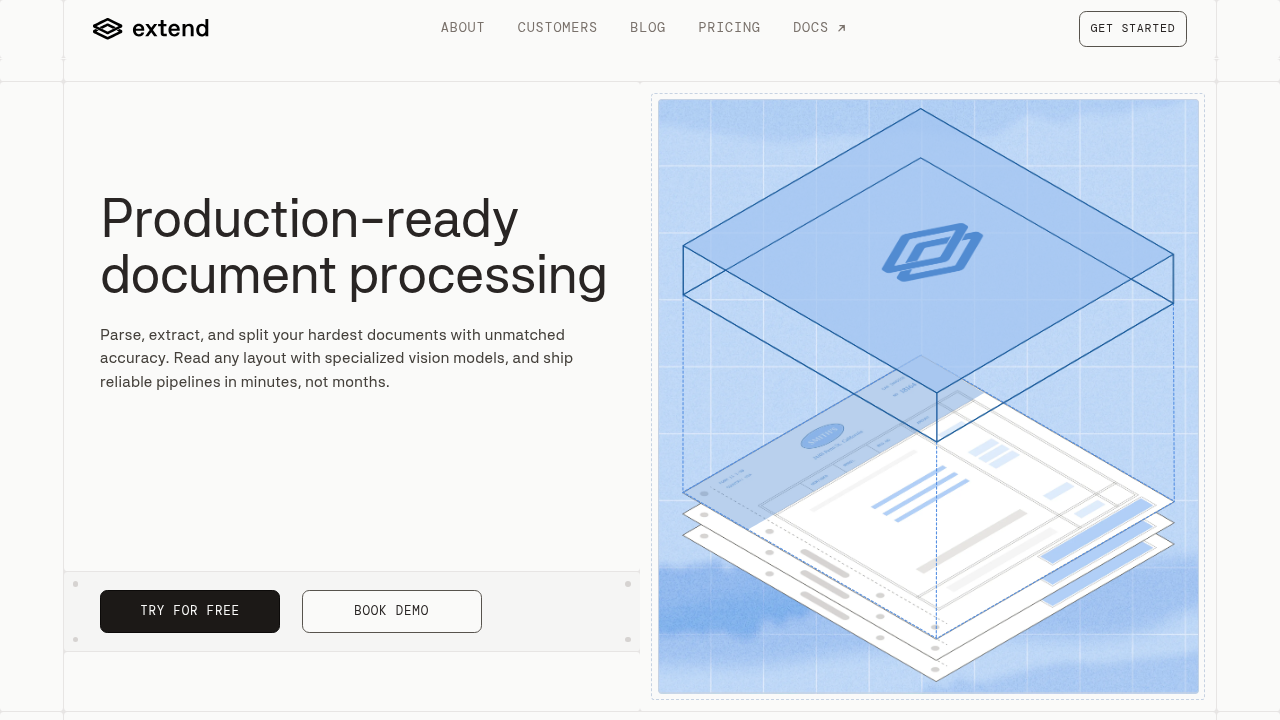
Extend is the complete document processing toolkit comprised of the most accurate parsing, extraction, and splitting APIs to ship your hardest use cases in minutes, not months. Extend's suite of models, infrastructure, and tooling is the most powerful custom document solution, without any of the overhead. Agents automate the entire lifecycle of document processing, allowing engineering teams to process the most complex documents and optimize performance at scale.
Key strengths:
- Multiple performance modes (low latency, cost optimized, high accuracy) for parsing, extraction, and splitting
- Built-in evaluation framework with accuracy reports, LLM-as-a-judge, vector similarity, and fuzzy matching scorers
- Composer AI agent that automatically optimizes schemas and prompts against evaluation sets
- Schema versioning with draft, publish, and rollback capabilities for safe production changes
- Native workflow orchestration with conditional routing, human-in-the-loop review UI, and audit logs
Extend is the best choice for organizations requiring production-grade document processing with evaluation-driven quality control, workflow orchestration, schema versioning, and agentic optimization. Teams in financial services, healthcare, real estate, and supply chain that need to process mission-critical documents with accuracy above 99%.
Extend delivers the complete infrastructure for building, iterating, evaluating, and deploying document pipelines with built-in agents that continuously optimize accuracy. Unlike Kofax's template-based approach requiring ongoing configuration, Extend provides multiple processing modes, evaluation tools, and automated optimization that removes manual prompt tuning.
ABBYY Vantage
ABBYY operates as an intelligent document processing provider with over 35 years of experience, offering a low-code approach for automation. ABBYY Vantage uses AI-enabled software to pull information from structured, semi-structured, and unstructured documents in any recognized language. The platform provides pre-trained document skills for over 150 use cases through its marketplace, OCR and ICR tech supporting over 200 languages, a low-code skill designer for custom document processing, and cloud-first deployment with on-premises options available.
ABBYY fits mid-level document management operations, though complex workflows may require substantial setup. The platform promotes fast starts with pre-trained skills and claims over 90% straight-through processing from day one for certain use cases, but users still handle model selection and configuration with no built-in evaluation framework or schema versioning capabilities. ABBYY offers strong OCR heritage and pre-trained models but lacks the evaluation tooling, workflow orchestration, and agentic optimization that Extend provides out of the box.
UiPath Document Understanding
UiPath uses OCR and AI to read invoices, receipts, and contracts, extracting specific data points and entering them into systems like SAP or Salesforce. The company has pivoted from rule-based bots to agentic automation, using LLMs with RPA infrastructure for legacy system integration. The platform provides Document Understanding integrated with broader RPA capabilities, pre-trained models for common document types, cloud and on-premises deployment options, and integration with UiPath AI Center.
UiPath works for organizations already invested in UiPath's RPA ecosystem who need document processing as one component of broader automation workflows. However, UiPath Document Understanding is tightly coupled to the broader UiPath setup, requiring teams to adopt the full RPA stack rather than just document processing APIs.
Reducto
Reducto positions itself as a document parsing API focused on converting documents into clean, structured data for AI applications. The service targets developers building RAG systems and other AI workflows that need document ingestion. Reducto provides a document parsing API with vision model processing, focus on chunk extraction for RAG applications, table and chart extraction capabilities, and developer-first API design.
Reducto fits teams building RAG systems who need basic document parsing without complex extraction requirements. However, Reducto lacks workflow orchestration, evaluation frameworks, schema versioning, and human-in-the-loop review capabilities. Large array extraction remains in beta, limiting production readiness for complex table processing. Reducto serves narrow parsing use cases but lacks the production infrastructure that teams need for mission-critical document workflows at scale.
Pulse
Pulse offers document processing capabilities with a focus on classification and extraction. The platform targets organizations looking for document automation without extensive technical setup. Pulse provides document classification capabilities, large array extraction support, pre-trained models for common document types, and API-based integration.
Pulse fits organizations with standard document types that need basic extraction without custom workflow requirements. However, Pulse provides no evaluation framework, schema versioning, workflow orchestration, or human-in-the-loop review. Deployment options and infrastructure details remain limited. Pulse handles basic extraction tasks but misses the evaluation tooling, versioning controls, and workflow capabilities that production systems require.
Feature Comparison: Kofax vs Top Alternatives
The table below maps feature availability across document processing solutions, making it easier to spot capability gaps when evaluating Kofax alternatives.
| Feature | Kofax | Extend | ABBYY | UiPath | Reducto | Pulse |
|---|---|---|---|---|---|---|
| Multi-mode processing (speed/cost/accuracy) | No | Yes | No | No | No | No |
| Built-in evaluation framework | No | Yes | No | No | No | No |
| Schema versioning | No | Yes | No | No | No | No |
| Agentic optimization | No | Yes (Composer) | No | No | No | No |
| Workflow orchestration | Yes | Yes | Limited | Yes (RPA-focused) | No | No |
| Human-in-the-loop review UI | Limited | Yes | Yes | Yes | No | No |
| Large array extraction | Yes | Yes (1000+ rows) | Yes | Yes | In beta | Yes |
| Document classification API | Yes | Yes | Yes | Yes | No | Yes |
| Cloud and on-premises deployment | Yes | Yes | Yes | Yes | Limited details | Limited details |
| Pre-trained models | Yes | Yes | Yes (150+ skills) | Yes | No | No |
Extend is the only solution that ships with evaluation-driven development, schema versioning, and agentic optimization built directly into the product. Composer agents automate the entire lifecycle of document processing, removing the manual tuning cycles and custom code required by legacy vendors. Engineering teams can process complex documents and optimize performance at scale without maintaining brittle extraction rules or hiring dedicated ML teams.
Why Extend is the Best Kofax Alternative
Extend outperformed every solution tested, including other vendors, open source, and foundation models, now powering key document workflows across 30,000 customers. Organizations switching from Kofax gain multiple performance tiers that optimize latency for real-time use cases, cost for bulk jobs, and accuracy for mission-critical documents.
Extend's Composer agent skips manual prompt trial-and-error by automatically refining schemas and improving accuracy in the background. Teams avoid the configuration burden and technical glitches that plague Kofax deployments because Extend's built-in evaluation framework catches regressions before production.
Schema versioning supports safe iteration without breaking live workflows. Draft, test, and publish changes while maintaining version history and rollback capabilities. Extend provides end-to-end orchestration for complex pipelines with multi-step workflows that parse, split, extract, validate, and route with versioning and durability out of the box.
The result: engineering teams ship production-grade document processing in days instead of months, processing complex files at scale without maintaining brittle extraction rules or hiring dedicated ML teams.
Final Thoughts on Evaluating Kofax
The Kofax review conversation always comes back to implementation time and ongoing maintenance. Extend cuts through both problems with built-in evaluation, schema versioning, and Composer agents that optimize extraction without your intervention. You get accuracy above 99% on complex documents, with deployment timelines measured in days rather than quarters.
Connect with us to discuss your document processing requirements.
FAQ
When should you consider moving away from Kofax?
Teams typically evaluate alternatives when facing extended implementation timelines, high licensing costs for limited use cases, or ongoing template maintenance overhead. If your team spends weeks configuring document processing pipelines or lacks dedicated IT resources to handle setup complexity, switching makes sense.
What features should you prioritize when comparing document processing alternatives?
Look for built-in evaluation frameworks that measure extraction accuracy, schema versioning for safe production changes, and multiple performance modes optimized for speed, cost, or accuracy. Agentic optimization that automatically refines schemas removes the manual tuning cycles required by template-based systems.
How does Extend handle documents that Kofax struggles with?
Extend uses a custom-built hybrid computer vision plus VLM pipelines that intelligently route pages and regions through purpose-built models for handwriting, dense tables, checkboxes, and irregular layouts. The system processes 1,000+ page files and extracts arrays with 1,000+ rows without manual template configuration.
Can you switch document processing vendors without breaking production workflows?
Extend's schema versioning lets teams draft, test, and publish changes while maintaining rollback capabilities and version history. The workflow orchestration API supports conditional routing and human-in-the-loop review, allowing gradual migration without disrupting live pipelines.