Every document Q&A agent architecture makes the same foundational trade-off: how much structure to impose before the model reasons, and where to let retrieval fill the gaps. This post covers the three dominant patterns, RAG, agentic loops, and hybrid extraction, along with their failure modes, chunking trade-offs, and what a reliable ingestion layer actually requires.
TLDR:
- Fixed-size chunking breaks RAG by splitting tables and parsing clauses, so LLMs answer with precision.
- OCR pipelines fail silently: misassigned fields, duplicate entities, and garbled multi-column text all reach the LLM as bad input.
- ReAct adds accuracy but stacks latency; Plan-Execute is faster but rigid when early results matter for later steps.
- Multi-agent setups break when subagents pass incomplete context, producing answers that cite wrong sections or merge conflicting fields.
- Extend's parsing, splitting, and confidence scoring APIs produce clean, structured input so retrieval pipelines don't start from fragments.
Core Architecture Patterns for Document Q&A Agents
Three widely used patterns shape how teams build document Q&A systems. Each makes a different trade-off between retrieval speed, reasoning depth, and ingestion complexity, and each breaks in a different place when documents get messy.
- RAG (Retrieval-Augmented Generation): Splits documents into chunks, indexes them in a vector store, and retrieves top-k candidates at query time for LLM synthesis. Fast and straightforward on clean text; fails when chunks sever semantic units or multi-hop questions require joining context from non-adjacent sections.
- Agentic Loops: Wraps retrieval with reasoning steps: the agent plans which sections to query, issues multiple retrieval calls, resolves conflicting passages, and synthesizes a final answer. Handles complex questions that RAG misses; compounds latency and multiplies failure points with each added reasoning hop.
- Hybrid Extraction plus Retrieval: Runs structured field extraction into a schema first, then retrieves against both the schema and the raw document. Fits workflows where some answers live in defined fields (invoice totals, policy numbers) and others require reading unstructured prose.
The sections below cover each pattern in depth, starting with the RAG foundation that underpins all three.
The RAG Foundation: Retrieval Augmented Generation for Document Processing
Retrieval-Augmented Generation sits at the core of most document Q&A agent architectures. When a query arrives, the system retrieves relevant document chunks from a vector store, injects them into an LLM prompt as context, and returns a grounded answer.
Document chunks get embedded using a model like text-embedding-3-large, then stored in a vector database (Pinecone, Weaviate, pgvector). At query time, the query gets embedded in the same space. A nearest-neighbor search returns the top-k chunks by cosine similarity, which get packed into the LLM context window.
The retrieval stage assumes clean, semantically dense text. Scanned PDFs, multi-column layouts, and tables encoded as raw strings degrade embedding quality before the LLM sees anything. A poorly parsed chunk produces a confident-sounding but factually wrong answer, with no signal in the response to indicate the failure originated in ingestion. Fixed-size chunking splits tables across boundaries and separates clause references from the contract terms they modify.
Parsing vs Understanding: The OCR-to-Intelligence Pipeline
Production failures in document ingestion pipelines originate in the gaps between the layers that precede the LLM, not in the model itself.
- Layout Misassignment: OCR extracts "Net 30" from a payment terms block, but layout analysis assigns it to an adjacent line item row because the table borders are faint in the scan. The LLM receives a structurally malformed input and either hallucinates a correction or returns a low-confidence field.
- Stateless Entity Resolution: Semantic resolution correctly identifies a borrower name on page 1, but when the same name appears in a guarantor field on page 14, a stateless extractor treats it as a new entity, producing duplicate or conflicting records downstream.
- Multi-Column Concatenation: Multi-column layouts in insurance certificates cause OCR to concatenate text from adjacent columns into a single string, which no amount of downstream prompting recovers cleanly.
Teams that skip layout analysis and pipe raw OCR text directly into an LLM see error rates climb fast on anything beyond single-page, single-column documents, which is why the intermediate layer is not optional in production pipelines handling real document variability.
Reasoning Patterns: ReAct, Plan-Execute, and Hybrid Approaches
Choosing the wrong reasoning pattern compounds ingestion failures downstream. A ReAct loop re-querying a fragmented chunk corpus iterates over bad input; a Plan-Execute agent locks in a retrieval plan before it knows whether early results are coherent. ReAct and Plan-and-Execute represent the two dominant architectures. Three patterns show up in production document Q&A systems, each with distinct failure profiles.
ReAct
ReAct interleaves reasoning traces with tool calls. The agent emits a thought, invokes retrieval, observes the result, then reasons again before answering. This feedback loop catches retrieval misses early, so the agent re-queries with a refined search term instead of answering from a stale context window. The failure mode is latency. On long document chains, repeated retrieval calls stack beyond acceptable thresholds, which is why ReAct works on targeted queries but degrades on multi-section contracts or loan packages with cross-references.
Plan-Execute
Plan-Execute separates planning from execution. The agent generates a full retrieval plan upfront, then runs each step without re-evaluating. This cuts round-trip overhead on straightforward queries. It breaks when early retrieval results should change the subsequent steps. Multi-section contracts and technical specs with cross-references trigger this failure regularly, because the plan commits to a section ordering before the agent knows whether the first retrieved chunk is complete.
Hybrid Approaches
Hybrid patterns run a lightweight planner that checkpoints after each retrieval step. When a result's confidence score falls below a calibrated threshold, the planner narrows the search scope or switches retrieval strategy before continuing. It does not commit to a full replan from scratch. Teams processing variable-length documents, including insurance policies and loan packages, use this pattern because it absorbs upstream retrieval failures without the round-trip cost of ReAct or the rigidity of Plan-Execute.
Multi-Agent Orchestration for Complex Document Workflows
Document workflows that span ingestion, retrieval, and answer synthesis across large document sets quickly exceed what a single agent can handle reliably. Multi-agent architectures handle this by splitting responsibility across specialized subagents: one handling ingestion and chunking, another running retrieval, a third managing answer synthesis and confidence scoring. Sequential pipelines pass document state through a defined chain of agents where each step depends on the previous one. Parallel fan-out dispatches the same document to multiple specialized agents simultaneously, then merges results at an aggregation layer.
Coordination overhead is the primary failure mode. When an orchestrator passes incomplete context between subagents, downstream agents produce answers grounded in partial information. A retrieval agent that returns chunks without page-level provenance metadata hands the synthesis agent insufficient signal, so the final answer cites the wrong section. Without a shared document-scoped context store, subagents treat the same document as independent inputs, causing field mismatches when entity references span agent handoffs.
Chunking Strategies and Context Window Management
Fixed-size chunking splits every document into 512-token segments with some overlap. It works until documents have structure that matters. A clause that spans 600 tokens gets split mid-sentence, and the retrieval index holds two fragments that each fail to answer the question independently. Chunking strategies affect retrieval quality across all RAG pipeline architectures.
Structural chunking splits on document-native boundaries: sections, headings, table rows, form fields. This requires a parsing layer that understands layout beyond text sequences. Semantic chunking groups sentences by embedding similarity before indexing, which produces coherent units but adds latency to the ingestion pipeline.
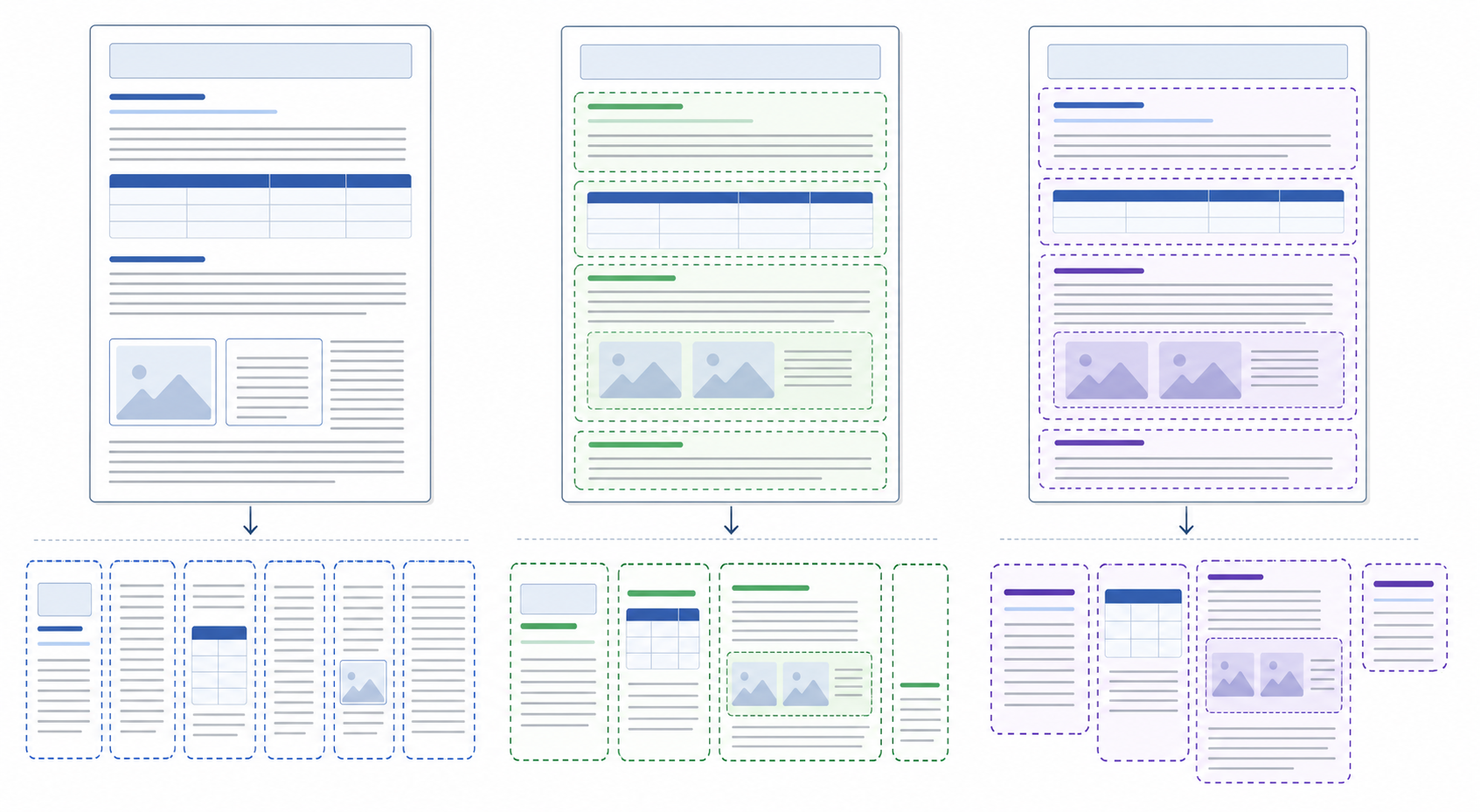
| Strategy | Works Well On | Breaks On |
|---|---|---|
| Fixed-size (512 tokens) | Flat prose, FAQs | Contracts, tables, multi-section forms |
| Structural (heading/section) | PDFs with clear headers | Scanned docs, handwritten forms |
| Semantic (embedding-based) | Mixed-format documents | High ingestion volume, latency-sensitive pipelines |
Context window limits set the ceiling on how much retrieved content the LLM reasons over per query. Retrieving more chunks raises recall but increases noise, degrading answer quality. Teams running RAG pipelines in production typically tune chunk size, overlap, and top-k together as a single configuration space.
Common Failure Modes and Where Document Agents Break
The two failure modes pull in opposite directions. Under-retrieval surfaces when top-k is set too low: a 40-page commercial lease with rent escalation terms spread across sections 4, 11, and an exhibit returns only the section 4 chunk, and the agent answers from partial context without flagging the gap. Over-retrieval surfaces when top-k is set too high: a 120-page loan package returns 20 chunks per query, burying the relevant covenant in positions 8 to 14 of the context block. Threshold calibration against production document types is required; synthetic benchmarks do not reproduce the layout variability or cross-reference density that trigger both modes.
Agents that retrieve too many chunks bury the relevant passage in the middle of a long context block. Research published in Lost in the Middle (Liu et al., 2023) found that LLM accuracy drops significantly when relevant information appears in the middle of the input context, with performance highest when it appears at the beginning or end, which is where retrieval rarely places it.
Validation, Confidence Scoring, and Quality Control
Raw extracted answers frequently fail silently. A model producing a grammatically valid date from a corrupted OCR fragment scores highly on generation fluency even when the date is factually wrong.
Production-grade validation requires cross-field consistency checks, source span verification, and schema-bound output validation. Source span grounding confirms the extracted value maps to a specific character range in the source document. Cross-field consistency catches logical contradictions: an invoice date that falls after the due date, a loan amount that conflicts with the amortization schedule. Schema validation rejects answers that pass fluency checks but violate output contracts.
Teams routing low-confidence extractions to human review close the loop. The correction data from those reviews feeds back into the model as labeled examples, which is how extraction accuracy improves on the specific document types running through production rather than on generic benchmarks.
How Extend Powers Production Document Q&A Agents
Extend is the complete document processing toolkit comprised of the most accurate parsing, extraction, and splitting APIs to ship your hardest use cases in minutes, not months. Extend's suite of models, infrastructure, and tooling is the most powerful custom document solution, without any of the overhead. Agents automate the entire lifecycle of document processing, allowing your engineering teams to process your most complex documents and optimize performance at scale.
Where document Q&A agents typically break at the ingestion and retrieval layers, Extend fixes the stack from the ground up. OCR and specialized computer vision models handle scanned PDFs, multi-page bundles, and mixed-format inputs. VLMs resolve semantic field references that span page boundaries, producing structured JSON representations that retrieval pipelines and LLMs consume directly. In RealDoc-Bench, Extend Parse 2.0 scored 95.7% on document Q&A accuracy across 1,359 prompts and 581 documents, ahead of LlamaParse Agentic at 92.1% and Reducto Agentic at 91.1%, with a layout F1 of 0.847 against human annotations across 1,500 samples.
What Extend Delivers to the Q&A Agent Stack
- Parsing APIs: convert raw documents into LLM-ready structured representations across 35+ file types, with preserved table hierarchies, cross-page field references, and layout metadata intact. Dedicated batch endpoints process thousands of files in background jobs without rate limiting, removing format normalization overhead from engineering teams.
- Confidence Scoring: surfaces low-certainty extractions before they reach the answer generation layer, routing ambiguous fields to human-in-the-loop review instead of letting hallucination risk compound downstream.
- Splitting APIs: segment long documents into retrieval-appropriate chunks while preserving cross-chunk context, which is why multi-page lease packages and loan files return coherent answers instead of fragmented, page-scoped responses.
- Extract APIs: pulls specific fields from documents as structured JSON based on a defined schema, returning each value with per-field confidence scores and bounding-box citations back to the source document. Parse runs under the hood, so table hierarchies and cross-page references carry through to every extracted field.
Accurate parsing, extraction, and splitting is what makes automated downstream decisioning possible. Nothing in the agent stack runs reliably without structured, validated input at the foundation.
Final Thoughts on Document Q&A Agent Design
Document Q&A agent architecture failures trace back to a single root: the ingestion layer delivers fragmented, structurally degraded input, and the agent reasons over fragments instead of documents. Chunking strategy, reasoning pattern, and orchestration architecture all matter. None of them recover from a parsing layer that linearizes tables, loses cross-page context, or passes raw OCR text without layout understanding.
The decision that matters most is where to invest before the agent reasons. Clean structured input, preserved table hierarchies, cross-chunk context, and grounded confidence scores make retrieval reliable. Without them, the agent pattern-matches against noise and failure compounds with every hop. See how Extend handles the full ingestion stack in our live demo.
FAQ
Can teams build a document Q&A agent without writing custom chunking logic?
Yes, but retrieval quality depends on the parsing layer handling structure upfront. Extend's Parse API converts documents into LLM-ready markdown with preserved table layouts and cross-page context, so retrieval components receive normalized input without requiring custom chunking strategies for every document type.
Document Q&A agent RAG vs agentic loops?
RAG retrieves chunks and synthesizes answers in one pass, which works well on clean text but breaks when questions require joining context from non-adjacent sections. Agentic loops add reasoning steps to handle multi-hop queries, but each added hop compounds latency and multiplies failure points, so production systems typically run hybrid patterns that replan only when confidence scores fall below thresholds.
How should teams handle tables in document Q&A pipelines without losing row-column relationships?
Parsing needs to preserve table structure before retrieval starts. Fixed-size chunking linearizes tables into text strings that destroy semantic relationships; Extend's hybrid vision pipeline reconstructs table hierarchies using OCR plus specialized computer vision models, producing structured output that LLMs consume directly without intermediate cleaning.
What breaks first in production document Q&A agents?
Retrieval breaks before extraction does. Fixed 512-token chunks split tables across boundaries in contracts, loan packages, and insurance certificates, separating headers from data rows and cutting mid-sentence in dense clause text. The retrieval index then holds two fragments that each fail to answer the question independently, so the agent answers confidently from partial context. No downstream prompting recovers cleanly from a retrieval layer built on broken input units.
When should teams route extractions to human review instead of auto-processing?
Route when confidence scores reflect actual retrieval quality, beyond generation fluency. Extend's Review Agent produces scores from 1 to 5 with cited explanations of potential issues, flagging low-confidence outputs for escalation before end users see them. Teams set thresholds based on downstream risk tolerance and process corrections as labeled examples that improve extraction accuracy on production document types.