Most batch ingestion pipelines for RAG knowledge bases treat parsing as a solved problem, then watch error rates climb silently as document formats vary across vendors. By the time retrieval surfaces the wrong chunk, thousands of documents have already processed without flagging a single failure. This article walks through where these pipelines break at scale and which architectural controls stop corruption before it reaches the retrieval index.
TLDR:
- Fixed-size chunking splits semantic units mid-sentence, so retrieval returns fragments without context.
- Ingestion drift corrupts data silently when field extractors trained on one layout misclassify another.
- Async batch embedding with queued workers decouples parsing from embedding to avoid pipeline stalls.
- Missing metadata at ingestion means updated documents enter the knowledge base without version tracking.
- Extend processes raw PDFs into structured JSON using OCR, computer vision models, and VLMs that resolve cross-page references.
Why Most Batch Ingestion Pipelines Break at Scale
Most batch ingestion pipelines are built around assumptions that hold in development and collapse in production. Naive RAG pipelines fail at retrieval roughly 40% of the time, with the LLM generating a confident, well-structured answer grounded in the wrong documents.
Documents arrive in consistent formats during testing; in production, invoices shift layouts across vendors, contracts vary by jurisdiction, and scanned PDFs arrive with skewed text layers that break OCR alignment. The pipeline processes these without flagging failures, so corrupted chunks enter the RAG knowledge base silently.
The architectural problem is static preprocessing in document ingestion. Fixed chunking strategies, hardcoded metadata schemas, and regex-based cleaning rules produce predictable output on known document types. Introduce a new document class and error rates compound without any signal reaching the review queue.
Three failure patterns tend to appear repeatedly at scale:
| Failure Pattern | Root Cause | What Breaks | Fix |
|---|---|---|---|
| Fixed-size chunking | Token windows split documents regardless of semantic boundaries | Retrieval returns fragments missing the context LLMs need to generate accurate answers | Semantic chunking that detects section headers, paragraph breaks, and topic transitions |
| Ingestion drift | Field extractors trained on one layout silently misclassify values in another | Chunk metadata corrupted (dates, entities, headers) with no parsing exception to surface it | Layout-aware models, per-field confidence scoring, and schema versioning at the document level |
| No deduplication or versioning | Updated documents append new chunks without retiring stale ones | Knowledge base accumulates contradictory content; LLM cites superseded versions | Document version hashes and source URIs attached as metadata before chunks enter the embedding queue |
Each failure is recoverable in isolation. At batch scale, they compound into a retrieval layer that surfaces corrupted, stale, and contradictory chunks with no parse error or confidence flag to catch them.
When Fixed-Size Chunking Destroys Context Across Documents
Fixed-size chunking splits documents into equal token windows regardless of where sentences, sections, or logical units end. A 512-token chunk boundary landing mid-paragraph severs the relationship between a claim and its supporting evidence, or between a contract clause and the condition it modifies.
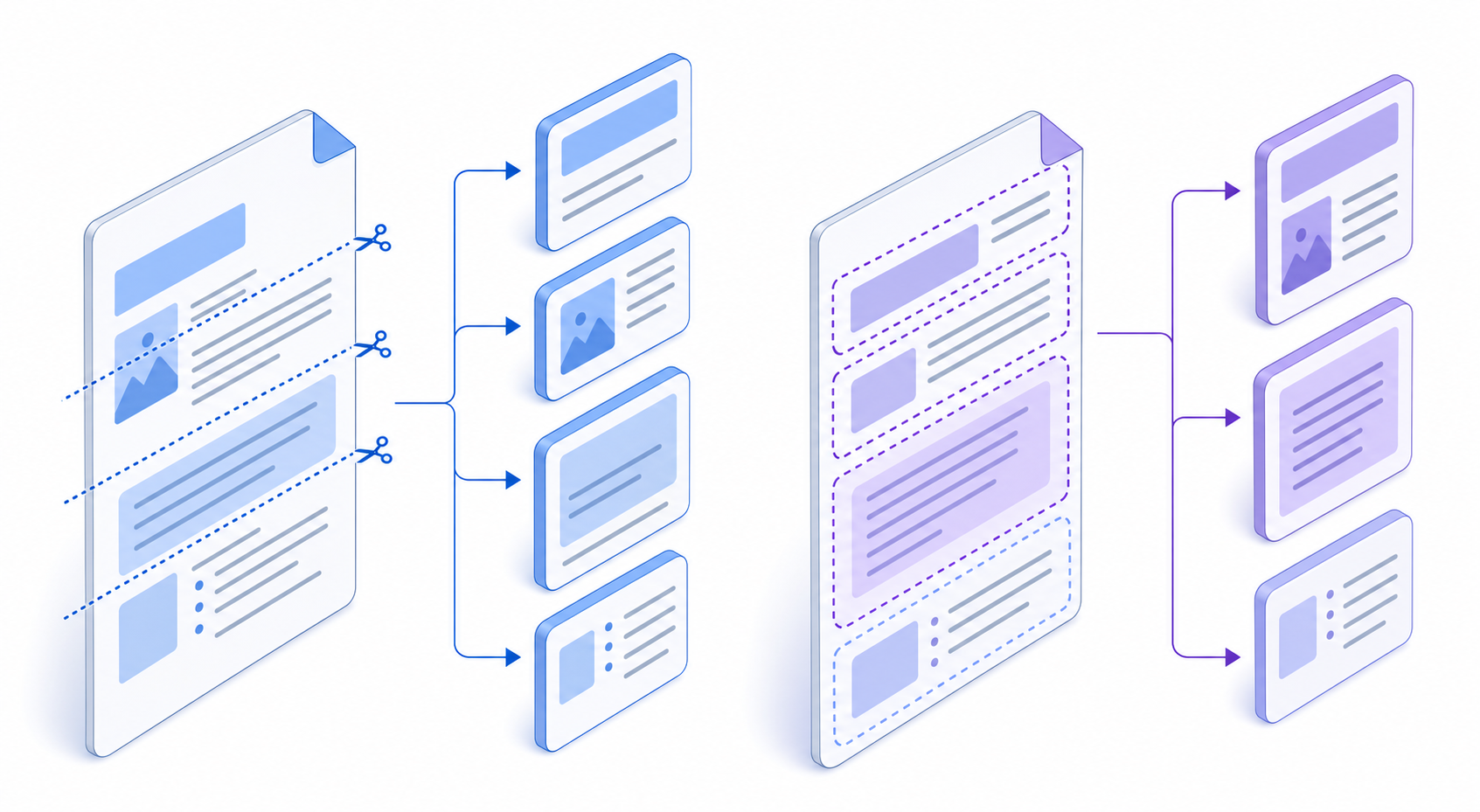
The failure shows up at retrieval time. A RAG query pulls the chunk containing the answer fragment but not the chunk containing the context that makes it interpretable. The LLM receives a partial signal and either hallucinates the missing context or returns an incomplete answer.
Multi-document batches compound this. When thousands of PDFs enter the same ingestion pipeline, chunk boundaries vary across documents with different layouts, page counts, formatting, and section density. A semantic unit that lands cleanly in one chunk for a short, well-structured document may be split across two chunks in a longer, densely formatted one. The result is an inconsistent retrieval surface across the knowledge base.
Semantic chunking resolves this by detecting logical boundaries instead of counting tokens. Teams processing high-volume document batches need chunking logic that adapts to document structure, not one that treats every file as an undifferentiated token stream. The fix targets three split-point signals:
- Section headers: mark the start of a new logical unit, so chunks align to the document's own structure.
- Paragraph breaks: preserve the boundary between distinct ideas, keeping claims and their supporting evidence in the same chunk.
- Topic transitions: catch shifts in subject matter that headers and paragraph breaks alone may miss, preventing context bleed across unrelated content.
Ingestion Drift: How Pipelines Corrupt Data Silently
Ingestion drift happens when document formats shift across batches and field extractors trained on one layout silently misclassify values in another. A vendor invoice that switches from a structured table to a line-item list mid-batch, for example, produces corrupted chunk metadata: date fields, entity references, and section headers all classified against the wrong schema, with no parsing exception to catch it. The retrieval index absorbs those errors without complaint.
The subtler failure mode is partial correctness, where a PDF extracts with 94% field accuracy and the remaining 6% contains the date fields, entity references, or section headers that chunk boundary logic depends on. Those gaps don't surface in pipeline logs; they show up as retrieval misses in production queries weeks later.
A production RAG pipeline that audited clean on launch can degrade within three months without a single deployment change. Containing drift requires extractors built to adapt to layout variation, not ones that assume it.
- Layout-aware models: retrain on observed format variations so extractors adapt to new layouts instead of silently misclassifying them.
- Per-field confidence scoring: surfaces the accuracy gap that a high-aggregate score conceals, flagging the specific fields where extraction uncertainty is highest.
- Schema versioning at the document level: catches structural changes before they reach the index, giving the pipeline a point to reject or reroute documents that no longer match the expected format.
No Deduplication or Versioning: How Knowledge Bases Accumulate Contradictions
Updated documents ingested without version tracking enter the knowledge base as new chunks alongside their predecessors. A policy revised in Q2 coexists with the Q1 version in the same index; retrieval returns both, the LLM receives contradictory inputs with no signal indicating which is current, and answers citing the superseded version pass through without a parse error or confidence flag. Contract amendments, regulatory updates, and vendor SOWs intensify this: near-duplicate documents with slightly different clause language or effective dates produce overlapping chunks that inflate retrieval noise without any formal versioning gap to surface the problem.
Most batch pipelines defer deduplication to post-processing, which loses the association between chunks and their source documents after splitting, particularly when async workers process chunks out of order.
The fix runs at ingestion time, before chunks enter the embedding queue:
- Document version hashes: catch re-ingested files that are substantively identical, blocking duplicate chunk proliferation across index updates.
- Source URIs: attached as chunk metadata, give the retrieval layer a reference point to verify whether the originating document is still the authoritative version.
- Stale chunk retirement: retires prior versions when a new document hash replaces an existing one, preventing the knowledge base from accumulating contradictory content over time.
- Chunk position index (page number, section header, paragraph offset): lets retrieval pipelines reconstruct citation context without re-fetching the full document. Without it, citations in LLM outputs lose their positional anchor, making it impossible to verify whether the retrieved chunk came from the current version or a superseded one.
Vector Database Ingestion Bottlenecks and Index Build Times
Slow index builds are where batch ingestion pipelines stall in production. Most teams hit this by defaulting to synchronous embedding calls per document. At low volume, this works. At thousands of documents, the per-call overhead compounds into blocked pipeline time, and rate limits from embedding providers start throttling ingestion mid-run. The result: embedding time routinely doubles or triples parse time when workers run in sequence.
Two patterns fix the throughput problem before it reaches the index:
- Async batch embedding with queued workers: decouples ingestion from embedding, so document parsing continues while prior chunks wait for vector generation. This keeps the pipeline moving without blocking on API responses.
- Tiered embedding strategies: assign lightweight models to low-priority or high-volume document classes and reserve higher-cost models for documents where retrieval precision has direct downstream impact on answer quality.
Combining chunk deduplication with async batching produces the best overall cost profile: deduplication cuts token spend before embedding starts, while async workers keep throughput high and latency risk low.
Error Handling Patterns for High-Volume Document Processing
Production pipelines that ingest thousands of documents per day will encounter malformed PDFs, truncated uploads, encoding failures, and extraction timeouts. Without a deliberate error handling architecture, these failures silently corrupt the knowledge base or block ingestion entirely. Teams building scalable data ingestion pipelines structure retry logic and dead letter queues before the first production document enters the system.
Three patterns cover most failure modes at scale:
- Retry with exponential backoff: handles transient failures like timeouts or upstream API rate limits. A document that fails on first attempt due to a momentary service interruption re-queues automatically, rather than surfacing as a permanent error requiring manual intervention.
- Dead letter queues: isolate documents that fail repeatedly so ingestion continues for the rest of the batch. Files in the dead letter queue get routed to human review instead of blocking pipeline throughput.
- Partial ingestion logging: records which chunks or pages succeeded before a failure, so retry logic resumes from the last successful checkpoint instead of reprocessing the entire document.
How Extend Processes Complex Documents in Complete Batch Workflows
Extend is the complete document processing toolkit comprised of the most accurate parsing, extraction, and splitting APIs to ship your hardest use cases in minutes, not months. Extend's suite of models, infrastructure, and tooling is the most powerful custom document solution, without any of the overhead. Agents automate the entire lifecycle of document processing, allowing your engineering teams to process your most complex documents and optimize performance at scale.
Extend's OCR layer handles scanned PDFs and image-heavy documents before specialized computer vision models resolve layout structure. VLMs then resolve semantic field references across page boundaries, which is why multi-page contracts and loan packages don't produce the cross-page field mismatches that template-based extractors generate when context resets per page. The output feeds directly into RAG knowledge base indexing without intermediate cleaning or schema normalization.
Every extracted field ships with a confidence score calculated from layout signal strength, OCR certainty, and cross-field consistency checks, giving the pipeline a per-field accuracy signal instead of a single aggregate pass/fail. Fields falling below a configurable threshold route automatically to human review queues; high-confidence fields pass through to the knowledge base without manual intervention. That separation is what keeps error rates low on variable-format document sets while maintaining batch throughput. In RealDoc-Bench, Extend Parse 2.0 scored 0.847 adjusted F1 on layout accuracy and 95.7% on document Q&A across 581 real-world documents, leading LlamaParse, Reducto, Azure Document Intelligence, and AWS Textract on both measures.
Final Thoughts on Building Resilient Batch Document Pipelines
Batch document ingestion for RAG knowledge bases is where retrieval quality is built or lost. The ingestion layer determines what enters the index, and what enters the index determines what the retrieval layer can return. Teams shipping high-volume pipelines on Extend get OCR, computer vision models, VLMs, per-field confidence scoring, and async ingestion infrastructure in a single API surface, without building or maintaining those components separately. Grab time with our team to see how Extend handles your most complex document types at scale.
FAQ
Batch document ingestion for RAG knowledge base vs real-time document processing: which is right for your use case?
Batch ingestion fits workflows where documents accumulate over time and retrieval latency tolerance is measured in hours, not seconds: think overnight processing of contract archives or periodic updates to policy knowledge bases. Real-time processing makes sense when documents trigger immediate downstream actions, like loan application intake or customer support ticket routing where retrieval must happen within seconds of upload.
Is it possible to build a RAG knowledge base without handling document parsing separately?
No. Parsing converts raw documents into the structured representations that retrieval depends on: accurate field extraction, semantic chunking, and metadata attachment all happen at this stage. Skip it, and the vector index absorbs incomplete or malformed chunks that the retrieval layer cannot distinguish from clean ones. Parsing is the foundational layer; retrieval quality is a direct output of how well it runs.
How should deduplication be handled in batch document ingestion pipelines?
Attach document version hashes and source URIs as metadata at ingestion time, before chunks enter the embedding queue. Pipelines that defer deduplication to post-processing lose the association between chunks and their source documents after splitting, particularly when async workers process chunks out of order, which inflates the index with near-duplicate content and degrades retrieval precision.
How can fixed-size chunking be prevented from destroying context across a document corpus?
Use semantic chunking logic that detects logical boundaries like section headers, paragraph breaks, and topic transitions, instead of counting tokens. Fixed-size chunking splits documents into equal token windows regardless of where semantic units end, severing the relationship between claims and supporting evidence, so retrieval returns fragments without the context LLMs need to generate accurate answers.