9 MIN READ
Dec 18, 2025
Blog Post
Best Semantic Chunking Solutions for Large Document Processing (December 2025)

Kushal Byatnal
Co-founder, CEO
Everyone's dealing with the same problem: traditional chunking methods destroy context. Your 40-page contract gets split at arbitrary boundaries, tables get separated from their headers, and related sections end up in different chunks. Context management for complex documents requires understanding structure, not just finding convenient places to cut.
We tested semantic chunking solutions on the documents that break simpler approaches. Multi-page tables, nested forms, dense columnar layouts. The kind of stuff your team actually needs to process in production.
TLDR:
Semantic chunking preserves document structure by keeping tables, forms, and related sections intact across chunks
Vision-based chunking outperforms text-only methods on multi-page documents with complex layouts
Schema versioning and built-in evaluation prevent production breakage when updating extraction logic
Extend combines custom-trained VLMs with layout-aware OCR for production-ready document processing
What is Semantic Chunking for Large Document Processing?

Semantic chunking breaks large documents into segments based on meaning rather than arbitrary boundaries like character count or page breaks. Traditional splitting methods cut documents at fixed intervals or use simple heuristics like paragraph breaks. This often splits tables mid-row, separates list items from their headers, or breaks related clauses across chunks.
The result is lost context that degrades extraction accuracy and makes it difficult for LLMs to understand relationships between data points. According to a 2025 Gartner report, 60% of AI projects will be abandoned by 2026 specifically due to a lack of 'AI-ready' data, highlighting why proper semantic chunking is critical for AI success.
Semantic chunking analyzes document structure and content relationships to create intelligent boundaries. When processing a large 50-page mortgage contract like those in real estate, semantic chunking keeps related information together in the same chunk. It keeps tables intact, preserves section context, and groups entities like line items or multi-page schedules together.
How We Ranked Semantic Chunking Solutions
We evaluated semantic chunking solutions across five factors that determine production readiness for document processing workflows.
Category | Reasoning |
|---|---|
Context preservation accuracy | Measures how well a solution maintains semantic relationships across chunks. This includes keeping tables intact, preserving multi-page structures, and grouping related entities together. Poor chunking breaks dependencies and forces LLMs to hallucinate missing context. |
Multi-page document handling | Evaluates whether a solution can process long documents while maintaining context across boundaries. Many tools struggle with documents over 20 pages or fail when tables span multiple pages. |
Complex structure support | Assesses accuracy on challenging layouts like nested tables, forms with checkboxes, handwriting, and dense columnar data. Real-world documents rarely follow clean templates. |
Speed and cost | Examines processing latency and pricing across volume scenarios. Teams need both fast modes for real-time workflows and cost-optimized options for high-volume batch processing. |
Schema management capabilities | Determine how easily teams can version, test, and deploy extraction schemas in production environments without breaking existing pipelines. |
Best Overall Semantic Chunking Solution: Extend
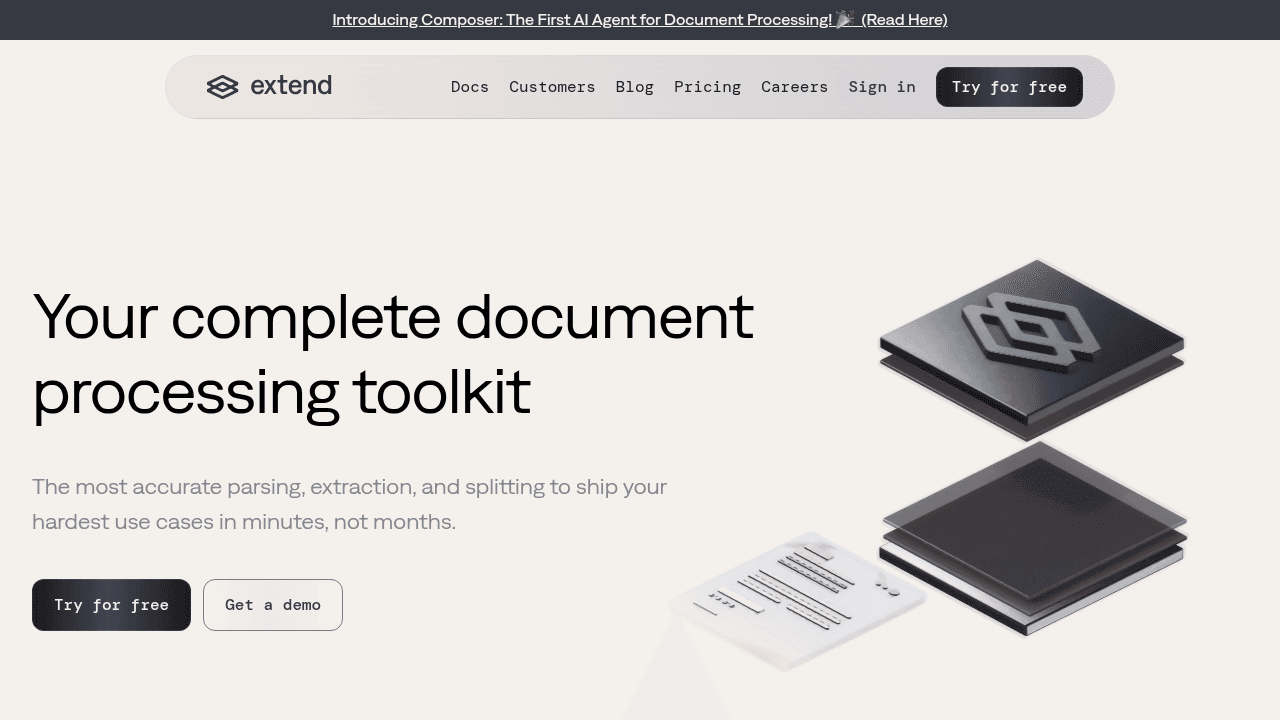
Extend is the complete document processing toolkit comprised of the most accurate parsing, extraction, and splitting APIs to ship your hardest use cases in minutes, not months. The suite of models, infrastructure, and tooling handles semantic chunking as a part of their end-to-end document solution.
Document-Aware Chunking
The semantic chunking combines layout-aware OCR with vision AI to understand document structure before creating chunks. Multi-page tables stay intact and related sections remain grouped because the system analyzes visual layout alongside textual content.
Intelligent Merging
LLM-based merging strategies resolve duplicates and conflicts across chunks. When extraction spans multiple chunks, the system maintains entity relationships and dependencies that break in simpler approaches.
Production Features
Schema versioning allows safe production deployments with rollback capabilities. Built-in evaluation includes LLM-as-a-judge scoring for automated quality checks. Review Agent provides confidence-based QA for human-in-the-loop workflows. SOC2, HIPAA, and GDPR compliance includes 99 percent uptime guarantees and audit logs.
Unstructured
Unstructured is an open-source library that converts PDFs, HTML, and Office documents into standardized text elements for downstream AI workflows.
The library provides modular file ingestion for PDFs, Word, PowerPoint, HTML, and images. Basic chunking includes connectors for vector databases and AI frameworks. Text-centric extraction handles standard element types like titles, paragraphs, and tables. Teams can use the open-source library directly or access the optional SaaS API for managed processing.
Unstructured works for development teams needing broad file format coverage and standard text extraction for basic document ingestion pipelines.
Limitations
Unstructured focuses on text-centric extraction with basic layout heuristics. It lacks vision-based semantic understanding needed for complex multi-page documents with structures like nested tables, handwritten annotations, or multi-column layouts. The chunking strategies are limited compared to solutions using multimodal AI to understand document context and relationships across pages. Teams processing mission-critical documents requiring high accuracy on challenging edge cases will find the approach functional for simpler scenarios but insufficient for production-grade accuracy on complex document types.
LlamaIndex
LlamaIndex is an open-source data framework for building AI applications. The library includes document loading capabilities and various chunking strategies for retrieval workflows.
Multiple node parsers handle different chunking approaches: SentenceSplitter divides text by sentences, TokenTextSplitter uses token counts, and SemanticSplitter groups content by meaning. Hierarchical parsing creates parent-child node relationships between chunks. Integration with embedding models and vector databases connects chunking directly to retrieval pipelines. Teams can customize chunking through extensible parser classes.
LlamaIndex works best for AI developers building retrieval pipelines who need flexible document chunking integrated with vector search workflows.
The framework provides chunking as a component not a complete document processing solution. Teams handle OCR quality, document structure understanding, and production reliability themselves. The semantic chunking relies on embedding-based sentence similarity without vision-based layout understanding for complex documents with tables or forms. Organizations must build extraction accuracy measurement, schema management, and QA systems separately.
LangChain
LangChain is an open-source framework for building applications with language models that includes text splitting and document processing utilities.
The framework provides RecursiveCharacterTextSplitter, TokenTextSplitter, and document-specific splitters for various formats. HTML, Markdown, and code-specific splitting strategies handle different content types. Integration with embedding models and retrieval components connects splitting to broader AI applications.
LangChain works for developers building language model applications who need basic text chunking for prototyping pipelines.
The framework treats document splitting as a preprocessing utility rather than purpose-built semantic chunking for production. Splitting strategies operate on text sequences without multimodal understanding of document layout or visual structure. Character and sentence-based splitters lack semantic intelligence to preserve meaning across multi-page tables or nested sections. Converting documents to clean text requires separate OCR tools. No built-in evaluation, schema versioning, or confidence scoring exists for production reliability.
Pinecone
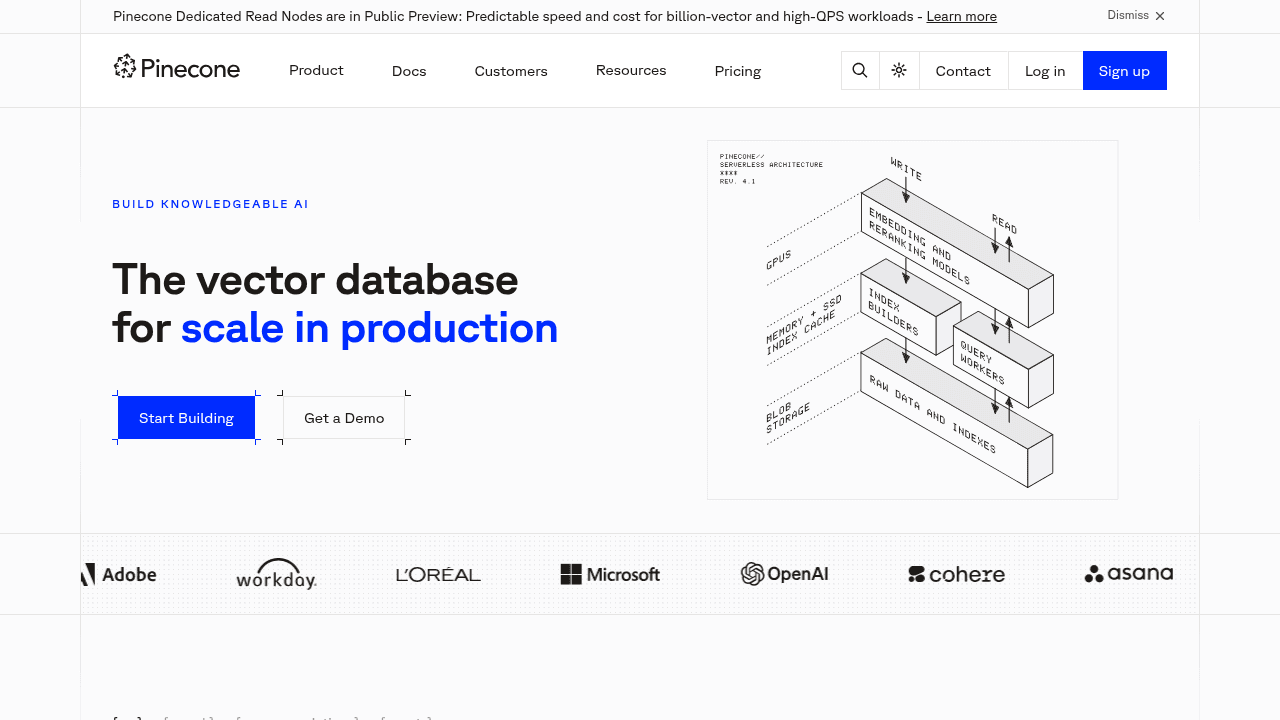
Pinecone provides chunking guidance and utilities within its vector database ecosystem for retrieval-augmented generation applications.
The approach includes documentation on fixed-size, recursive, and semantic chunking strategies optimized for vector search. Integration patterns connect embedding models with chunk-level vector storage, while chunk expansion techniques handle post-processing of retrieved content.
Pinecone works for teams already using Pinecone vector database who need chunking strategies for semantic search and retrieval workflows.
The limitation: Pinecone offers chunking as a best practice for vector search, not a managed document processing service. Teams must implement document parsing, OCR, structure understanding, and chunk generation separately. The guidance focuses on preparing text for embedding and retrieval but doesn't handle production challenges like processing complex documents with tables, forms, or multi-page layouts. Organizations must build their own systems for document structure awareness, intelligent merging across page boundaries, schema management, and quality assurance.
Feature Comparison Table of Semantic Chunking Solutions
The table below summarizes how each solution handles critical capabilities for production document processing. We focused on features that directly impact accuracy, deployment speed, and reliability at scale.
Capability | Extend | Unstructured | LlamaIndex | LangChain | Pinecone |
|---|---|---|---|---|---|
Semantic chunking with context preservation | Vision-based layout understanding | Text-based only | Embedding-based | Character/sentence-based | Guidance only |
Schema versioning for safe production changes | Native versioning | No | No | No | No |
Built-in evaluation and accuracy measurement | Yes | No | No | No | No |
Intelligent merging across document chunks | Multi-step LLM process | Basic | Framework-dependent | No | No |
Vision-based layout understanding | Custom-trained VLMs | No | No | No | No |
Agentic automation and optimization | Composer and Review agents | No | No | No | No |
Human-in-the-loop review UI | Built-in | No | No | No | No |
Multi-page table and form handling | Advanced | Basic | Framework-dependent | No | No |
Extend provides the complete set of capabilities needed for production deployments, while alternatives require significant engineering work to achieve comparable results.
Why Extend is the Best Semantic Chunking Solution for Large Document Processing
Extend is the complete document processing toolkit comprised of the most accurate parsing, extraction, and splitting APIs to ship your hardest use cases in minutes, not months. For semantic chunking, this means custom-trained VLMs and layout-aware OCR that understand document structure before splitting content.
The vision-based approach preserves multi-page tables, nested forms, and related sections where text-based methods break semantic relationships. Composer handles schema optimization and drift automatically, removing manual tuning cycles. Processing modes let you optimize for latency in real-time workflows or cost in batch scenarios.
Built-in evaluation, schema versioning, and confidence-based routing provide reliability for production deployments.
Extend delivers this as an integrated toolkit rather than separate OCR, chunking libraries, evaluation systems, and QA interfaces. See how teams are using it in production in our customer reviews.
Final thoughts on document chunking strategies
When you're building document AI workflows, chunking determines whether your extractions maintain context or lose critical relationships. Vision-based approaches understand layout and structure before splitting, which keeps multi-page tables together and preserves semantic meaning. The right chunking strategy saves you from debugging broken extractions and hallucinated data downstream.
FAQ
How do I choose the right semantic chunking solution for my document processing needs?
Start by evaluating your document complexity and volume requirements. If you're processing mission-critical documents with multi-page tables, nested forms, or handwriting, you need vision-based semantic chunking with layout understanding. For simpler text extraction or prototyping, open-source frameworks may suffice, but expect to build production infrastructure yourself.
Which semantic chunking approach works best for high-volume batch processing versus real-time workflows?
Solutions with multiple processing modes let you optimize for different scenarios. Fast modes prioritize latency for real-time extraction, while cost-optimized modes handle high-volume batches economically. Single-mode solutions force you to choose between speed and cost across all workflows, limiting flexibility as requirements change.
What's the difference between text-based and vision-based semantic chunking?
Text-based chunking splits documents using character counts, sentences, or embeddings without understanding visual layout. Vision-based chunking analyzes document structure through VLMs and layout-aware OCR to preserve multi-page tables, forms, and nested sections. The vision approach maintains semantic relationships that text-only methods break.
Can I use open-source chunking libraries for production document processing?
Open-source frameworks like LlamaIndex and LangChain provide chunking utilities for prototyping, but you'll need to build OCR integration, schema management, evaluation systems, and QA workflows separately. Production deployments require handling edge cases, measuring accuracy, versioning schemas safely, and maintaining reliability at scale.
When should I consider a managed semantic chunking solution instead of building my own?
If you're spending weeks tuning prompts, building evaluation infrastructure, or debugging extraction failures on complex documents, a managed solution accelerates deployment. Teams processing mission-critical documents where 90% accuracy isn't sufficient benefit from purpose-built systems with built-in evaluation, schema versioning, and confidence-based routing.
WHY EXTEND?