As AI continues to reshape how we access and interact with information, the landscape of retrieval-augmented generation (RAG) is evolving faster than ever. Traditional RAG systems—designed to pull relevant data from knowledge bases and generate responses—have served us well, but they often hit limits when tasks require reasoning, multi-step planning, or dynamic decision-making. Enter Agentic RAG: a new breed of AI that combines retrieval with autonomous agent capabilities, allowing models to not just fetch information but also plan, act, and adapt in real time.
In 2026, it’s clear why agentic approaches are winning. They offer smarter, context-aware responses, handle complex workflows, and reduce the human effort needed to get actionable insights. In this post, we break down the key differences between Agentic RAG and Traditional RAG, exploring why the next generation of AI agents is redefining what “intelligent assistance” truly means.
TLDR:
- Agentic RAG uses autonomous agents to make decisions and adapt retrieval strategies mid-query, unlike traditional RAG's fixed retrieve-then-generate pattern.
- Multi-agent systems deliver 89% better performance on complex tasks by coordinating specialized agents for routing, planning, and validation.
- Agentic architectures excel when answers span multiple sources or require iterative refinement that single-pass retrieval can't handle
- Extend applies agentic intelligence through Composer AI and Review Agent to achieve 99%+ accuracy on production documents in minutes.
What Is Agentic RAG and Why Does It Matter in 2026
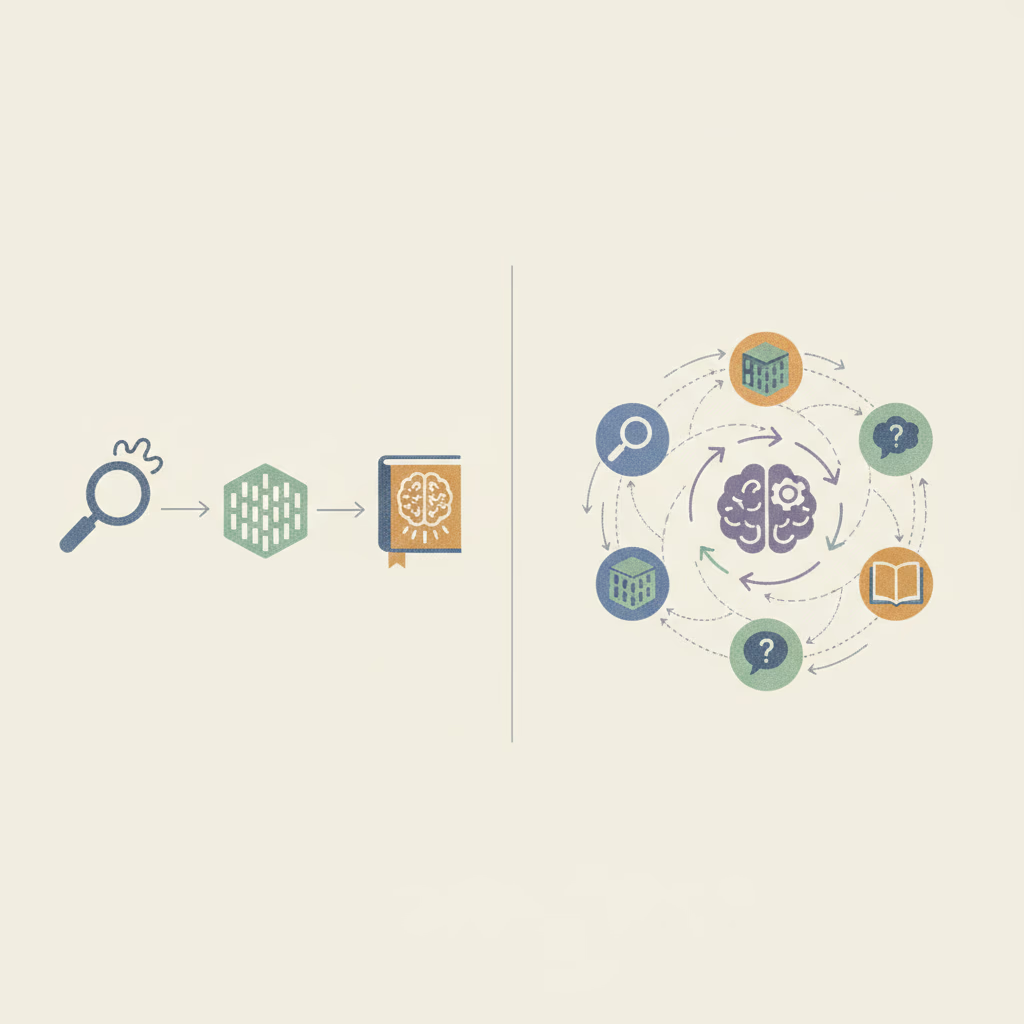
Agentic RAG takes retrieval-augmented generation beyond simple query-and-retrieve workflows by embedding autonomous AI agents directly into the pipeline. Unlike traditional RAG, which follows a fixed pattern of retrieval followed by generation, agentic RAG gives agents the ability to make decisions, plan multi-step retrieval strategies, and adapt their approach based on what they find. These agents can choose which data sources to query, determine when to refine searches, and decide whether retrieved information actually answers the question.
The difference shows up most clearly in how each system handles complexity. Traditional RAG retrieves documents based on semantic similarity and hands them to an LLM for answer generation. Agentic RAG agents can reason about whether the first retrieval was sufficient, execute follow-up queries to different knowledge bases, and even recognize when they need to change tactics entirely. This matters for document processing scenarios where answers span multiple sources or require contextual understanding that goes beyond keyword matching.
By the end of 2026, 40% of enterprise applications will include task-specific AI agents. That shift reflects the growing recognition that static retrieval pipelines can't handle real-world information needs. Agentic RAG addresses the core limitation of traditional systems: their inability to think through complex queries that demand adaptive reasoning rather than pattern matching.
Traditional RAG Architecture vs Agentic RAG Architecture
The architectural differences between traditional and agentic RAG create measurable performance gaps that matter for production document workflows. Traditional RAG's linear pipeline works for simple queries but breaks down when documents require multi-step reasoning or cross-referencing. The following comparison shows how each approach handles retrieval patterns, decision logic, and the complex scenarios that define real-world document processing:
| Feature | Traditional RAG | Agentic RAG |
|---|---|---|
| Retrieval Pattern | Single-pass retrieval with fixed similarity thresholds targeting one knowledge base | Multi-step retrieval with adaptive strategies across multiple sources based on query complexity |
| Decision Making | No decision logic - follows linear pipeline from query embedding to answer generation | Autonomous agents make decisions about which sources to query, when to refine searches, and whether results are sufficient |
| Feedback Loops | No feedback mechanism - if initial retrieval misses relevant information, system cannot correct course | Validation agents check retrieval quality and trigger alternate strategies like query expansion or semantic re-ranking |
| Query Handling | Treats each query independently with single retrieval execution | Breaks complex questions into sub-queries and determines optimal retrieval sequence through planning agents |
| Multi-Source Retrieval | Limited to single vector database query per request | Parallel or sequential retrieval from multiple heterogeneous sources coordinated by routing agents |
| Context Awareness | Treats document chunks independently without understanding structure | Recognizes document structure and retrieves adjacent sections when context is incomplete |
| Performance on Complex Tasks | Fails when answers span multiple sources or require cross-referencing data | 89% better performance on complex tasks with 30% improvement in response accuracy |
| Best Use Cases | Simple FAQ retrieval, single-document Q&A, straightforward keyword matching scenarios | Multi-document synthesis, nested dependencies, conditional logic, scenarios requiring 90%+ accuracy |
Beyond these structural differences, agentic RAG introduces capabilities that fundamentally change how systems handle uncertainty and complexity.
This architecture introduces feedback loops and conditional logic that don't exist in traditional RAG. Agents can detect when initial retrieval quality is low and trigger alternate strategies such as query expansion, semantic re-ranking, or switching to different embedding models. Multi-source retrieval happens in parallel or sequentially depending on what prior steps uncover.
The result is a system that scales to complex document scenarios where answers require synthesizing information across formats, validating conflicting data, or drilling into nested structures. Traditional RAG collapses when queries demand more than surface-level similarity matching. Agentic systems adapt.
Key Agent Types Powering Agentic RAG Systems
Agentic RAG systems rely on specialized agents that each handle distinct parts of the retrieval and reasoning process. These agents work in coordination rather than isolation, passing results between steps and adjusting their approach based on what earlier agents discovered.
Routing Agents
Routing agents analyze incoming queries and decide which knowledge sources or retrieval strategies to invoke. When a question involves financial data, the routing agent directs retrieval to structured databases or spreadsheets. For unstructured contract language, it routes to document stores with semantic search. This agent prevents wasted compute by targeting only relevant sources rather than querying everything.
Query Planning Agents
Query planning agents decompose complex questions into sub-queries that can be answered independently and then synthesized. If a query asks for year-over-year revenue changes across product lines, the planning agent breaks this into separate retrievals for each year and product, then structures how results should be combined. This prevents context window overflow and improves retrieval precision.
ReAct Agents
ReAct agents interleave reasoning and action in loops. They generate a thought about what information is needed, take an action like retrieving documents, observe the results, and reason about the next step. This cycle repeats until the agent determines it has enough information to answer confidently or escalate for review.
Plan-and-Execute Agents
Plan-and-execute agents create a full retrieval plan upfront, then execute each step sequentially. They're suited for workflows where dependencies between steps are clear and the path to an answer follows predictable logic, such as extracting data that requires validating against reference tables before output.
When Traditional RAG Fails and Agentic RAG Succeeds
Traditional RAG returns incomplete answers when information spans multiple document types. A financial analyst asking for cash flow trends across subsidiaries gets invoice data but misses bank statements and internal reports—because traditional RAG queries one vector store and stops. Agentic RAG deploys separate retrieval agents for structured spreadsheets and unstructured PDFs, validates numerical consistency across sources, and flags discrepancies before generating answers.
Complex documents with nested dependencies expose the second failure mode. Healthcare prior authorization forms reference diagnosis codes that link to treatment protocols stored elsewhere. Traditional RAG retrieves the form but misses the referenced context because it executes a single similarity search. Agents follow citation trails, retrieve linked documents iteratively, and build complete context before extraction.
The decision point comes down to information complexity and accuracy requirements. Simple FAQ retrieval or single-document Q&A works fine with traditional RAG. Multi-document synthesis, conditional logic, or scenarios where 90% accuracy creates compliance risk require agentic approaches. When retrieval needs reasoning rather than just matching, agents become necessary infrastructure instead of optional enhancement.
Extend applies this intelligence through specialized agents that handle the full complexity spectrum—from Composer AI optimizing extraction schemas to Review Agent validating edge cases—so teams ship accurate document workflows without building custom agentic architectures from scratch.
Agentic RAG Performance Metrics and Accuracy Improvements
Measuring agentic RAG performance requires different evaluation methods than traditional retrieval systems. Mean Reciprocal Rank (MRR) tracks how quickly agents surface correct information across multi-step queries. Normalized Discounted Cumulative Gain (nDCG) measures ranking quality when agents retrieve from multiple sources simultaneously. Precision and recall quantify how well agents filter irrelevant results during iterative refinement, while F1 scores balance both metrics across the full retrieval pipeline.
Research shows agentic RAG delivers 89% better performance on complex tasks compared to basic RAG. These gains appear most clearly in resolution rates, where agentic systems answer multi-hop questions that traditional approaches fail to address. Response quality metrics track citation accuracy, factual consistency, and answer completeness across agent decision paths.
Organizations quantify value through automated decision-making rates, measuring how often agents complete workflows without human escalation. Confidence score distributions show where agents excel versus where review remains necessary, informing which document types benefit most from agentic augmentation versus simpler retrieval patterns.
How Extend Brings Agentic Intelligence to Document Processing
Extend applies agentic intelligence across the entire document processing lifecycle through autonomous agents that operate without manual intervention. The Composer AI agent experiments with prompt and schema variants in parallel, converging to optimal extraction configurations in minutes rather than the weeks traditional approaches require. This agent-driven optimization delivered 99%+ accuracy for customers like Brex across millions of production documents.
The agent workflow spans the full pipeline: agentic OCR routes pages through specialized models based on content type, handling handwriting and strikethroughs that traditional systems miss. Extraction agents adapt retrieval strategies for multi-page tables and nested arrays. The Review Agent applies confidence scoring to flag edge cases for human validation while auto-approving high-confidence outputs.
This feedback loop creates continuous improvement where agents learn from corrections and validated results, refining extraction logic without engineering intervention. Organizations ship complex document workflows in days instead of building and tuning custom RAG pipelines from scratch.
Final Thoughts on Agentic RAG Architecture
Complex document workflows break traditional RAG because they need reasoning, not just retrieval. Agentic RAG systems close that gap by giving agents the ability to plan multi-step queries, validate results, and adapt their approach based on what they discover. Extend applies this intelligence across your entire document processing pipeline so you ship accurate extraction without the overhead of building custom agent architectures.
FAQ
What is the main difference between agentic RAG and traditional RAG?
Traditional RAG follows a fixed pattern of retrieving documents once based on semantic similarity and generating an answer, while agentic RAG uses autonomous agents that can plan multi-step retrieval strategies, query multiple sources, and adapt their approach based on what they find.
How do agentic RAG systems decide which retrieval strategy to use?
Routing agents analyze query characteristics and direct retrieval to appropriate knowledge sources, while planning agents decompose complex questions into sub-queries that execute sequentially or in parallel based on dependencies discovered during initial retrieval steps.
What performance improvements do agentic RAG systems deliver?
Agentic RAG systems deliver 89% better performance on complex tasks compared to basic RAG by coordinating specialized agents for routing, planning, and validation across multi-step queries.
When should you choose agentic RAG over traditional RAG?
Choose agentic RAG when queries require synthesizing information across multiple heterogeneous sources, handling nested dependencies between documents, or when accuracy requirements exceed 90% and compliance risk makes errors costly.
How does Extend apply agentic intelligence to document processing?
Extend deploys autonomous agents across the full pipeline: Composer AI optimizes extraction schemas automatically, agentic OCR routes pages through specialized models, extraction agents adapt strategies for complex tables, and the Review Agent applies confidence scoring to flag edge cases while auto-approving high-confidence outputs.