Most document processing platforms are designed for clean, standardized inputs. Supply chain teams face a much messier reality: water-damaged bills of lading, multilingual packing lists, handwritten corrections on commercial invoices, and faxed customs forms with barely legible text. With 57% of logistics executives reporting shipment delays in the past year due to document errors, operations teams need supply chain document processing tools designed for real-world supply chain conditions. We compared top enterprise solutions to determine which can handle mission-critical documents without disrupting production workflows.
TLDR:
- Supply chain document processing AI extracts data from BOLs, invoices, and customs forms at scale
- Extend handles messy logistics documents with agentic OCR and processes thousands of line items
- Schema versioning lets teams update extraction rules without breaking production pipelines
- Most solutions lack evaluation frameworks and workflow orchestration for supply chain operations
- Extend offers fast modes for low latency use cases and cost-optimized modes for high volume use cases
What is Supply Chain Document Processing?
Supply chain document processing refers to AI systems that automatically extract, validate, and route data from logistics documents. These solutions handle the paper trail that moves alongside physical goods: bills of lading, commercial invoices, purchase orders, packing lists, customs declarations, and shipping manifests.
The challenge lies in volume and variety. A single shipment can generate dozens of documents across multiple formats, languages, and quality levels. Manual data entry creates bottlenecks, delays shipments, and introduces costly errors that ripple through inventory systems, customs clearance, and financial reconciliation.
Document processing AI applies LLMs and vision models to read these documents at scale, extracting structured data that feeds directly into ERP systems, warehouse management software, and tracking dashboards. The result is faster processing times, fewer errors, and better visibility across the entire supply chain.
How We Ranked Enterprise Document Processing Solutions for Supply Chain Management
Supply chain teams need document processing that handles real-world logistics chaos: water-damaged bills of lading, multilingual customs forms, and handwritten packing slips. 57% of logistics executives reported shipment delays in the past year directly tied to document errors, directly impact their ability to meet delivery commitments.
We evaluated solutions based on six criteria that matter for logistics operations:
- Accuracy across variable document formats, including scanned, photographed, and faxed documents
- Processing speed that keeps pace with time-sensitive shipments and customs deadlines
- Coverage of logistics document types like BOLs, commercial invoices, and ASNs
- Integration depth with existing ERP, TMS, and WMS systems
- Fraud detection for forged or altered shipping documents
- Compliance tooling for customs regulations and audit trails
Best Overall Enterprise Document Processing for Supply Chain: Extend
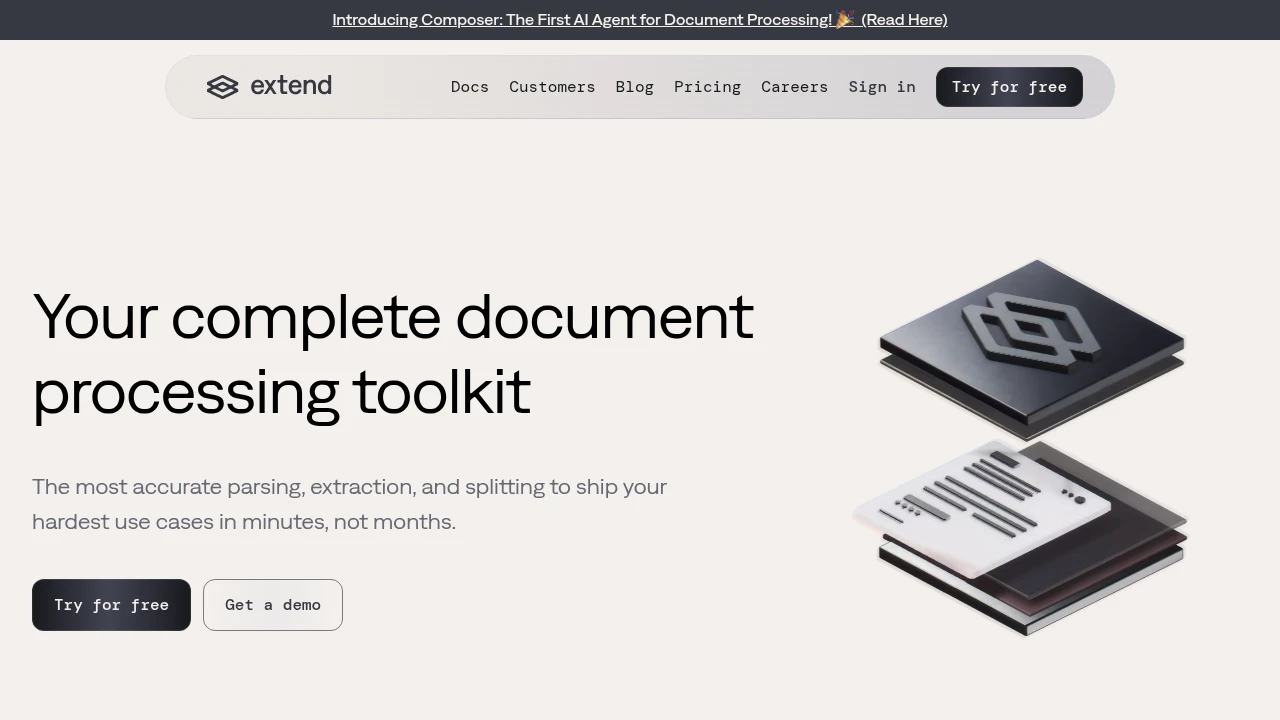
Extend is the complete document processing toolkit comprised of the most accurate parsing, classification, extraction, splitting, and editing APIs to ship supply chain use cases in minutes, not months. Extend's suite of models, infrastructure, and tooling is the most powerful custom document solution, without any of the overhead.
Key Features:
- Schema versioning allows teams to update extraction logic as supplier formats change without breaking downstream systems.
- Built-in evaluation frameworks generate automated accuracy reports at both field and document levels
- Human-in-the-loop review interface enables operations teams to inspect and correct exceptions before they impact fulfillment or settlement.
- Fast processing modes for time-sensitive use cases like customs clearance, alongside cost-optimized modes for high-volume invoice processing.
- Composer AI agent continuously tests prompt variants to maximize extraction accuracy, reducing manual tuning from weeks to minutes.
Bottom Line:
Extend’s agentic OCR pipeline routes document regions through specialized models to handle real-world logistics paperwork, including water damage, fax artifacts, multilingual text, and handwritten notes. While many platforms struggle with large tables, Extend reliably extracts thousands of line items across multi-page bills of lading and commercial invoices.
Built for regulated supply chain environments, Extend supports SOC 2, HIPAA, and GDPR with full version history and granular citations linking every extracted field to its source text, enabling audits, dispute resolution, and customs compliance. For mission-critical supply chain documents, Extend delivers the reliability, control, and flexibility required to operate with confidence.
Nanonets
Nanonets provides AI-powered document processing with OCR and deep learning models designed to automate accounts payable, order processing, and general document workflows. The solution processes unstructured documents including invoices, receipts, purchase orders, and bills of lading.
Key Features:
- Template-free OCR that adapts through machine learning
- Pre-trained models for common financial and logistics documents
- Custom model training without code requirements
- API integrations allow extracted data to flow into downstream business systems
Limitations:
Nanonets shows limitations in more complex supply chain environments. Users report inconsistent processing speeds, and the platform lacks native workflow orchestration, schema versioning, evaluation frameworks, and agentic optimization, all of which are important for maintaining accuracy as supplier formats change and document volumes scale.
Bottom Line:
Nanonets works for teams processing straightforward documents with predictable formats. However, the platform's template-free approach still requires significant manual oversight, and inconsistent processing speeds create bottlenecks during peak shipping periods. Without built-in quality controls or automated optimization, teams end up managing the system instead of trusting it—problematic when document errors directly cause customs delays and shipment holds.
Rossum
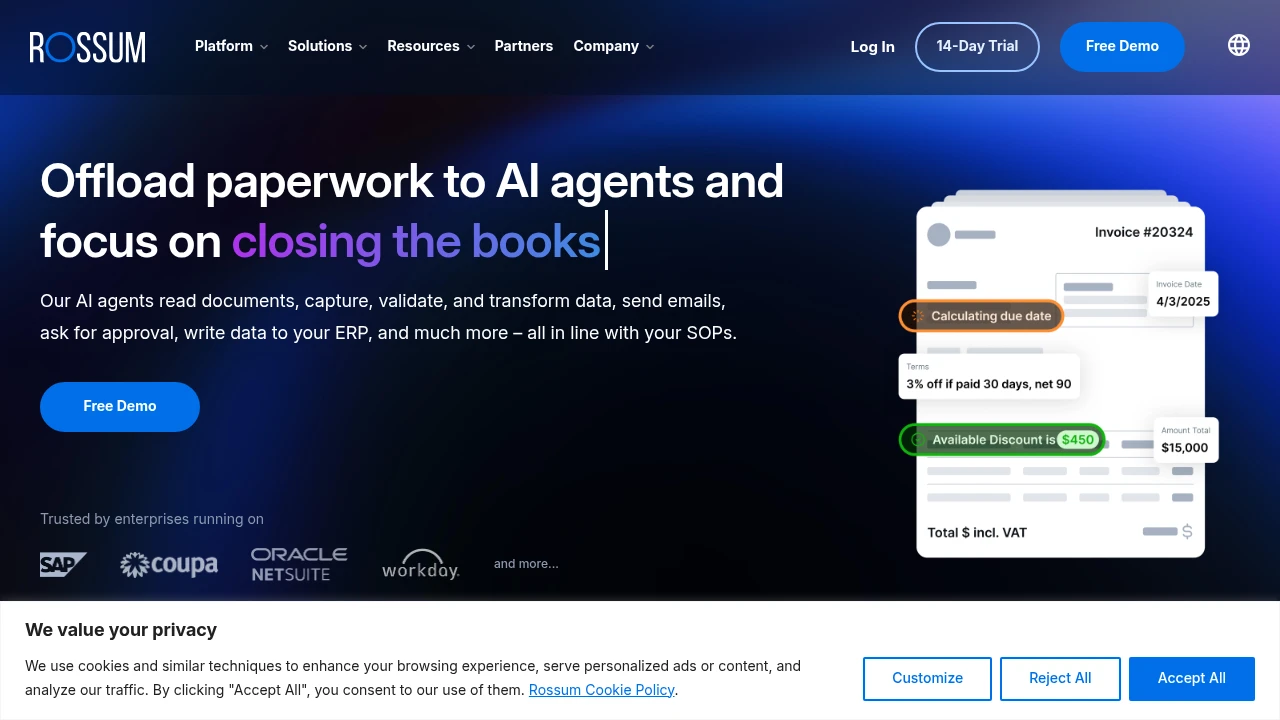
Rossum provides an AI-powered document processing platform focused on transactional documents like invoices, purchase orders, and delivery notes. The solution combines machine learning with human-in-the-loop validation workflows, targeting finance and procurement teams that process high volumes of supplier documents.
Key Features:
- Pre-trained models for invoices, purchase orders, and delivery notes
- Human-in-the-loop validation interface with collaborative review workflows
- Built-in business rules engine for data validation and routing
- Integration connectors for ERP and accounting systems
Limitations:
Rossum's template-based approach requires configuration for each document variant, creating maintenance overhead as supplier formats evolve. The solution also struggles with complex supply chain documents like multi-page bills of lading with thousands of line items, dense customs forms with variable layouts, and heavily damaged or handwritten documents.
Bottom Line:
Rossum handles invoice and purchase order processing effectively when suppliers maintain consistent document formats. The platform's strength lies in its human-in-the-loop validation workflows and business rules engine for financial documents. However, its template-based architecture creates maintenance overhead as formats evolve, and it struggles with the complex, variable documents common in international logistics, making it better suited for procurement automation than end-to-end supply chain document processing.
Pulse
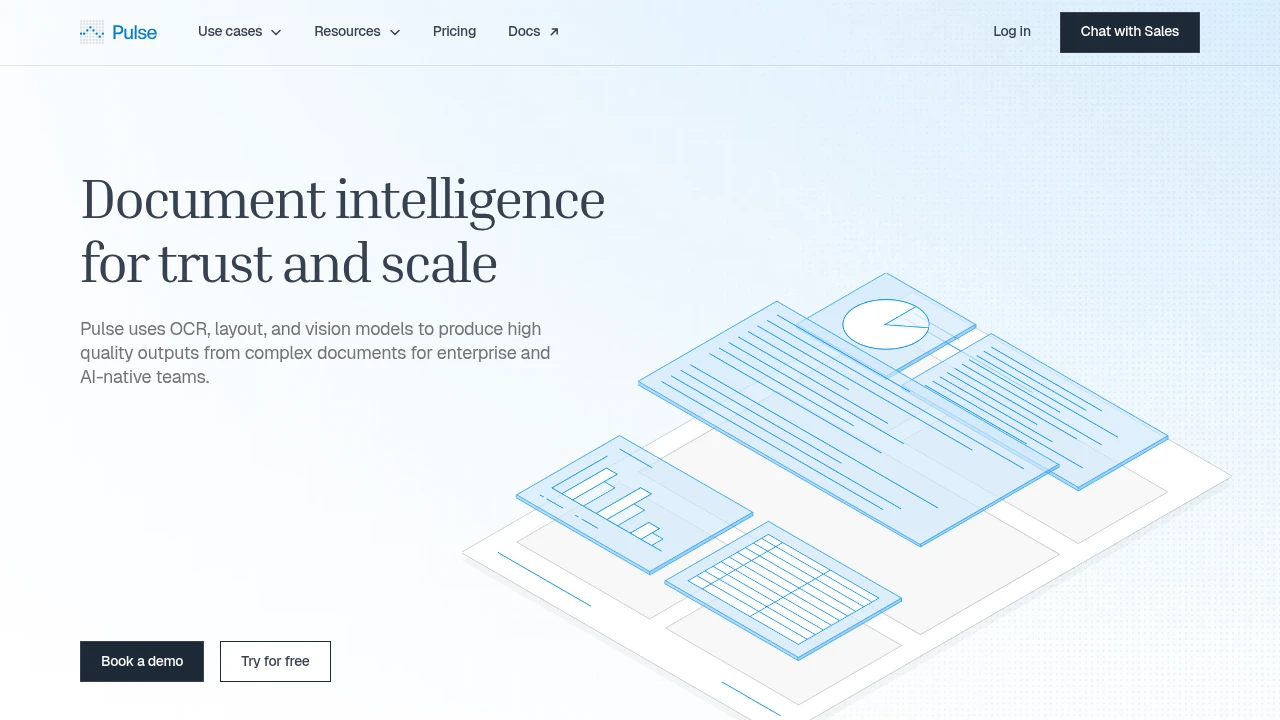
Pulse offers a document extraction service that converts PDFs, images, and office files into markdown, HTML, or structured JSON, making it useful for digitizing supply chain documents into machine-readable formats. Its API supports async processing, webhooks, and bounding box metadata, enabling basic automation across document-driven logistics and operations workflows.
Key Features:
- REST API for document extraction to markdown, HTML, and structured JSON
- Schema-based extraction supporting custom data structures
- Bounding box coordinates linking extracted data to source locations
- Webhook notifications and asynchronous job handling
Limitations:
Pulse does not offer evaluation sets for regression testing, schema versioning for safe updates as supplier formats change, or workflow orchestration beyond simple webhooks. The platform also falls short on complex use cases common in logistics, including large line-item arrays, dense tables, document splitting, and classification.
Bottom Line:
Pulse works for development teams needing basic document digitization with simple API integration. For supply chain operations requiring production-grade reliability—evaluation frameworks for quality assurance, schema versioning for safe updates, workflow orchestration for end-to-end pipelines, and agentic optimization for continuous improvement—the platform's feature gaps make it unsuitable for mission-critical logistics workflows where extraction failures cause shipment delays, customs issues, or financial reconciliation errors.
Reducto
Reducto offers an OCR-focused API designed to extract and parse text from a variety of document formats. It supports basic digitization of PDFs and images and can be integrated into simple extraction workflows, making it suitable for early-stage automation efforts within supply chain environments.
Key Features:
- REST API for document extraction to markdown, HTML, and structured JSON
- Basic OCR capabilities across common document formats
- Simple API integration for digitization workflows
- Standard text extraction from PDFs and images
Limitations:
Reducto's single processing mode treats all documents the same regardless of type or urgency, which limits flexibility for supply chain operations where customs clearance requires sub-second processing while invoice backfills can optimize for cost. The platform lacks production-grade features needed for mission-critical logistics workflows: no schema versioning for safe updates as supplier formats change, no evaluation frameworks for quality assurance, no workflow orchestration beyond basic API calls, and no support for complex supply chain document features like large line-item arrays, dense tables, document splitting, or classification.
Bottom Line:
Reducto serves development teams needing basic OCR and text extraction with minimal setup. For supply chain operations requiring production reliability—schema versioning for safe evolution, evaluation frameworks for quality control, workflow orchestration for end-to-end pipelines, and agentic optimization for continuous improvement—the platform's feature set falls short for mission-critical logistics workflows where extraction failures cause shipment delays, customs issues, or financial reconciliation errors.
Feature Comparison Table of Enterprise Document Processing Solutions
The table below compares core capabilities across the six document processing solutions evaluated for supply chain operations.
| Feature | Extend | Nanonets | Pulse | Reducto |
|---|---|---|---|---|
| Multiple Processing Modes | Yes | No | No | No |
| Schema Versioning | Yes | No | No | No |
| Workflow Orchestration | Yes | No | No | No |
| Evaluation Framework | Yes | No | No | No |
| Agentic Optimization | Yes | No | No | No |
| Document Classification API | Yes | Yes | No | No |
| Human-in-the-Loop Review | Yes | No | No | No |
| Supply Chain Document Types | Yes | Limited | No | No |
| Global Document Support | Yes | Yes | Yes | Yes |
Extend is the only solution offering multiple processing modes for different latency and cost requirements, schema versioning for safe production changes, evaluation frameworks for regression testing, and agentic optimization that continuously improves accuracy without manual tuning.
Why Extend is the Best Enterprise Document Processing Solution for Supply Chain Management
Supply chain operations can't afford document processing failures. When customs clearance depends on accurate invoice extraction or warehouse operations rely on real-time BOL data, accuracy and reliability aren't optional.
Extend delivers production-grade document processing with the complete tooling that supply chain teams actually need. While other solutions offer basic extraction APIs, Extend provides workflow orchestration that chains classification, splitting, extraction, and review into end-to-end pipelines. Schema versioning lets teams update extraction rules as supplier formats change without breaking production systems.
The evaluation framework provides automated accuracy reporting and regression testing that catches issues before they reach production. Agentic optimization continuously improves extraction accuracy based on real documents, eliminating the manual tuning cycles that slow down other solutions.
Supply chain workflows vary wildly in their requirements. Customs clearance needs sub-second processing, while invoice reconciliation can optimize for cost over speed. Extend supports both through dedicated processing modes, something no competitor offers.
For teams processing mission-critical logistics documents, Extend provides the reliability, quality control, and operational flexibility required to ship with confidence.
Final Thoughts on Automating Logistics Document Workflows
Most procurement document processing tools handle the happy path well enough. The difference shows up when you're dealing with damaged scans, multilingual forms, and constantly changing supplier formats. Extend gives you the workflow orchestration and quality controls that matter when documents can't fail. Your operations depend on accurate data extraction, so choose infrastructure that makes reliability the default. Start where manual processing costs you the most time.
FAQ
How do I choose the right document processing solution for supply chain operations?
Start by evaluating whether you need production-grade features like schema versioning, evaluation frameworks, and workflow orchestration—not just basic OCR. Match processing modes to your use cases: fast modes for customs clearance, cost-optimized for invoice backfills. Solutions built for supply chain (versus repurposed financial or insurance tools) will handle logistics document types like BOLs and customs forms out of the box.
Which document processing solution works best for global logistics versus regional operations?
Global supply chain operations require solutions that handle multilingual documents, variable formats across regions, and international document types. Most solutions support global documents, but look for proven multi-region document handling and customs documentation support for worldwide operations.
What's the difference between basic OCR APIs and enterprise document processing platforms?
Basic OCR APIs extract text from documents but lack the surrounding infrastructure needed for production operations. Enterprise platforms include document classification, workflow orchestration, quality control through evaluation frameworks, schema versioning for safe updates, and human-in-the-loop review. The difference matters when processing mission-critical documents where extraction failures cause shipment delays or customs issues.
Can I update document extraction schemas without breaking production systems?
Schema versioning allows safe evolution of extraction rules as supplier document formats change. Without this capability, updating extraction logic risks breaking production pipelines. Only Extend provides native schema versioning among the solutions evaluated, letting teams iterate on extraction rules while maintaining system stability.
When should I prioritize processing speed versus cost optimization for document workflows?
Use fast processing modes for time-sensitive operations like customs clearance where delays cost money and create shipping bottlenecks. Apply cost-optimized modes for high-volume backfills like historical invoice processing or batch reconciliation where throughput matters more than latency. Extend offers both modes; most competitors provide only single-speed processing regardless of use case requirements.